Lebanon09 July, 20263 min read
U.S.-Brokered Framework Agreement Deepens Lebanon Divisions as Hezbollah Rejects Disarmament
This article is an automated aggregation of coverage from news outlets. Our editorials offer in-depth analysis curated by the NewsCord team.
U.S.-brokered trilateral framework envisions Israeli withdrawal from Lebanon and eventual peace agreement. Hezbollah rejects disarmament, deepening Lebanon's political divisions and fears of civil crisis.

Framework Deal, Rising Fractures
A U.S.-brokered framework agreement signed in Washington on Friday, June 26, 2026 set a path to end the conflict between Lebanon and Israel while allowing the Lebanese state to regain sovereignty and enabling a gradual withdrawal of Israeli forces.
The agreement came at the conclusion of the fifth round of direct negotiations between Lebanon and Israel under American mediation, and it contains 14 provisions for a gradual and conditional process aimed at a comprehensive peace and security agreement.
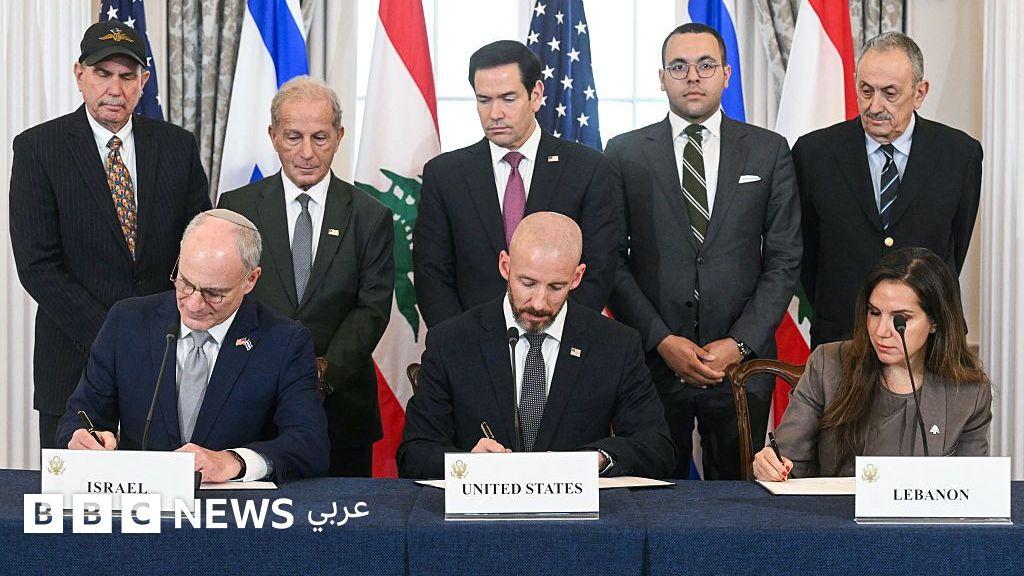
U.S. Secretary of State Marco Rubio described the deal as "the first step on a journey that will undoubtedly be difficult, but important and necessary," while Hezbollah rejected it and said its Secretary-General Naim Qassem called it "humiliating, a disgrace, and a surrender of sovereignty."
In Lebanon, the dispute over disarmament and sovereignty has deepened divisions and raised fears of political paralysis or even a return to civil war, with one Hezbollah lawmaker warning the country would plunge into civil war if the government tries to force disarmament.
The agreement’s implementation begins in two pilot areas, where the Lebanese army will gradually assume full security responsibility after verifying the disarmament of non-state armed groups and dismantling their infrastructure.
Voices Clash Over Sovereignty
Lebanese President Jozef Aoun welcomed the framework agreement, stressing that it is "the first step on the path to Lebanon reclaiming sovereignty over its land in full," and he thanked U.S. President Donald Trump for hosting the negotiations.
Prime Minister Nawaf Salam said Lebanon’s commitment to establishing state sovereignty and exclusive weaponry is not new, and he pushed back against Hezbollah’s rhetoric by saying, "I am not looking for a confrontation with Hezbollah but neither myself nor anyone in the government will accept to be blackmailed by Hezbollah."

Hezbollah’s Secretary-General Naim Qassem rejected the agreement in a Saturday, June 27, 2026 statement, saying "This agreement does not exist," and he argued that direct negotiations are concessions to Israel that impose subservience to Israeli-American dictates.
The Amal Movement criticized the agreement in a statement as "unbalanced," and Speaker of Parliament Nabih Berri warned of consequences of internal division by telling: "Oh my people in Lebanon, all of Lebanon, this is sedition."
In parallel, the BBC reported that the clause regarding disarming does not name Hezbollah specifically, but refers to disarming all non-state armed groups, while Hezbollah insisted linking Israeli withdrawal to Hezbollah’s disarmament crosses red lines.
What’s at Stake Next
The framework agreement does not constitute a final peace treaty or an immediate Israeli withdrawal agreement, and it instead lays out a gradual and conditional process that would lead to a comprehensive agreement if implemented. The BBC said the Lebanese army would assume de facto security authority over Lebanese territory after verifying the disarmament of non-state armed groups and dismantling their infrastructure, and it also described pilot areas where Lebanese civilians would be allowed to safely return under exclusive control of the Lebanese state. In the broader political dispute described by the AP account, the agreement conditioned a full Israeli withdrawal on Hezbollah being disarmed, infuriating the Iran-backed militant group and prompting supporters to block major roads in protest.
One Hezbollah lawmaker warned the country would plunge into civil war if the government tries to force the group’s disarmament, and Hassan Fadlallah said the government "will not be able to enforce the agreement signed in Washington unless they go, with American support, to civil war." With the deal deadlocked, the AP account said Israel and Lebanon agreed to establish two pilot zones where Israeli forces would turn over control to the Lebanese army after clearing areas of any Hezbollah presence, while the BBC reported that reconstruction efforts would begin with international support.