Full story
Tankers hit after missile attack
The U.S. struck three Iranian oil tankers on Saturday after the Islamic Revolutionary Guard Corps launched ballistic missiles toward two U.S. Navy warships in regional waters, according to U.S. Central Command (CENTCOM).
“No American personnel were hurt.”
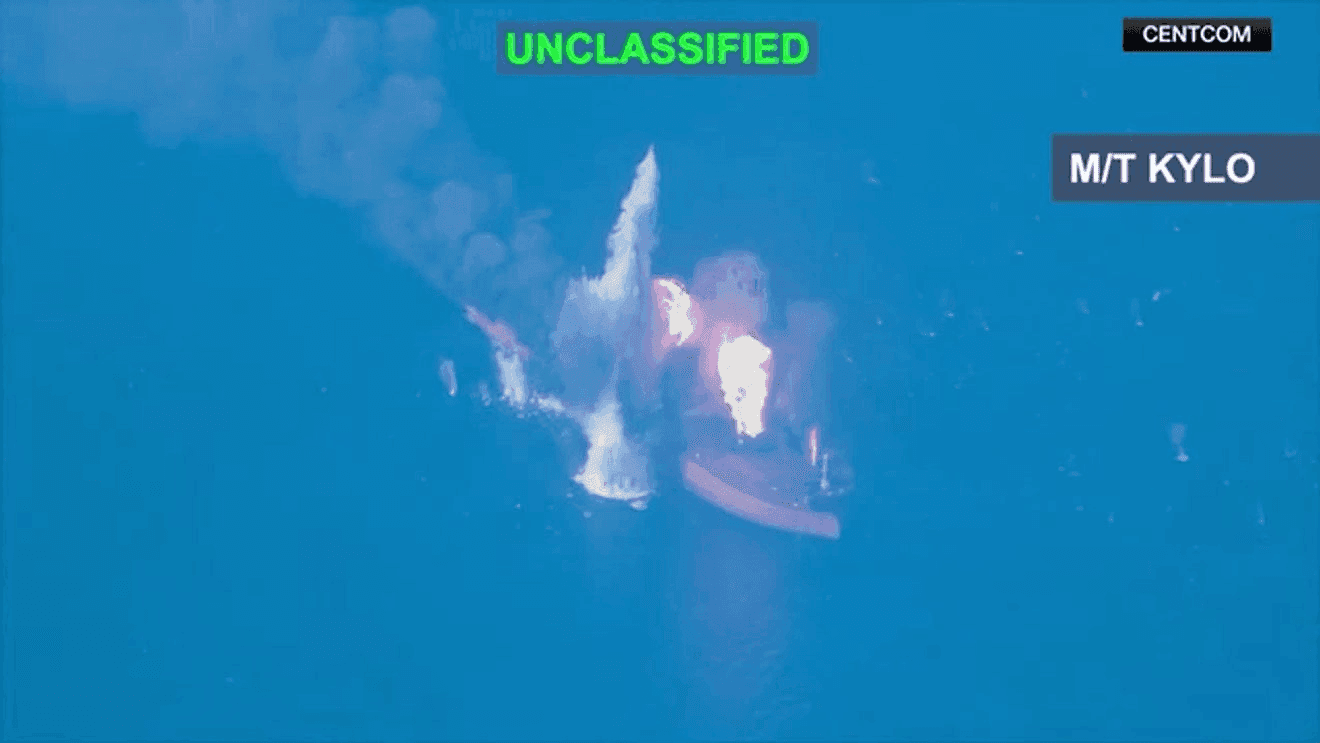
CENTCOM said it "permanently disabled" the M/T Downy off Kharg Island and the M/T Stark 1 near Jask, and "completely destroyed" the unladen M/T Kylo, also known as the Noxen, in the Gulf of Oman.

CENTCOM also said a U.S. aircraft carrier and a guided-missile destroyer evaded multiple attacks and that "No American personnel were harmed."
Iranian state media reported there were no casualties in the attack on the tanker near Kharg Island, and IRIB said footage indicated the vessel's cooling system put out the fire within an hour.
The strikes prompted Iran to threaten intensified action against U.S. military vessels, with Iran's military command warning that strikes would be "more severe than before" and could be expanded if the naval blockade continued, Reuters reported.
Warnings, skepticism, and costs
Defense Secretary Pete Hegseth wrote on social media that "It's simple: if Iran shoots at US ships, we will destroy (and sink) their oil tankers," after CENTCOM said the IRGC fired ballistic missiles at U.S. Navy warships.
CENTCOM commander Adm. Brad Cooper said in an X post, "Let the message to the IRGC be clear: If you shoot at two of our ships, we will impose an even higher economic cost -- taking out three of yours," linking the tanker strikes directly to attacks on U.S. ships.

The BBC reported that U.S. Vice-President JD Vance addressed claims by Iran that American strikes killed at least four people, including two children, at a wedding in southern Iran, and Vance said he was "extremely sceptical" while confirming the U.S. would investigate.
The Reuters account said the exchange of attacks followed renewed fighting after a period of relative calm, and noted the conflict has disrupted global energy supplies and drawn opposition from a majority of Americans before congressional elections in November.
Ahead of those elections, the BBC said Trump faced pressure over how much the war is costing American consumers, citing that the average price for one gallon of diesel in the U.S. hit $5.85 compared with $3.71 a year ago.
What comes next for the war
The BBC said a 60-day ceasefire between the U.S. and Iran formally expired last month, with little sign of a further diplomatic settlement on the horizon, as the Strait of Hormuz remained a major point of conflict.
“Brent crude futures closed at their highest level since July 24 on Friday, at $96.28 a barrel”
Reuters said the U.S. imposed a blockade of Iranian oil exports after Iran effectively shut the Strait of Hormuz, and it added that the U.S. attack on Kharg would further pressure Iran's oil industry and wider economy.
The BBC reported that the conflict in the strait has raised energy prices globally, and Reuters said Brent crude futures closed at $96.28 a barrel as tensions drove global supply concerns.
In a separate thread of escalation, CGTN reported Trump said the U.S. may soon strike Iran's Pickaxe Mountain, telling reporters at the White House, "We may hit Pickaxe very soon," while also claiming the conflict was "small potatoes."
CGTN also quoted Senate Minority Leader Chuck Schumer pushing back, saying there was "nothing small" about the human and economic costs, and referencing "the families of the 18 troops we have lost" alongside "record high prices."