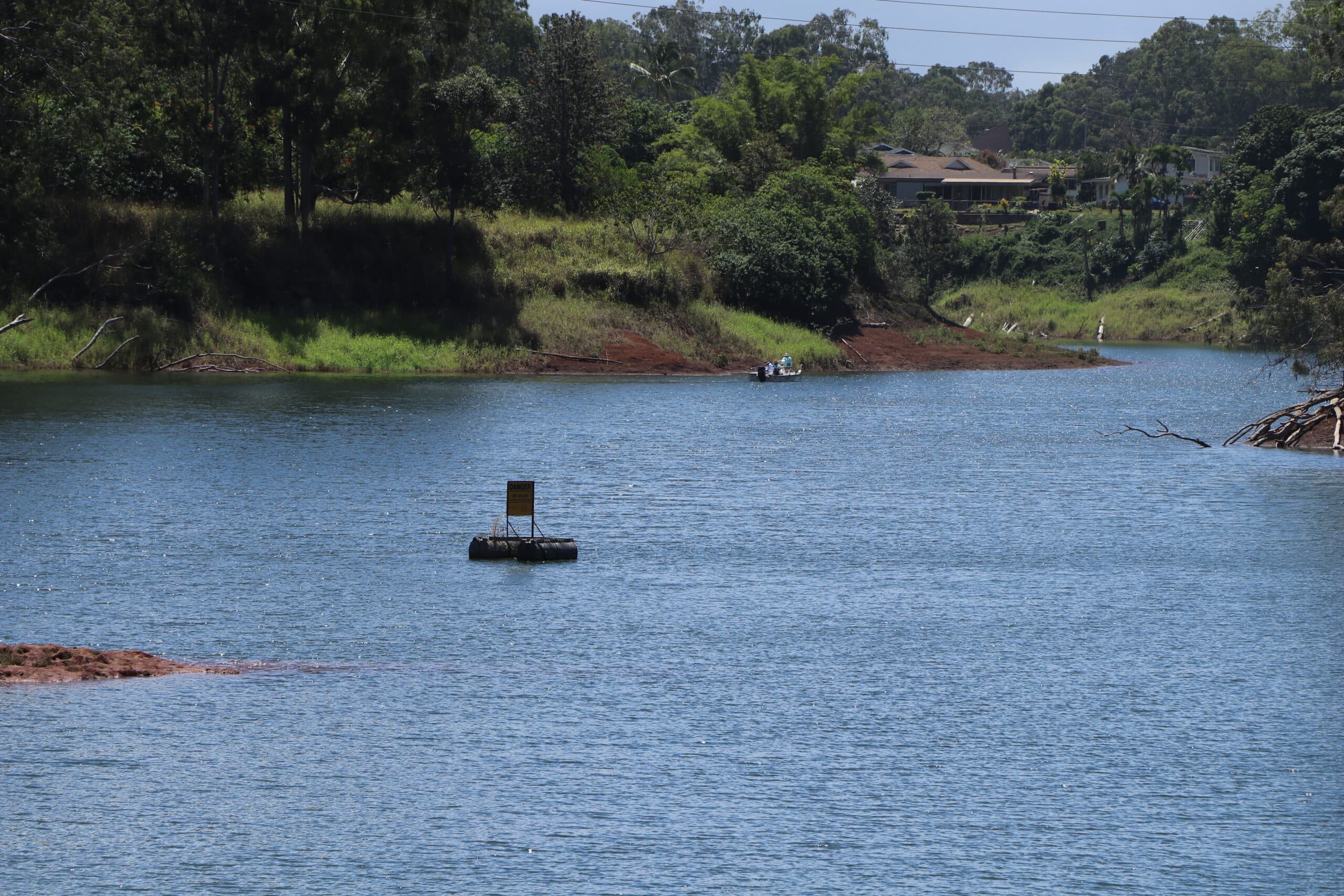
‘We’re Screwed’: Dole Did Little To Fix Dangerous Wahiawā Dam
Key Takeaways
- Dole Food Co. knew for decades Wahiawā Dam could flood, risking 2,500 lives.
- The dam rose above mandatory evacuation levels for Haleʻiwa and Waialua during heavy rain.
- Residents posted on social media that they were struggling amid overnight rain.
Immediate danger and day-of events
‘We’re Screwed’: Dole Did Little To Fix Dangerous Wahiawā Dam The Dole Food Co. has known for nearly five decades that the Wahiawā Dam could flood in heavy rainfall, putting 2,500 lives at risk.
As rain battered Oʻahu Friday morning, the dam rose rapidly above mandatory evacuation levels for the downstream towns of Haleʻiwa and Waialua, which were already flooding from the overnight rain, with residents posting on social media that they were struggling to find ways out on inundated roads.
Just before 8:30 a.m., an “imminent dam failure” notice was posted by the city and county.
Even before last week’s Kona low, however, the state repeatedly warned the international company about safety issues.
But Dole has not made the significant improvements to the dam’s spillway required by the state to bring its more than century-old reservoir into compliance with modern safety standards.
Accountability, penalties, and ownership disputes
The company started racking up deficiency notices and fines in 2009 as the state land board attempted to hold it accountable.
But after lawmakers cleared the way for the state to acquire the dam, the land board did an about-face, removing the threat of penalties for Dole’s noncompliance.
In doing so, it shifted the responsibility for fixing the dam from the company to taxpayers, who will bear the cost of repairs estimated at more than $20 million and climbing.
Since that decision in 2024, the dam has languished as a deal to acquire it – along with the reservoir and surrounding waterways – has dragged on.
In that time, Dole’s parent company has logged record income levels and payments to its investors, even as its local operation has said that it cannot afford the dam upgrades.
“It’s not a matter of ‘if’ something happens,” state engineer Carty Chang said during a meeting on the dam in 2023.
“It’s a matter of ‘when’… We have a very precarious situation, and nothing really has been done to address it.”
The state has gone back and forth over whether to acquire the dam since the mid-1990s.
The latest delay happened last week as the Kona low that shuttered the state and caused Lake Wilson to top the spillway also cancelled the land board meeting where the process to close the transfer was to enter its final stages.
It was an ironic hiccup in a saga that has dragged on for decades.
“I think the frustration for a lot of us is just watching it dragging out,” said Racquel Achiu, vice chair of the North Shore Neighborhood Board.
“The sense of urgency has just been dissipating.
We face this every year, it becomes a hot topic, then it just goes away.”
State dam safety and engineering staff were unavailable for interviews this week while they dealt with clean-up from the storm.
But Andrew Laurence, a spokesman for the Department of Land and Natural Resources, which regulates dams, confirmed that Dole has not addressed deficiencies identified by the agency.
Foremost among them is an undersized spillway that could lead to catastrophic flooding.
Laurence said in an email that the department wasn’t aware of any improvements since 2023, the year lawmakers cleared the way for state acquisition of the dam.
Executives with Dole plc, Dole Food’s parent company, declined an interview.
In a written statement from company spokesman William Goldfield, Dole said responsibility for the dam and any modifications and safety improvements will be the responsibility of the state once it assumes ownership.
The company said the dam is stable and operating as designed.
It also said that a portable, water-filled flood barrier will remain in place for the remainder of the wet season to temporarily increase the capacity of the reservoir.
“The dam and reservoir continue to be monitored closely, and Dole remains committed to ongoing coordination, transparency, and communication with state and county agencies to support public safety and watershed resilience,” Goldfield’s statement said.
Dan Nellis, Dole’s general manager in Hawaiʻi, told Civil Beat last week that “minor tweaks” to the dam have been made as state officials identified deficiencies.
But he also acknowledged that the spillway has not been addressed.
The stormy weekend, paired with another Kona low predicted to last through this weekend and dump several more inches of rain on the state, worries North Shore resident Achiu.
But it’s nothing new – in fact, it happens every year, she said.
Achiu, born and raised in the area, remembers high rains heralding a show at the spillway and bridge over Kaukonahua Stream.
“It never used to be a threat before,” Achiu said.
“We’d all go to the bridge to watch the water … It was a cool thing.”
But as climate change fuels bigger storms, paired with aging infrastructure and the state’s failure to enforce the sanctions imposed on Dole, the fun of watching the water rise is gone.
“Now it’s just like: ‘Crap’,” Achiu said.
Achiu doesn’t think Dole is purposefully leading the state astray or overestimating the safety of the dam, which has never broken despite annual floods.
She said the state must quicken its pace to acquire the dam because it still needs to be upgraded.
The acquisition is divided between three state agencies that must perform due diligence on the deal and design the safety upgrades.
The dam, spillway and irrigation would eventually be managed by the state-owned Agribusiness Development Corporation, while the Department of Land and Natural Resources would own and manage the reservoir.
As a rancher, Achiu knows the dam’s value and its danger.
If the delays continue or the state has to decommission the dam, “either way, we’re screwed,” she said.
Technical warnings and legislative trajectory
Undersized Spillway Owners of the Wahiawā Dam were warned as far back as 1978 that the spillway, which remains largely unchanged, was not large enough to bring down the water level of the dam in the event of “probable maximum precipitation,” an extreme rain event used as the measuring stick for flood control.
It’s hypothetical, but dam owners across the country prepare for such scenarios.
The earthen dam, like many built by the plantations, was not meant to last as long as it has.
Early designs were based on “precedence and experience,” according to the U.S. Army Corps of Engineers’ 1978 report — the first official warning of the disintegrating dam’s dangers.
State officials continue to note in annual dam safety reports that the Wahiawā spillway is undersized.
Spillways are crucial for the safety of earthen embankment dams such as Wahiawā’s, according to Kamal Gautam, California-based chief engineer for rPlus Hydro, which designs and builds hydro dams.
If water rises above the rim “you can guarantee that that dam is going to fail,” he said
Unlike concrete dams, earthen dams begin to erode once water runs over them, undermining the structure and creating holes.
It’s also important to monitor for water seeping into the embankment, which can lead to longer-term failures.
“Once you have established that the spillway is undersized, there is a risk that it’s going to overflow,” Gautam said.
“And since it’s an earthen dam, it’s something that you should never, ever allow.”
State officials have shown interest in acquiring the dam for more than 30 years.
Efforts intensified after the 2006 failure of Ka Loko Dam on Kauaʻi, which killed seven and destroyed several homes.
The failure of Ka Loko Dam was likely due to water overflowing from the reservoir after years of erosion to the banks, according to engineers’ best estimations.
The disaster prompted Hawaiʻi to remove legal provisions that exempted old dams from the state’s dam safety regulations, among other things.
Those rules have been updated once since 2007, though most of Hawaiʻi’s dams remain federally classified as being in “poor” or “unsatisfactory” condition.
In Wahiawā, the state’s interest is twofold: keeping the public safe and supporting agriculture.
Lawmakers pinned their hopes on boosting the region’s food production with the help of the dam’s irrigation system.
In light of Dole’s apparent inability to foot the bill and insistence that the dam would be impossible to replace, agricultural advocates have supported the acquisition No Money?
Beginning in 2021, after imposing a series of fines and deficiency notices, DLNR put Dole on a tight schedule to submit new safety plans and spillway designs.
The land board gave the company an extension in 2022.
Under the new timeline, it would have until December 2024 to finalize drawings and begin construction around September 2025.
Company officials continued arguing to various state entities that they couldn’t pay for the repairs.
But, even as lawmakers offered to acquire the dam and fund spillway improvements in 2023 with taxpayer money, Dole’s parent company reported record income levels.
In 2023, the same year lawmakers approved taxpayer funding for the repairs, Dole plc tallied $155 million in net income, its highest since going public in 2021, according to Securities and Exchange Commission reports.
As the bill for the state to acquire the reservoir moved through the Legislature in 2023, Dole attorney Jared Gale flew from company headquarters in North Carolina to testify in person at the Hawaiʻi State Capitol.
He told lawmakers that if money was a concern, the state could try to get federal funds to help pay for repairs.
That money was only available to government entities, he told state House members.
And what if the state doesn’t purchase the system? Gale said it would be decommissioned, leaving farmers downstream without a reliable source of water.
Dole urged lawmakers to approve the acquisition because the company was running into regulatory deadlines for complying with safety standards.
“The decision,” Gale said, “is now.”
The Legislature approved the measure that year.
It was introduced and supported by Sen. Donovan Dela Cruz of Wahiawā, who had pushed for acquisition since 2015 and proposed adding hydroelectric power as part of the dam’s renovation plans in a bill that would have had the state acquire the reservoir.
Over the years, lawmakers introduced three separate bills and a resolution to acquire the dam.
Dole has known what it would take to fix the dam since 2020.
That year, it retained consultants to provide cost estimates for spillway improvements.
The figure then was about $20 million.
But the company never recognized that as a liability on its balance sheets – meaning it didn’t plan to pay for the improvements – because it had put the reservoir up for sale, according to annual earnings reports.
After lawmakers cleared the way for the state to acquire the reservoir and dam in 2023, Dole asked the land board in October 2023 to suspend that remediation schedule while it worked with the state to transfer ownership.
State engineers at the time roundly rejected that request.
Pausing fines against Dole would set a bad precedent for other dam owners, engineer Carty Chang told the land board.
“The thing Dole should do is take accountability as a dam owner,” Chang said.
“They’ve been on notice a very long time, and they’ve done little to nothing to address the major issue, which is the spillway.”
He continued: “This has been on the books for 120 years. And here we are today. And it has the potential to kill many people.”
The company said it couldn’t afford the repairs.
Nellis, the general manager, said Dole didn’t have anywhere near the resources it once did.
“Pineapple is a hard business,” he said, minutes before the land board rejected Dole’s request.
Then, just six months later, the land board flipped.
In April 2024, it took up a request by Dole to remove the dam.
The request had support from Dela Cruz, whose district covers Wahiawā, and Gov. Josh Green as well as the Hawaiʻi Farm Bureau.
What made the proposal strange was that neither Dole nor the state actually intended to decommission the dam.
“I don’t want farmers to be alarmed that the request is now to remove the dam,” Dawn Chang, then the chairwoman of the land board, said.
That baffled some of the board members.
“So if we approve removal, how does it not end up removed?” Riley Smith, the land board member from the Big Island, asked.
Chang later explained that the previous schedule, which held Dole to spillway improvements and fines for noncompliance, “wasn’t in sync” with Dole’s desire to avoid paying for improvements and instead hand the dam to the state.
“We think this schedule is more in alignment with our due diligence, versus the previous schedule forcing Dole’s hand,” she said.
The new schedule – which kicked demolition of the dam past July 2026 – was just a placeholder while the state worked to acquire the system.
It passed unanimously, and in doing so, absolved Dole of the most major and expensive safety improvements.
Vernon Char, who was the vice chair of the land board at the time, said that decision was intended to maintain the status quo.
“It was never to get rid of the dam because the water is needed for agricultural purposes,” Char told Civil Beat.
In his view, the vote – rather than letting Dole off the hook – cleared the way for state acquisition.
Taking this course was likely necessary because Dole said it couldn’t afford the improvements, Char said.
Current risk assessment and plans
Threats Could Increase The state and Dole disagree over how much rain the dam should be required to withstand.
There’s also disagreement over how much water the spillway can handle.
Company officials have noted that the dam has not failed since it was rebuilt in 1921, despite many heavy rainfall events.
Typically, dam safety officials base designs on estimates of a catastrophic storm that would happen once every 100 years.
But experts warn that it may not take a once-in-a-century storm to topple a dam.
Much more common storms may be enough to weaken stressed structures.
Researchers at North Carolina State University analyzed the events surrounding the last 552 dam failures in the continental U.S.
They found that the vast majority failed after moderate rainfall events that occurred one after the other over five to 30 days.
The biggest contributing factor was the amount of water already in a reservoir at the time of the dam’s failure, according to Jeongwoo Hwang, the study’s lead author.
And the risk of failure could increase as climate change brings on more severe and more frequent storms.
Gautam, the engineering consultant, said climate change should be a consideration for dam owners.
“Nobody wants to be sorry,” he said.
The state plans to install a zigzag weir on the reservoir side of the spillway to increase the outlet’s capacity.
Preliminary drawings released last week also show improvements being made to reinforce the dam embankments and spillway downslope.
The state’s acquisition is still expected to be completed ahead of a June 30 deadline.
Irrigation from the dam snakes 30 miles north of Wahiawā in a series of ditches, flumes and pipelines.
This network supplied 30 million gallons per day during
More on Technology and Science

Hawaii's Worst Flooding in 20 Years Threatens Dam, Prompts Evacuations as More Rain Looms
11 sources compared

Hawaii Deploys National Guard as Worst Flooding in 20 Years Swamps Oahu
68 sources compared
Heatwave shatters March records as Southwest bakes under extreme temperatures
48 sources compared
Record heat blankets the US Southwest as March logs hottest temperature in Arizona
10 sources compared