China · updated 1h ago · 3 min read
Xi Jinping Proposes Five Initiatives for Greater BRICS Cooperation at 18th Summit in New Delhi
Xi proposed five initiatives covering AI, trade/investment facilitation, digital industries, smart manufacturing, and talent development. They aim to deepen BRICS cooperation to create a more integrated market with stronger trade and investment.
How much political governance context accompanies the five initiatives.
8 of 9 outlets skipped it: xi offered people-centred commitments, NDB support and zero-tariff for Africa.
18outlets compared
Same story, two versions
tap a side to read it in full
CGTN
“Xi stressed that Global South countries should jointly defend the rule of law in international affairs”Read the original ↗
International Business Times
“Xi proposed new initiatives covering artificial intelligence, trade, digital industries, manufacturing and technology talent”Read the original ↗
CGTN links the initiatives to rule-of-law and multilateral governance, while IBTimes frames them mainly as economic and technology proposals.
Xi’s five BRICS initiatives
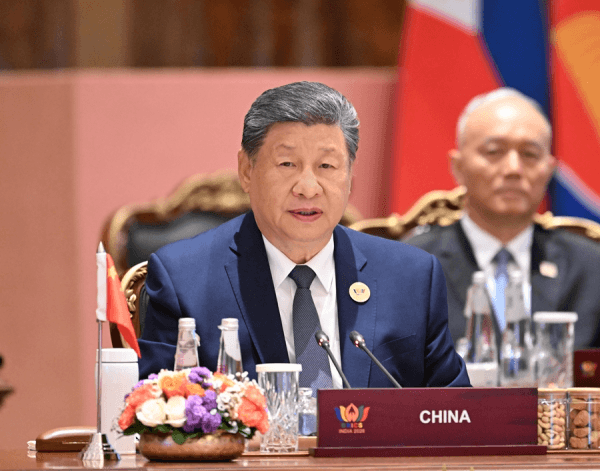
Chinese President Xi Jinping proposed five initiatives for “greater BRICS” cooperation at the 18th BRICS Summit in New Delhi on September 13, 2026, covering AI, trade and investment facilitation, digital industry, smart manufacturing and talent development.
“set the stage for China's chairmanship next year”
The proposals were framed as a push for “greater BRICS” to make “greater impacts” and lay “a solid foundation for practical cooperation,” with Xi urging BRICS to build innovation incubators, upgrade traditional industries and develop emerging industries.
Xi’s agenda also set up China’s next role, with the summit marking the grouping’s 20th anniversary and “set the stage for China's chairmanship next year,” according to Global Times.
In a separate account of the same summit session, Xinhua said Xi stressed that “greater BRICS” must make greater impacts, achieve greater development, and lay a solid foundation for practical cooperation.
The initiatives were presented alongside the summit’s broader agenda, with the New Delhi gathering producing “more than 50 outcomes” across resilience, innovation, cooperation and sustainability, including the Strategy for BRICS Economic Partnership 2030.
Global South focus and voices
Global Times reported that Indian journalists and Global South-focused observers watched Xi’s remarks closely, including Mohammed Saqib, founder and secretary general of the India China Economic and Cultural Council, who told the outlet, "The Chinese president's speech was inspiring..."
Saqib also linked the summit’s success to Xi’s visit, saying, "I think this BRICS summit was pretty successful, partly thanks to Xi's visit," as Global Times described expectations that China’s chairmanship would bring Xi’s vision to life.

In the same summit context, Outlook India said Xi called on BRICS to rally the Global South and described BRICS as an “active, stabilizing and positive force” in international affairs.
International Business Times added that Xi’s proposals were made as China sought to enhance BRICS’s role as a platform for economic cooperation among emerging and developing economies, and it cited the Chinese Embassy in South Africa on industrial and supply-chain links.I
The Reuters account carried by Internazionale said Xi told the closing session that “Greater BRICS” nations should “maintain the stability of industrial and supply chains” and “cultivate an integrated market,” as Beijing sought to weld the grouping into a practical platform for Global South development.
What’s at stake next
The initiatives were presented as a roadmap for China’s BRICS chairmanship in 2027, with Global Times saying the Sunday initiatives “outline the direction for China's BRICS presidency in 2027” and with International Business Times describing China’s hosting of the BRICS Forum on Trade in Services in 2027.
“new technologies can light the way toward shared prosperity”
Xi’s proposals also tied economic mechanisms to governance and development goals, with the Chinese Foreign Ministry statement saying the foundation of greater BRICS cooperation must be cemented and calling for stable and smooth industrial and supply chains and a “large integrated market.”
The Foreign Ministry statement also placed people-centered development and global AI governance in the same framework, saying China would work faster to evolve a consensus-based global AI governance framework so that “new technologies can light the way toward shared prosperity.”
At the same time, Daily Sabah reported that Modi warned that geopolitical tensions, disrupted supply chains and climate crises are increasingly affecting people worldwide, and it quoted Modi saying, "The number of conflicts and tensions in the world is increasing, increasingly impacting ordinary people," alongside Xi, Vladimir Putin and Iranian President Masoud Pezeshkian.
Daily Sabah further said the bloc agreed to establish an integrated early warning system for infectious diseases, and it reported that the joint declaration expressed concern over escalating tensions in the Middle East and Sudan and called for disputes to be resolved through dialogue and diplomacy.