The reality of the Bell review published this week: the Education Secretary, Lucy Powell, will write to every school and college in England to say she expects them to adopt the IHRA definition of antisemitism, a definition whose examples are mostly about the State of Israel.
Antisemitism in English schools is real, and Jewish children must be protected from it. The review is full of it. A year 7 pupil said he wanted to "build a gas chamber and chain up Jews". A 14-year-old girl was called a "Jew bitch" on a bus. Jonathan Frisher, a Jewish student from Cheshire, was told he belonged in a gas chamber and watched Nazi salutes become normal at his school. None of that needs the IHRA definition to be recognised as racism. Any teacher knows it when they see it.
What the definition adds is Israel. Seven of its eleven examples are about the Israeli state. Calling Israel "a racist endeavor" is one. Comparing Israeli policy to the Nazis is another. That is dangerous, because it treats a state and Jewish people as the same thing. A policy that cannot tell Jewish children apart from the Israeli state only benefits the Israeli state, by conflating the two and misrepresenting real antisemitism.
So we read the whole review, its terms of reference, its evidence spreadsheet, the government's response and the Commons statement, and every report on it we could find in the first 48 hours.
What we found:
- The review says a belief held by 45% of British adults, that "Israel treats the Palestinians like the Nazis treated the Jews", "could be regarded as antisemitic according to the IHRA definition".
- Its terms of reference said in March that it "will be using" the IHRA definition. The call for evidence opened eight weeks later.
- 158 of the 587 responses used a template that criticised the IHRA definition. The review's answer to the worry that IHRA limits criticism of Israel misquotes the definition.
- 526 of 590 respondents said they were confident they could tell antisemitism from criticism of Israel. Eleven said they were not. The review leaves that answer out.
- "Three in five Jewish pupils" rests on 70 Jewish UCAS applicants. 29 of them said they had experienced antisemitism themselves.
- The longest single section of the review is about Palestine badges and flags. It gives political impartiality 2,407 words, and supporting the victims of antisemitism 267.
- A charity whose "only issue on which ASG has firm policy is opposition to BDS" lists Sir David Bell on its National Council. The terms of reference say he "has no conflict of interest".
- Of 37 reports from 23 outlets, 4 quoted any of the definition's examples about Israel, 2 said how many Jewish pupils were surveyed, and 0 mentioned the 45% passage.
What the government has told schools to do
Powell accepted all 27 recommendations on Wednesday 21 October. She told the House of Commons:
“I will therefore write to all schools and colleges to set out my expectation that they adopt the International Holocaust Remembrance Alliance's working definition of antisemitism.”
Lucy Powell, Education Secretary, Hansard, House of Commons, 21 October 2026Read the original
The definition cannot be made compulsory, and the review itself says it is "not a proxy for the legal test" a court would apply. But the government has built it into almost everything else it is changing:
- A new online antisemitism training package for every school and college leader and safeguarding lead, which "will include content on the IHRA working definition".
- Antisemitism written into Keeping children safe in education, the statutory safeguarding guidance, in 2027.
- A separate antisemitism category in every school's incident records by the end of the 2027/28 school year, covering "wider manifestations of antisemitism" where there is no identifiable victim.
- New Prevent advice from the Home Office on when antisemitism "may be indicators of radicalisation risk".
- Teachers' Standards rewritten so that antisemitic behaviour breaks them "within and outside the school, including online".
- A survey of every school and college in 2027/28 "to assess levels of adoption".
The same letter will ask schools to adopt the government's definition of anti-Muslim hostility.
Put two of those together. The review says every time it uses the word antisemitism, it means "the IHRA working definition and its accompanying examples". It then asks every school to record "wider manifestations of antisemitism", even when nobody is the victim. Under those examples, a pupil who says the State of Israel is a racist endeavour could be one.
What the IHRA definition says
The definition itself is two sentences. It calls antisemitism "a certain perception of Jews, which may be expressed as hatred toward Jews". The work is done by the eleven examples that come with it.
The eleven examples
The eleven contemporary examples of antisemitism published with the IHRA working definition, printed in full. Examples 5 to 11, seven of the eleven, concern the State of Israel and are marked About Israel. Examples 1 to 4 concern Jews and the Holocaust.
Whilst some of the Israel examples, like holding Jews collectively responsible for what Israel does, describe real antisemitism, others describe what people believe about a state: that it is a racist project, or that its policies can be compared to the Nazis.
Karon Monaghan KC, the equality barrister the National Education Union asked to investigate antisemitism inside the union, looked at exactly this. She found that the belief that the State of Israel is a racist endeavour is a protected belief under the Equality Act, and wrote:
“The IHRA definition and examples, then, are both too narrow (in only covering hate) and too wide (in treating protected beliefs as antisemitic when the law would not regard them as so).”
Karon Monaghan KC, Report for the National Education Union, April 2026Read the original
Paragraph 87. Earlier in the same section, on whether the union should adopt it: "This is a problematic definition, and it would not be appropriate to adopt it."
The man who led the drafting of the definition, Kenneth Stern, told the US Senate Judiciary Committee in September 2024 that it is "energetically used to target speech regarding Israel".
Parliament saw this coming. When the government adopted the definition in December 2016, the Home Affairs Committee had asked for two safeguards to go with it, the first of them: "It is not antisemitic to criticise the Government of Israel, without additional evidence to suggest antisemitic intent." The government refused. It said the definition's own line on criticism of Israel was "sufficient to ensure freedom of speech".
That line is the definition's one written protection for criticism of Israel. In the passage where the review answers its critics, Sir David Bell rewrote it.
The IHRA definition
“However, criticism of Israel similar to that leveled against any other country cannot be regarded as antisemitic.”
International Holocaust Remembrance AllianceRead the original
The Bell review, page 42
“However, the definition recognises that criticism of the State of Israel, similar to that levelled against any other democratic country, is not antisemitic.”
Independent review, CP 1691Read the original
The word democratic is not in the definition's protection. It comes from example 8, the one that calls "double standards" antisemitic. The review quotes the protection correctly on page 22.

How the review itself uses the definition
The review does not treat the definition as a guide to be weighed. It makes it the meaning of the word.
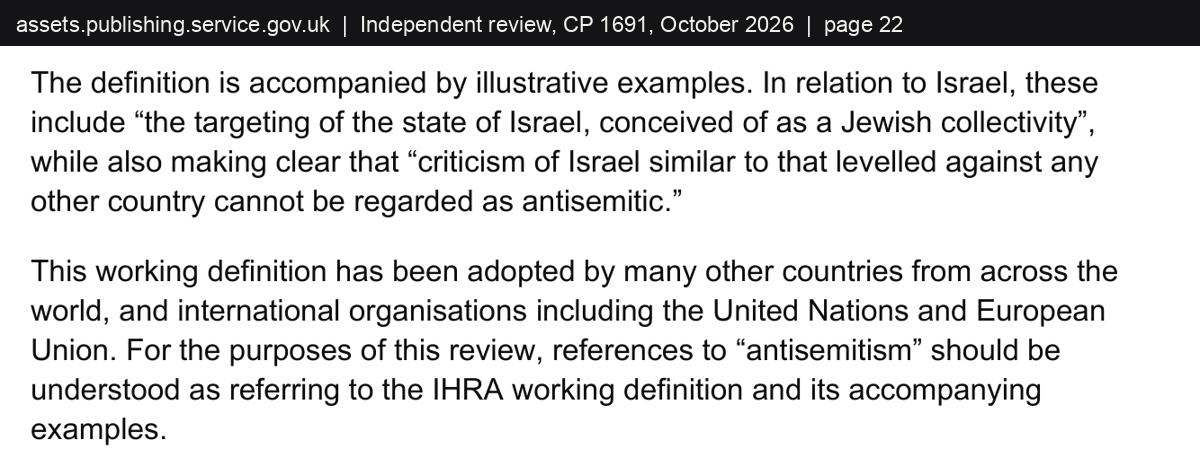
Then it applies it to the country.
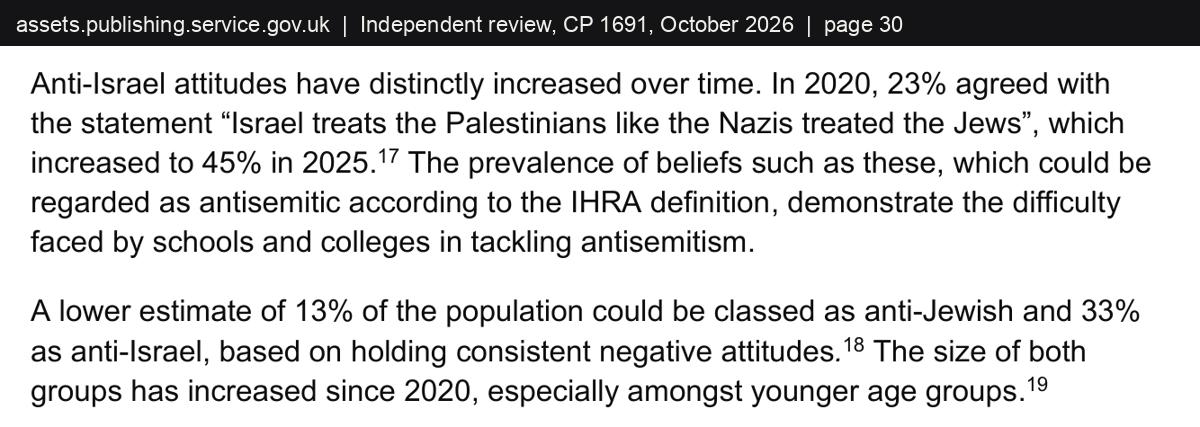
Notice what that does. A view about how Israel treats Palestinians, held by almost half of British adults, becomes a measure of antisemitism, in a 107-page report that never once uses the word genocide about Gaza.
The 45% comes from the Campaign Against Antisemitism's Antisemitism Barometer, a YouGov poll of 2,245 British adults carried out online on 1 and 2 September 2025. The review cites it in a footnote as "YouGov (2025) Judaism & Jewish People (Antisemitism Barometer)". The charity calls that statement "one of the most common antisemitic tropes that we see", and says 60% of young people agree with it. Those are the young people the review wants schools to teach.
The same section lists "anti-Israel attitudes" next to anti-Jewish ones, and counts the 25% of adults who disagree with the statement "I am comfortable spending time with people who openly support Israel".
The review also gets the definition's own standing wrong:
The Bell review, page 22
“This working definition has been adopted by many other countries from across the world, and international organisations including the United Nations and European Union.”
Independent review, CP 1691Read the original
The United Nations
“Nonetheless, the United Nations Secretariat does not endorse any definition on antisemitism.”
UN Action Plan to Enhance Monitoring and Response to Antisemitism, January 2025Read the original
In 2022 the UN's special rapporteur on racism went further and called on member states "to suspend the adoption and promotion of the working definition and the examples attached to it".
The review chose IHRA before it heard any evidence
The review was announced on 4 March 2026. Its terms of reference had already decided the question at the centre of the row.

When people did respond, more than a quarter of them objected to exactly that.
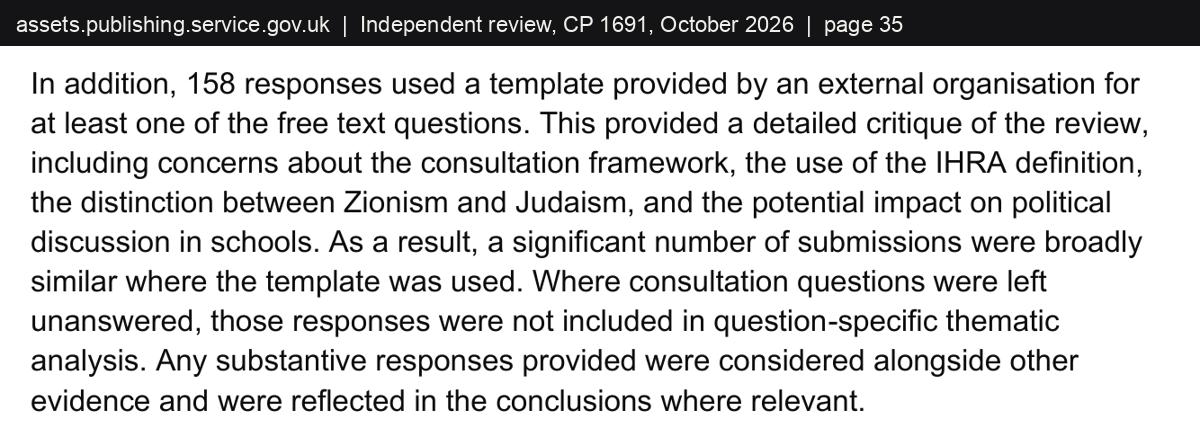
The review does not name the organisation. In July the Jewish Chronicle reported that Parents for Palestine, a parents' group backed by a section of the NEU, had circulated a template response. It ran the story under the headline "Teachers blocking plan to tackle antisemitism 'have no place in the classroom'", and quoted the shadow education secretary, Laura Trott: "Any teachers actively undermining efforts to combat antisemitism have no place in our classrooms." Objecting to a definition was reported as objecting to tackling antisemitism.
When the review answers the worry that the definition limits criticism of Israel, its reply begins "However" and says the definition protects criticism "similar to that levelled against any other democratic country". That is the sentence with the word the definition does not contain.
The review's own call for evidence asked one question that goes to the heart of all this: "Are you confident that you can effectively distinguish between antisemitic comments and comments about, and criticism of, actions of the State of Israel?"
Can you tell antisemitism from criticism of Israel?
Answers to the review's own call for evidence, 590 respondents. Source: the review's evidence annex, sheet Identifying and reporting.
See the figures
| Answer | Respondents |
|---|---|
| Very confident | 442 |
| Fairly confident | 84 |
| Neither | 11 |
| Not very confident | 6 |
| Not at all confident | 5 |
| Not sure | 42 |
526 of 590 said yes, very or fairly confident. Eleven said no. That answer is in the evidence spreadsheet the government published. It is not in the review. The review's executive summary says instead that the evidence suggests "confusion around the boundary between legitimate political expression and antisemitism".
This was a self-selected consultation, not a survey of schools. Of the 568 who answered the question, 41% said they were Jewish. Half of all responses came from parents, and half related to London.
The figure in every headline
Three in five Jewish pupils. Nearly every report led with it. Here is where it comes from.
- The review commissioned a survey of England's UCAS applicants aged 16 to 19. 5,847 answered.
- 92 said they were Jewish. 70 of them answered the question about antisemitism.
- 29 of the 70 said they had experienced antisemitism themselves. The "three in five", 59%, adds those who said they had witnessed it: about 41 young people.
- The review says the sample of 92 "should be treated with caution" and that the survey is "not representative".
Behind three in five
70 squares for the 70 Jewish UCAS applicants who answered the antisemitism question: 29 filled squares for those who said they experienced antisemitism themselves, about 12 outlined squares for those who only witnessed it, and 29 faded squares for no or not sure.
Two of the 37 reports we read told readers how many Jewish pupils were surveyed. Three went further than the survey did, and said three in five Jewish pupils had been "targeted" or had suffered "abuse".
How 37 reports described "three in five"
The survey asked whether pupils had experienced or witnessed antisemitism.
See the figures
| Described as | Reports |
|---|---|
| Experienced or witnessed, as the survey asked | 7 |
| Experienced, with witnessed left out | 16 |
| Targeted, or suffered abuse | 3 |
| Unclear wording | 1 |
| Did not give the figure | 10 |
What the review spends its words on
We counted every word of the review's own text, 30,287 words once the footnotes, headings and contents page are left out, and sorted every paragraph by what it talks about.
What the count shows:
- Half the review, 51%, is about antisemitism and never mentions Israel, Palestine or politics. That half covers abuse, reporting, recording, training and Holocaust education.
- 23% is about Israel, Palestine, Zionism or political expression: badges, flags, slogans, protest and impartiality.
- In the chapter on staff conduct that rises to 60%. In the chapter on keeping Jewish schools safe it is 0%.
- The longest single section of the review, 1,073 words, is headed "Political expression and pupil wellbeing in schools". It is about pupils and teachers showing support for Palestine with badges, flags and slogans. It uses the word antisemitic or antisemitism twice: once to say that support for or criticism of Israel "is not antisemitic", once in the title of another review.
- The review gives political impartiality 2,407 words. It gives supporting the victims of antisemitism 267.
What each part of the review talks about
Words of body text in each part of the review, footnotes left out, sorted by what each paragraph mentions. How we sorted them is set out under How we counted.
See the figures
| Part of the review | Names Israel, Palestine or Zionism | Political expression, without naming them | Antisemitism, with neither | Everything else |
|---|---|---|---|---|
| Foreword | 39 | 250 | 1,072 | 291 |
| Executive summary | 359 | 264 | 2,413 | 549 |
| Introduction | 245 | 382 | 482 | 321 |
| Evidence | 203 | 54 | 1,093 | 445 |
| Call for evidence | 181 | 41 | 1,181 | 385 |
| 1. Understanding antisemitism | 154 | 274 | 1,167 | 118 |
| 2. Recognising and responding | 170 | 0 | 2,185 | 726 |
| 3. Prevention | 314 | 345 | 2,526 | 2,011 |
| 4. Staff conduct and support | 861 | 1,901 | 1,015 | 822 |
| 5. External pressures | 485 | 358 | 532 | 668 |
| 6. Safety of Jewish schools | 0 | 0 | 594 | 1,107 |
| 7. Accountability | 0 | 0 | 1,035 | 318 |
| 8. Conclusion | 0 | 0 | 112 | 239 |
That is the job the review was given. Its terms of reference told it to look at how staff stay "politically impartial, in particular related to Israel/Palestine". Every political symbol it describes on a pupil or a teacher is a Palestinian one: a badge, a flag, the words "Free Palestine". The Ukrainian flag appears once, as the comparison respondents made.
Where the review spends its words
Words of body text in each section, footnotes left out. Together the three sections on politics, unions and campaign pressure run to 4,395 words, and the seven on protecting Jewish pupils and staff to 4,984. No single section on protecting them is as long as the one on political impartiality.
See the figures
| Section | Politics, unions and campaign pressure | Protecting Jewish pupils and staff |
|---|---|---|
| Political impartiality | 2,407 | 0 |
| Safety and security of Jewish schools (chapter 6) | 0 | 1,701 |
| External influences on decision making | 1,048 | 0 |
| Trade unions | 940 | 0 |
| Bullying and harassment of staff | 0 | 855 |
| Reporting | 0 | 766 |
| Antisemitism as a form of harm | 0 | 582 |
| Recording | 0 | 435 |
| Early intervention for perpetrators | 0 | 378 |
| Supporting victims | 0 | 267 |
How often the review uses each word
| Word | Uses in the review's own text |
|---|---|
| antisemitism or antisemitic | 501 |
| Jewish | 239 |
| political or politically | 108 |
| Israel or Israeli | 54 |
| Holocaust | 49 |
| badge, flag, symbol or slogan | 33 |
| Palestine or Palestinian | 32 |
| IHRA | 28 |
| Zionism or Zionist | 8 |
| 7 October | 5 |
| Hamas | 3 |
Whose words it quotes
- The review quotes 51 passages. Jewish pupils, parents and teachers describing the antisemitism they faced are among them, and they should be heard.
- None criticises the IHRA definition. The 158 responses that did are counted, not quoted.
- It quotes the NEU's own Monaghan report four times, and never on the definition.
What it says about Palestine solidarity
The terms of reference asked how staff "remain politically impartial, in particular related to Israel/Palestine". On the badges, flags and slogans, this is what the review concluded:
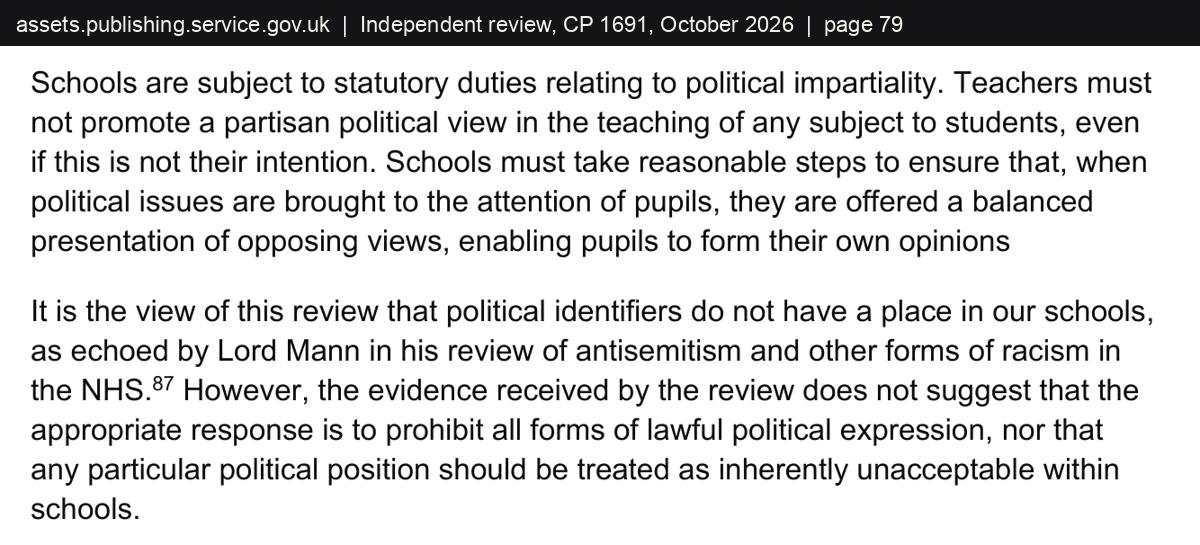
In the next paragraph it says it does not want a blanket ban. It records that respondents described schools banning the Palestinian flag while allowing the Ukrainian flag, and asks for policies "applied consistently across different political issues". Then it tells schools that where a pupil wears a badge that "may express a political view", the school "should provide pupils a balanced account of opposing views".
Powell went further than the review in the Commons:
“Sir David looked closely at the issue of political symbols displayed by staff and students. He found it not to be a widespread issue, and therefore concluded that extending existing legal duties on schools would be disproportionate. I accept his recommendation, but as Education Secretary, I should make it clear that I would not expect to see teachers coming to school or college wearing or displaying any political material.”
Lucy Powell, Hansard, House of Commons, 21 October 2026Read the original
On Holocaust Memorial Day, the government's response says the day is for pupils to reflect on "the Holocaust, subsequent genocides, and the dangers of antisemitism, hatred and prejudice". In the same paragraph it says some schools have stopped marking it for fear that pupils or parents "may seek use the occasion to draw links with ongoing events in Israel/Palestine", and that the day "should not be used to advance political or partisan views". Read together, that leaves one genocide a pupil is not meant to bring up.
On the unions, the review says some Jewish members feel unsupported "when unions overwhelmingly focus, in a well-documented way, on a pro-Palestine, anti-State of Israel position". Its footnote for that says "since 2023, the NEU has passed national motions on Palestine at every annual conference and at executive level". It opens that chapter with a line from the NEU's own Monaghan report, and cuts it:
The Bell review, page 87
“Members and staff who are pro-Israel, or hold Zionist views… suppress the expression of those views because dissenting voices are often met with hostility.”
Independent review, CP 1691Read the original
Karon Monaghan KC
“Members and staff who are pro-Israel, or hold Zionist views, and members and staff who hold gender critical views suppress the expression of those views because dissenting voices are often met with hostility.”
Report for the National Education Union, April 2026Read the original
The review never quotes what the same report says about the definition it recommends: "This is a problematic definition, and it would not be appropriate to adopt it."
It asks the Home Office for new Prevent advice on when antisemitism may signal radicalisation, and wants teachers' conduct judged "within and outside the school, including online". The review gives its own example of where the line falls: a teacher may attend a protest, but "displaying an antisemitic sign at the protest could breach Teachers' Standards". Under the IHRA examples, a placard comparing Israel's bombing of Gaza to the Nazis could be that sign.
What schools were already doing
The review describes a "chilling effect" on teachers. It cites research by Alison Liddle in which teachers described "a censorship of discussion" about Israel and Palestine. One assistant head in that research put the fear plainly: "There is a fear that the school will be accused of antisemitism and supporting terrorism."
That fear has a record. In November 2023, after pupils wore Palestine colours and badges, Barclay Primary School in Leyton wrote to parents that "extremist or divisive comments can and will lead to formal meetings with the school, referrals to the PREVENT Team or the Hate Crime Team in Waltham Forest". The trust later said it had never reported anyone to Prevent.
In July 2024 UK Lawyers for Israel announced that a Cambridge sixth-form college had told a sociology teacher his Palestinian flag was not appropriate at an open day: "We are pleased that the school has taken action to ensure that its staff do not wear inappropriate political badges on school premises."
The review heard about that climate, named it, and then recommended a definition, a recording category and new Prevent advice that all point the same way.
What the Education Secretary said in the Commons
Labour MP Peter Prinsley told her he is a Zionist and asked her to agree that "we must refute other spurious definitions of Zionism fabricated for political purposes". She answered:
“Zionism is not racism, which is why the motion passed by the Green party is so wholly wrong and is antisemitic, and I want people to hear that loudly and clearly. The IHRA definition of antisemitism is clear that denying Jewish people the right to self-determination is antisemitic, which is why it is really important that schools adopt it.”
Lucy Powell, Hansard, House of Commons, 21 October 2026Read the original
That is the conflation, in the Education Secretary's own words, on the day. A motion about a political ideology, passed at a party conference, is antisemitic, and that is why the IHRA definition must go into schools. Monaghan KC found that anti-Zionist beliefs are protected by the Equality Act.
Sixteen MPs asked questions after the statement. The Liberal Democrat Munira Wilson said some young constituents had not been allowed to discuss the Middle East at school. Not one raised the definition's critics. The shadow education secretary, Laura Trott, asked Powell to investigate union members who opposed an MP's school visit and, "when warranted, have them removed from schools".
Powell opened the statement with an apology. The report had leaked. Sky News published the recommendations at 9.29pm on Monday 19 October. By the time Powell stood up, the BBC, the Guardian, the Telegraph, the Times, the Daily Mail, LBC and Jewish News had all reported them from the leak, before anyone could read the review. Powell told MPs she had ordered a leak inquiry.
Who wrote it, and who will put it into practice

Sir David Bell is a former permanent secretary of the Department for Education, the department that commissioned him, and a former chief inspector at Ofsted. He is vice-chancellor of the University of Sunderland.
The Academic Study Group on Israel and the Middle East lists him on its National Council. It listed him in October 2025, five months before he was appointed, and it still did when we checked on 21 October 2026.
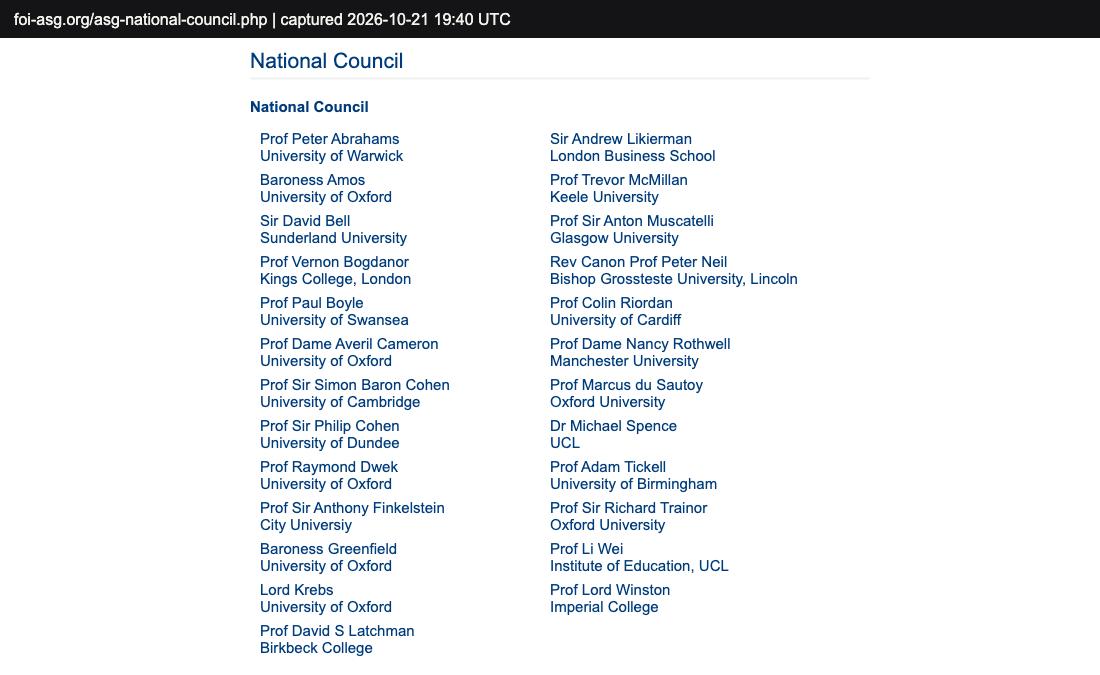
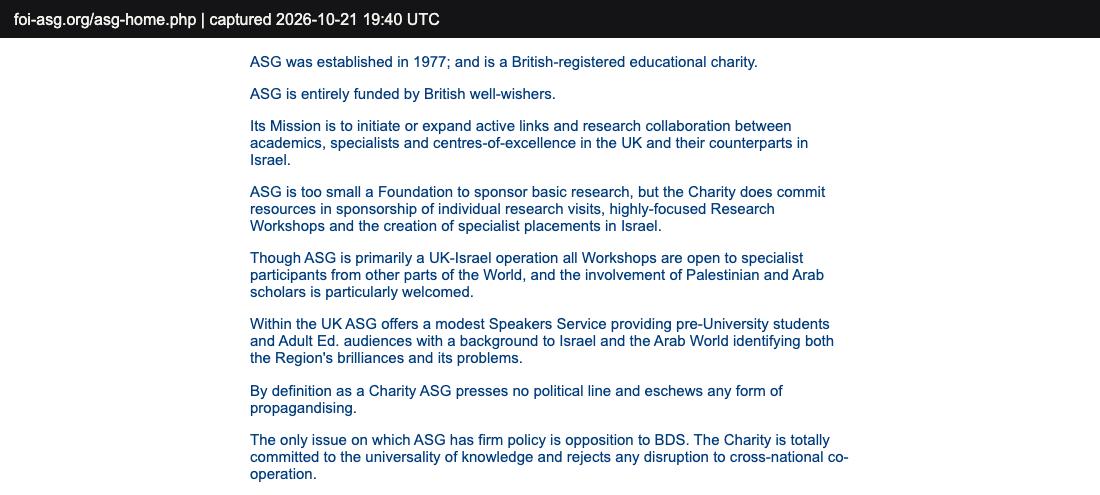
The charity says its mission is to build links between UK academics and "their counterparts in Israel". It says it "presses no political line", and in the next sentence that "The only issue on which ASG has firm policy is opposition to BDS", the movement to boycott, divest from and sanction Israel. It runs a speakers service giving "pre-University students" a background to Israel and the Arab world. Its director, John Levy, joined the Zionist Federation in 1970 and also runs the Friends of Israel Educational Foundation, according to his profile on the charity's own site.
None of that appears in the terms of reference. A review whose central decision is how schools should treat speech about Israel was led by a man listed on the council of a charity whose one firm policy is opposing the boycott of Israel.
The government's implementation group includes the Partnerships for Jewish Schools, the Antisemitism Policy Trust and the Union of Jewish Students, whose campaign to get universities to adopt IHRA the review cites in a footnote. £2.3 million of the government's antisemitism education programme has been awarded to Palace Yard and the Union of Jewish Students to deliver training.
Powell told MPs the chief executive of the Holocaust Educational Trust "sits on the implementation taskforce". That chief executive, Karen Pollock, wrote in the Jewish Chronicle the same day: "The spurious, unfounded and legally illiterate charge of genocide against Israel achieves one thing only: it puts a target on the back of every Jew."
What the press told you
We read every report on the review we could find from the Sky News leak on 19 October to the evening of 21 October: 37 reports from 23 outlets, from the BBC and the Guardian to GB News, the Jewish Chronicle and Middle East Eye. We coded every paragraph by whose words it carried.
What 37 reports told their readers
37 reports from 23 outlets, 19 to 21 October 2026. Every report is listed at the foot of this page.
See the figures
| The report | Reports |
|---|---|
| Named the IHRA definition | 27 |
| Said, even in general terms, that its examples concern Israel | 8 |
| Quoted any of its examples about Israel | 4 |
| Reported any criticism of the definition | 9 |
| Said it is not legally binding or cannot be compulsory | 4 |
| Said how many Jewish pupils were surveyed (92) | 2 |
| Said the review was committed to IHRA from the start | 1 |
| Quoted Kenneth Stern, the definition's lead drafter | 1 |
| Called Israel's assault on Gaza a genocide in its own words | 2 |
| Mentioned the 158 responses that criticised IHRA | 0 |
| Mentioned the review's 45% Nazi comparison passage | 0 |
| Mentioned Sir David Bell's place on the ASG council | 0 |
- 27 of 37 named the IHRA definition. 4 quoted any of its examples about Israel, and one of those four was Powell using it against the Green Party.
- 9 reported any criticism of it. In six of them the only critic was the NEU. Kenneth Stern, who led its drafting, appeared in one report, in Middle East Eye.
- 1, Middle East Eye, told readers the terms of reference had committed the review to IHRA from the start.
- 0 mentioned the 45% passage, the 158 critical responses, or Sir David Bell's place on the Academic Study Group's council.
- Only one, a blog, mentioned a Jewish group that opposes the definition.
Whose words filled the coverage
Every paragraph coded by whose position it carried. Reporters' own narration (2,699 words), captions and unrelated text are left out.
See the figures
| Voice | Words |
|---|---|
| The review and Sir David Bell | 11,913 |
| The government | 4,776 |
| Jewish communal and pro-Israel organisations | 3,770 |
| Opinion writers backing the review | 3,054 |
| Jewish pupils, parents and teachers on antisemitism they faced | 1,316 |
| Named critics of IHRA, quoted | 883 |
| Opinion writer criticising the review | 545 |
| Unions, not criticising IHRA | 715 |
| Politicians | 660 |
Named critics of the definition were quoted for 883 words across 37 reports, and 828 of those came from one NEU statement. The Community Security Trust alone got 1,119.
The badge story
Eight reports put badges, flags or political symbols in their headline or standfirst. LBC: "Teachers to face ban on Palestine badges in schools amid rising antisemitism". The Telegraph: "Teachers face ban on wearing Palestine badges". The Independent: "Antisemitism review settles debate over banning pro-Palestine badges in schools". The review does say that political identifiers "do not have a place in our schools". But it recommends no ban, and Powell told MPs that Bell found political symbols "not to be a widespread issue". Palestine solidarity became the story. The definition it will be judged by did not.
Every headline
All 37 headlines in the census, as cards with outlet and date, filterable by their main idea: the scale of antisemitism (10), Palestine badges (6), Powell promises change (5), safeguarding and harm (4), critics of IHRA (4), Holocaust education (2) and other (6). Eight reports put badges, flags or political symbols in the headline or standfirst; those cards carry an accent bar.
What the Times did to the union's words
The NEU's general secretary, Daniel Kebede, used the word genocide three times in his statement. Most outlets that quoted him printed it. The Times printed this:
The NEU's statement
“The IHRA's contested framing risks blurring the line between antisemitism and legitimate criticism of the Israeli government and the genocide in Gaza, leaving teachers with uncertainty when they need clarity.”
National Education Union, 21 October 2026Read the original
The Times
“legitimate criticism of the Israeli government … leaving teachers with uncertainty”
The Times, 21 October 2026Read the original
The ellipsis sits where "and the genocide in Gaza" was. Two paragraphs later the Times paraphrased "classroom discussion of the Gaza genocide" as discussion "of the Israeli-Palestinian conflict", outside the quote marks. Its headline said "debate on Gaza".
How the critics were described
- Jewish News called Kebede a "left-wing leader" and wrote that it "seemed inevitable that hard-left activists would raise concerns about the IHRA definition".
- The BBC told readers in its own voice that the definition "is supported by mainstream Jewish organisations", and that some of its examples "have proven controversial", without saying what any of them are about.
- The Times called it "the internationally recognised definition".
- The Daily Mail reported that the review "was set up after a Jewish MP was stopped from visiting pupils in Bristol". The terms of reference do not mention him, and the review itself records the independent finding that the school's decision "was not made for reasons of antisemitism".
Jewish children are being abused in English schools, and they deserve protection. A definition that treats what people believe about Israel as antisemitism gives them none, and teaches every other child that Jewish people and the Israeli state are the same thing.
How we counted
How we did this
Method
We read the review (CP 1691), the government's response (CP 1693), the terms of reference, the evidence annex and the Hansard record of the statement in full. The census covers every report about the review we could find, published between 9.29pm on 19 October and 9pm on 21 October 2026, found through each outlet's own sitemaps and RSS feeds, news searches and topic pages: 37 reports from 23 outlets. Syndicated copies (Yahoo, AOL, aggregators) were removed; reports by different outlets that carried the same agency copy were kept, because each outlet chose to run it. The Guardian, the Times, the Telegraph and the Daily Mail were read through a subscriber's browser. Every paragraph was given one speaker code and every report answered the same questions, from a written codebook. Paragraph coding was done with AI assistance and every published count was checked against the text by hand. The 45% figure, the survey numbers and the call for evidence answers come from the government's own documents. For the count of the review itself, we read its 107-page PDF with a script that separates body text from footnotes and headings by type size, gives every paragraph the chapter and section it sits under, and matches whole words. A paragraph counts as naming Israel, Palestine or Zionism if it contains Israel, Israeli, Palestine, Palestinian, Gaza, West Bank, Zionism, Zionist, Middle East, 7 October, Hamas or hostage. It counts as political expression if it contains none of those but mentions political, politics, impartial, partisan, badge, flag, symbol, slogan, chant, keffiyeh, protest, demonstration, march, free speech, freedom of expression or academic freedom. It counts as antisemitism if it contains antisemitism, antisemitic or anti-Jewish and none of the above. Section lengths are taken at the smallest heading the review uses. Every count was checked against the text by hand.
Every report we read
- 2026-10-19
Outlet
Sky NewsHeadline
Report reveals vast scale of antisemitism in English schoolsNamed IHRA
YesSaid it is about Israel
NoCriticism of IHRA
NoReport
- 2026-10-20
Outlet
BBC NewsHeadline
Schools should recognise antisemitism as distinct form of harm, review saysNamed IHRA
YesSaid it is about Israel
NoCriticism of IHRA
Unnamed criticsReport
- 2026-10-20
Outlet
Daily MailHeadline
Three in five Jewish pupils have faced antisemitism in school as review calls for sweeping changes to protect themNamed IHRA
YesSaid it is about Israel
NoCriticism of IHRA
NoReport
- 2026-10-20
Outlet
Jewish NewsHeadline
Schools in England failing to identify antisemitism as form of hate, new report warnsNamed IHRA
YesSaid it is about Israel
NoCriticism of IHRA
NoReport
- 2026-10-20
Outlet
LBCHeadline
Schools 'must include antisemitism in safeguarding' and teachers should be politically impartial, landmark review to sayNamed IHRA
YesSaid it is about Israel
NoCriticism of IHRA
NoReport
- 2026-10-20
Outlet
The GuardianHeadline
Schools in England must recognise antisemitism as distinct category of harm, report saysNamed IHRA
YesSaid it is about Israel
NoCriticism of IHRA
NoReport
- 2026-10-20
Outlet
The TelegraphHeadline
Teachers face ban on wearing Palestine badgesNamed IHRA
YesSaid it is about Israel
NoCriticism of IHRA
NoReport
- 2026-10-20
Outlet
The TelegraphHeadline
Are Britain’s schools now unsafe for Jewish children?Named IHRA
NoSaid it is about Israel
NoCriticism of IHRA
NoReport
- 2026-10-20
Outlet
The TimesHeadline
All schools in England urged to mark Holocaust Memorial DayNamed IHRA
YesSaid it is about Israel
NoCriticism of IHRA
NoReport
- 2026-10-21
Outlet
BBC NewsHeadline
Holocaust school lessons to be improved after 'shocking' antisemitism reviewNamed IHRA
YesSaid it is about Israel
In general termsCriticism of IHRA
Named criticReport
- 2026-10-21
Outlet
Daily ScepticHeadline
Teachers May be Banned by Schools From Wearing Politically-Contentious Badges – The Daily ScepticNamed IHRA
NoSaid it is about Israel
NoCriticism of IHRA
NoReport
- 2026-10-21
Outlet
FE WeekHeadline
Colleges told to set out stance on staff wearing political symbolsNamed IHRA
YesSaid it is about Israel
NoCriticism of IHRA
NoReport
- 2026-10-21
Outlet
GB NewsHeadline
Teachers could be banned from wearing Palestine badges after review of antisemitism in schoolsNamed IHRA
NoSaid it is about Israel
NoCriticism of IHRA
NoReport
- 2026-10-21
Outlet
ITV NewsHeadline
Education secretary promises change after report shows 'shocking scale' of antisemitism in schools | ITV NewsNamed IHRA
YesSaid it is about Israel
In general termsCriticism of IHRA
Named criticReport
- 2026-10-21
Outlet
JNSHeadline
Nazi salutes to gas chamber taunts: UK review finds rising antisemitism in English schoolsNamed IHRA
YesSaid it is about Israel
NoCriticism of IHRA
NoReport
- 2026-10-21
Outlet
Jerusalem PostHeadline
Extensive antisemitism found in English schools, independent review findsNamed IHRA
YesSaid it is about Israel
Quoted an exampleCriticism of IHRA
NoReport
- 2026-10-21
Outlet
Jewish ChronicleHeadline
Schools need new teaching tools to cover Israel-Palestine conflict, says government-backed report on antisemitism in educationNamed IHRA
YesSaid it is about Israel
NoCriticism of IHRA
NoReport
- 2026-10-21
Outlet
Jewish ChronicleHeadline
I welcome this report – but we are on a long road to fight surge in hate amid obsession with IsraelNamed IHRA
NoSaid it is about Israel
NoCriticism of IHRA
NoReport
- 2026-10-21
Outlet
Jewish NewsHeadline
Why the Bell Review regarding antisemitism in education is so importantNamed IHRA
NoSaid it is about Israel
NoCriticism of IHRA
NoReport
- 2026-10-21
Outlet
Jewish NewsHeadline
Leader of largest education union says calling on schools to adopt IHRA definition the 'wrong approach'Named IHRA
YesSaid it is about Israel
In general termsCriticism of IHRA
Named criticReport
- 2026-10-21
Outlet
Jewish NewsHeadline
Education Secretary insists 'change is coming' as report reveals 'shocking scale' of antisemitism in English schoolsNamed IHRA
YesSaid it is about Israel
NoCriticism of IHRA
NoReport
- 2026-10-21
Outlet
LBCHeadline
Teachers to face ban on Palestine badges in schools amid rising antisemitismNamed IHRA
YesSaid it is about Israel
NoCriticism of IHRA
NoReport
- 2026-10-21
Outlet
LBCHeadline
When Jewish children are called baby killers at school, it's clear Britain has a serious problem with antisemitismNamed IHRA
NoSaid it is about Israel
NoCriticism of IHRA
NoReport
- 2026-10-21
Outlet
Manchester Evening NewsHeadline
Lucy Powell orders leak inquiry after report on 'shocking scale' of antisemitismNamed IHRA
YesSaid it is about Israel
NoCriticism of IHRA
NoReport
- 2026-10-21
Outlet
Middle East EyeHeadline
IHRA definition used in UK schools antisemitism review, which could see Palestine badges bannedNamed IHRA
YesSaid it is about Israel
Quoted an exampleCriticism of IHRA
Named criticReport
- 2026-10-21
Outlet
Schools WeekHeadline
Antisemitism review: New training and Ofsted trust scrutiny pledgedNamed IHRA
YesSaid it is about Israel
NoCriticism of IHRA
NoReport
- 2026-10-21
Outlet
SkwawkboxHeadline
Latest antisemitism scam suggests Jewish pupils face antisemitism at Jewish schoolsNamed IHRA
YesSaid it is about Israel
In general termsCriticism of IHRA
Own voiceReport
- 2026-10-21
Outlet
The IndependentHeadline
Change will come on antisemitism in England’s schools – Education SecretaryNamed IHRA
YesSaid it is about Israel
NoCriticism of IHRA
Named criticReport
- 2026-10-21
Outlet
The IndependentHeadline
Powell promises change after ‘shocking scale’ of antisemitism in schools revealedNamed IHRA
NoSaid it is about Israel
NoCriticism of IHRA
NoReport
- 2026-10-21
Outlet
The IndependentHeadline
Antisemitism review settles debate over banning pro-Palestine badges in schoolsNamed IHRA
NoSaid it is about Israel
NoCriticism of IHRA
NoReport
- 2026-10-21
Outlet
The IndependentHeadline
Schools urged to allow Israel-Palestine conflict to be discussed ‘openly’Named IHRA
NoSaid it is about Israel
NoCriticism of IHRA
NoReport
- 2026-10-21
Outlet
The SpectatorHeadline
What’s really causing anti-Semitism in British schoolsNamed IHRA
NoSaid it is about Israel
NoCriticism of IHRA
NoReport
- 2026-10-21
Outlet
The TelegraphHeadline
Schools’ anti-Semitism crackdown will restrict free speech, union claimsNamed IHRA
YesSaid it is about Israel
Quoted an exampleCriticism of IHRA
Named criticReport
- 2026-10-21
Outlet
The TimesHeadline
Teachers say antisemitism definition will stifle debate on GazaNamed IHRA
YesSaid it is about Israel
Quoted an exampleCriticism of IHRA
Named criticReport
- 2026-10-21
Outlet
Times of IsraelHeadline
3 in 5 Jewish students experience antisemitism in English schools, review saysNamed IHRA
YesSaid it is about Israel
NoCriticism of IHRA
NoReport
- 2026-10-21
Outlet
Times of IsraelHeadline
Review finds nearly 3 in 5 Jewish students in England report antisemitismNamed IHRA
YesSaid it is about Israel
NoCriticism of IHRA
NoReport
- 2026-10-21
Outlet
i24NEWSHeadline
'antisemitism crosses all boundaries,' review finds rampant antisemitism in English schools - i24NEWSNamed IHRA
YesSaid it is about Israel
NoCriticism of IHRA
NoReport
| 2026-10-19 | Sky News | Report reveals vast scale of antisemitism in English schools | Yes | No | No | Link |
|---|---|---|---|---|---|---|
| 2026-10-20 | BBC News | Schools should recognise antisemitism as distinct form of harm, review says | Yes | No | Unnamed critics | Link |
| 2026-10-20 | Daily Mail | Three in five Jewish pupils have faced antisemitism in school as review calls for sweeping changes to protect them | Yes | No | No | Link |
| 2026-10-20 | Jewish News | Schools in England failing to identify antisemitism as form of hate, new report warns | Yes | No | No | Link |
| 2026-10-20 | LBC | Schools 'must include antisemitism in safeguarding' and teachers should be politically impartial, landmark review to say | Yes | No | No | Link |
| 2026-10-20 | The Guardian | Schools in England must recognise antisemitism as distinct category of harm, report says | Yes | No | No | Link |
| 2026-10-20 | The Telegraph | Teachers face ban on wearing Palestine badges | Yes | No | No | Link |
| 2026-10-20 | The Telegraph | Are Britain’s schools now unsafe for Jewish children? | No | No | No | Link |
| 2026-10-20 | The Times | All schools in England urged to mark Holocaust Memorial Day | Yes | No | No | Link |
| 2026-10-21 | BBC News | Holocaust school lessons to be improved after 'shocking' antisemitism review | Yes | In general terms | Named critic | Link |
| 2026-10-21 | Daily Sceptic | Teachers May be Banned by Schools From Wearing Politically-Contentious Badges – The Daily Sceptic | No | No | No | Link |
| 2026-10-21 | FE Week | Colleges told to set out stance on staff wearing political symbols | Yes | No | No | Link |
| 2026-10-21 | GB News | Teachers could be banned from wearing Palestine badges after review of antisemitism in schools | No | No | No | Link |
| 2026-10-21 | ITV News | Education secretary promises change after report shows 'shocking scale' of antisemitism in schools | ITV News | Yes | In general terms | Named critic | Link |
| 2026-10-21 | JNS | Nazi salutes to gas chamber taunts: UK review finds rising antisemitism in English schools | Yes | No | No | Link |
| 2026-10-21 | Jerusalem Post | Extensive antisemitism found in English schools, independent review finds | Yes | Quoted an example | No | Link |
| 2026-10-21 | Jewish Chronicle | Schools need new teaching tools to cover Israel-Palestine conflict, says government-backed report on antisemitism in education | Yes | No | No | Link |
| 2026-10-21 | Jewish Chronicle | I welcome this report – but we are on a long road to fight surge in hate amid obsession with Israel | No | No | No | Link |
| 2026-10-21 | Jewish News | Why the Bell Review regarding antisemitism in education is so important | No | No | No | Link |
| 2026-10-21 | Jewish News | Leader of largest education union says calling on schools to adopt IHRA definition the 'wrong approach' | Yes | In general terms | Named critic | Link |
| 2026-10-21 | Jewish News | Education Secretary insists 'change is coming' as report reveals 'shocking scale' of antisemitism in English schools | Yes | No | No | Link |
| 2026-10-21 | LBC | Teachers to face ban on Palestine badges in schools amid rising antisemitism | Yes | No | No | Link |
| 2026-10-21 | LBC | When Jewish children are called baby killers at school, it's clear Britain has a serious problem with antisemitism | No | No | No | Link |
| 2026-10-21 | Manchester Evening News | Lucy Powell orders leak inquiry after report on 'shocking scale' of antisemitism | Yes | No | No | Link |
| 2026-10-21 | Middle East Eye | IHRA definition used in UK schools antisemitism review, which could see Palestine badges banned | Yes | Quoted an example | Named critic | Link |
| 2026-10-21 | Schools Week | Antisemitism review: New training and Ofsted trust scrutiny pledged | Yes | No | No | Link |
| 2026-10-21 | Skwawkbox | Latest antisemitism scam suggests Jewish pupils face antisemitism at Jewish schools | Yes | In general terms | Own voice | Link |
| 2026-10-21 | The Independent | Change will come on antisemitism in England’s schools – Education Secretary | Yes | No | Named critic | Link |
| 2026-10-21 | The Independent | Powell promises change after ‘shocking scale’ of antisemitism in schools revealed | No | No | No | Link |
| 2026-10-21 | The Independent | Antisemitism review settles debate over banning pro-Palestine badges in schools | No | No | No | Link |
| 2026-10-21 | The Independent | Schools urged to allow Israel-Palestine conflict to be discussed ‘openly’ | No | No | No | Link |
| 2026-10-21 | The Spectator | What’s really causing anti-Semitism in British schools | No | No | No | Link |
| 2026-10-21 | The Telegraph | Schools’ anti-Semitism crackdown will restrict free speech, union claims | Yes | Quoted an example | Named critic | Link |
| 2026-10-21 | The Times | Teachers say antisemitism definition will stifle debate on Gaza | Yes | Quoted an example | Named critic | Link |
| 2026-10-21 | Times of Israel | 3 in 5 Jewish students experience antisemitism in English schools, review says | Yes | No | No | Link |
| 2026-10-21 | Times of Israel | Review finds nearly 3 in 5 Jewish students in England report antisemitism | Yes | No | No | Link |
| 2026-10-21 | i24NEWS | 'antisemitism crosses all boundaries,' review finds rampant antisemitism in English schools - i24NEWS | Yes | No | No | Link |
Download the data
- Every report in the censusCSV, 37 rows
- What 37 reports told their readersCSV, 12 rows
- Words by whose position they carriedCSV, 9 rows
- How reports described the three in five figureCSV, 5 rows
- Confidence in telling antisemitism from criticism of IsraelCSV, 6 rows
- What each part of the review talks about, in wordsCSV, 13 rows
- Words in selected sections of the reviewCSV, 10 rows
- How often the review uses each wordCSV, 11 rows
How we did this
Sources
Department for Education: Independent review, antisemitism in schools and colleges in England, CP 1691, and government response, CP 1693, both 21 October 2026; terms of reference, March 2026; evidence annex. Hansard, House of Commons, 21 October 2026. IHRA working definition. Karon Monaghan KC, report for the NEU, April 2026. NEU statement, 21 October 2026. Kenneth Stern, testimony to the US Senate Judiciary Committee, 17 September 2024. Home Affairs Committee, Antisemitism in the UK, October 2016, and the government response, December 2016. UN Action Plan, January 2025; UN special rapporteur on racism, A/77/512, October 2022. Campaign Against Antisemitism, Antisemitism Barometer, September 2025. Academic Study Group, National Council and home page, captured 21 October 2026. All times are UK time unless marked UTC.