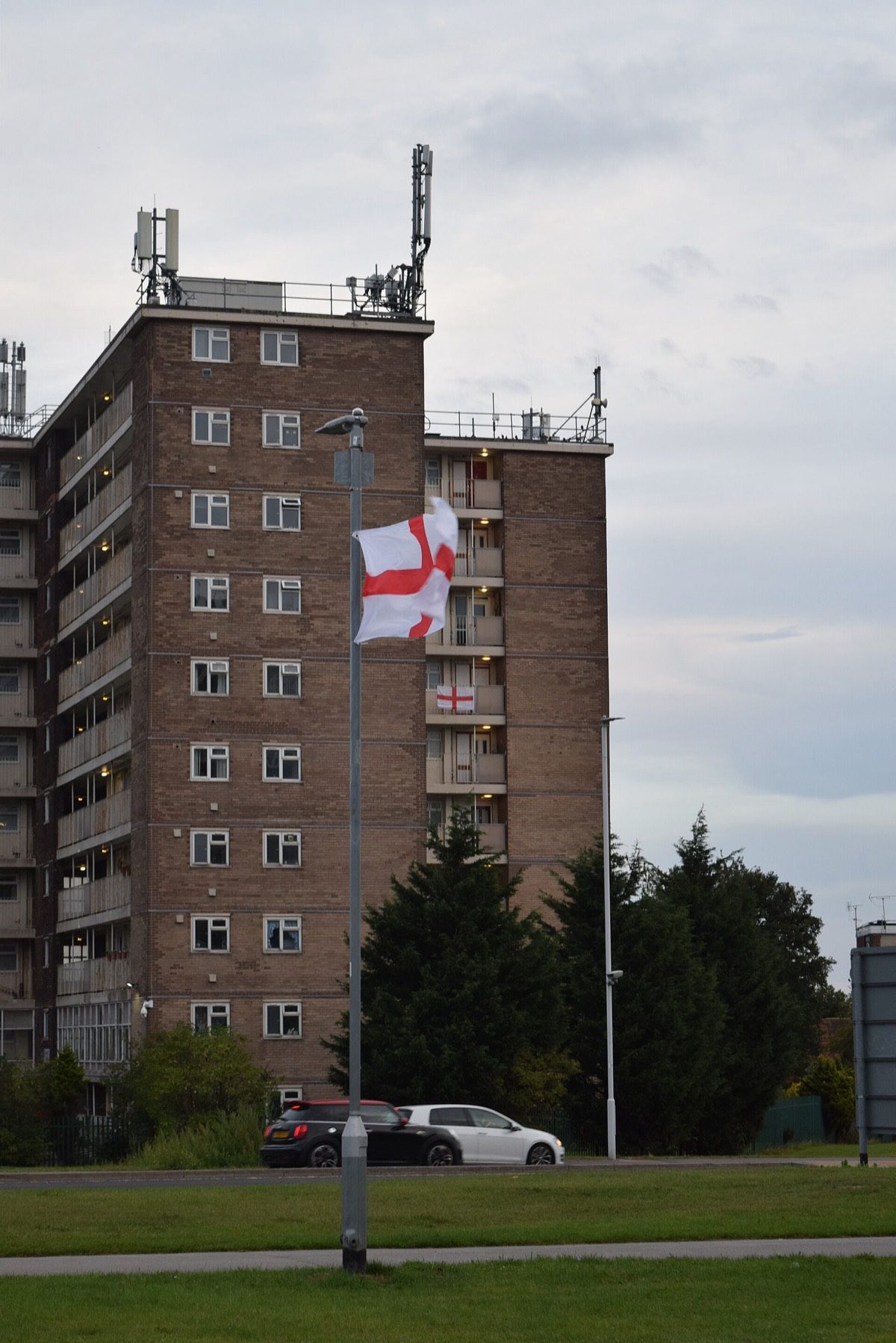
The populist right in Britain places a disproportionate focus on immigration. Their priorities lack substance, and taken together with Operation Raise the Colours last year, they show a love of country that doesn't extend much further than national symbols.
They blame immigration for problems it did not cause, from the housing shortage to low pay, while the real causes go unfixed. Net migration has fallen by three-quarters of a million since 2023, yet immigration is still the issue they put above every other.
When the figures show crime falling, in London and across the country, they deny them. "London is in a state of collapse. Crime is out of control," Nigel Farage posted in 2025, the year London recorded its fewest homicides since 2014.
A true love of country would prioritise its well-being, and the conditions in which its people live. Theirs does not. That is love without substance.
In 2025, Union Jacks and St George's flags flew from lampposts across the country. One could almost be forgiven for thinking the World Cup was taking place. Of course, what unfolded over the summer last year was no cause for unity. Instead, it further fractured an already divided nation.
The flags went up under the banner of a campaign called Operation Raise the Colours, and its own organisers said what they stood for. "Britons are starting to speak now," Carla Kennedy of the Worcester Patriots told the news agency AFP at the height of the campaign. "We are against illegal immigration and it is standing for that." Yet the people its supporters gathered against were asylum seekers, who have a right under international law to claim asylum. The same flags were carried to protests outside hotels housing them.
The campaign disguised itself as patriotism while weaponising national symbols against those its proponents believed didn’t belong.
Apologists for the movement ask why anyone should take offence at the British and English flags. The flags were never the problem. What they were being used for was. A flag hung to tell your neighbours they are not welcome is not an act of patriotism. And much of the country read the flags exactly that way. Half of Britons told YouGov that people putting England flags on lampposts mostly did it to express anti-migrant or anti-ethnic minority feeling, against a quarter who said national pride. Among ethnic minority adults, 52% said the England flag had become a racist symbol.
Operation Raise the Colours was the most visible sign of a wave of right-wing populism that has been rising in Britain for years. What sets this wave apart is that its targets can be traced back to a single event.
Where this wave came from
Hostility to immigrants and to Muslims is nothing new in Britain, but this wave found its targets in the marches against Israel's genocide in Gaza.
Within weeks of the first marches in October 2023, the home secretary, Suella Braverman, branded them "hate marches". On Armistice Day that November, far-right counter-protesters turned out against the march and clashed with police near the Cenotaph. Discussing the marches on GB News in February 2024, the Conservative MP Lee Anderson said Islamists had "got control of Khan" and "got control of London". Within three weeks he had joined Reform UK.
Nigel Farage dates the turn the same way. Writing on the third anniversary of 7 October, he set "the decent majority of British people" against "a substantial minority in this nation" who "felt something entirely different", and went on to name the Palestine Solidarity Campaign.
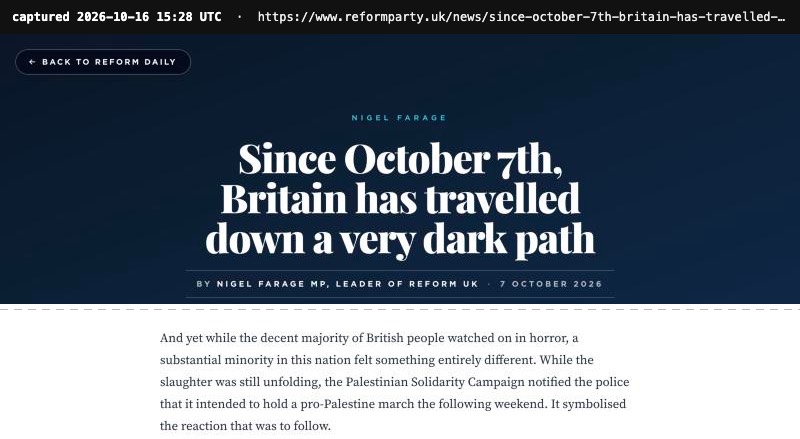
The marches were a protest against Israel's genocide in Gaza. The populist right recast them as a threat from Muslims and migrants, and in doing so found its targets.
What the populist right prioritises
Of all the issues facing Britain, immigration is the one the far right turns out for, the one Reform voters rank first, and the one Reform writes about.
Start with the streets. Every major far-right mobilisation since October 2023 has been about immigration or asylum accommodation, Islam, Tommy Robinson, "two-tier" policing or free speech, from the Southport riots of 2024, when mosques and asylum hotels were attacked, to the Unite the Kingdom rally that drew about 110,000 people in September 2025 and this autumn's attempts to stop small boats landing on the south coast. Not one was about housing costs, wages or the NHS. Where housing came up at all, it was to oppose housing asylum seekers. And they call it patriotism. The leader of Patriot Platform, one of the groups behind the boat protests, said they were driven by "love for our children, country and most importantly the future that we are leaving for our children".
Far-right mobilisations in the UK since October 2023
11 November 2023
Armistice Day counter-protest, London
Far-right counter-protesters turned out against the pro-Palestine march, saying they were defending the Cenotaph, which the march did not pass. Police made 145 arrests, at least 90 of them counter-protesters.
1 June 2024
Tommy Robinson march, London
Thousands marched from Victoria to Parliament Square, with speeches on "two-tiered policing" and montages of small boats.
27 July 2024
Robinson rally, Trafalgar Square
Thousands gathered for a rally billed as patriotic, chanting "We want our country back".
30 July to 7 August 2024
Riots after the Southport murders
False claims that the killer was a Muslim asylum seeker, when he was born in Britain, set off 246 protests and incidents of disorder. Mosques and hotels housing asylum seekers were attacked. By January 2025 police had made 1,804 arrests.
26 October 2024
Unite the Kingdom, Parliament Square
Thousands rallied while Robinson was in custody, under placards reading "Stop the Boats" and "Bring back Rwanda".
1 February 2025
March for Robinson's release, London
Thousands marched for Robinson's release, under a "Stop the Boats" flag.
9 to 12 June 2025
Disorder in Ballymena and across Northern Ireland
Migrant families' homes were attacked after an alleged sexual assault. Police called the violence "racially-motivated hate attacks".
July to September 2025
Asylum hotel protests, from Epping to Canary Wharf
Protests at hotels and flats housing asylum seekers spread from Epping, where they began after a resident was charged with sexually assaulting a 14-year-old girl. One placard read "Locals In Illegals Out".
August 2025 onwards
Operation Raise the Colours
Flags went up on lampposts and crosses were painted on roundabouts, starting in Weoley Castle, Birmingham, after councils removed flags.
13 September 2025
Unite the Kingdom, Whitehall
About 110,000 people by the Met's count, at a rally billed as a defence of free speech, with placards reading "stop the boats" and "send them home". Elon Musk told the crowd by video that "violence is coming to you".
26 October 2025
Robinson march to an asylum hotel, Southampton
A march against illegal migration and the hotel housing asylum seekers.
13 December 2025
Unite the Kingdom carol service, Whitehall
A gathering framed around Christianity. Robinson said it was "not about Islam, immigration, or the useless communists".
25 January 2026
March against an asylum camp, Crowborough
Hundreds marched against a plan to house 500 men at a former army site, chanting "Deportation, no accommodation".
15 and 20 April 2026
Epsom protests
After a reported rape, protesters targeted hotels and homes falsely said to house asylum seekers. Police later found that no offence had taken place.
16 May 2026
Unite the Kingdom, Parliament Square
About 60,000 by the police's count, with immigration the main theme. Robinson said Parliament held "650 traitors to this country".
2 June 2026
Protest at a police station, Southampton
Hundreds protested over the police's handling of a dying teenager after a stabbing. Eleven officers were injured.
9 to 11 June 2026
Disorder in Belfast, spreading to Glasgow
After a Sudanese man was charged over a stabbing, the homes of ethnic minority residents were set alight. Police made 35 arrests.
5 September to 4 October 2026
Stop the boats protests on the south coast
Masked protesters in Dover, Portsmouth, Southampton and Gosport tried to stop migrants arriving by small boat. The Home Office called it "intimidating and thuggish behaviour".
Reform voters tell pollsters the same thing. In YouGov's 10,000-person voter study this summer, 86% named immigration as one of the most important issues facing the country, against 42% of all adults. Only 20% named the NHS, and just 5% housing. The cost of living is their second concern, named by 38%, but immigration outranks it more than two to one. Asked by Ipsos last month for the single most important issue, 55% of Reform supporters said immigration. Three per cent said housing.
What Reform voters say matters, against the public
Share naming each issue as one of the most important facing the country, up to three each. Big YouGov Voter Study, 15 to 24 June 2026, 10,421 adults.
See the figures
| Issue | Reform voters | All adults |
|---|---|---|
| Immigration and asylum | 86 | 42 |
| The cost of living | 38 | 47 |
| The NHS | 20 | 31 |
| Housing | 5 | 9 |
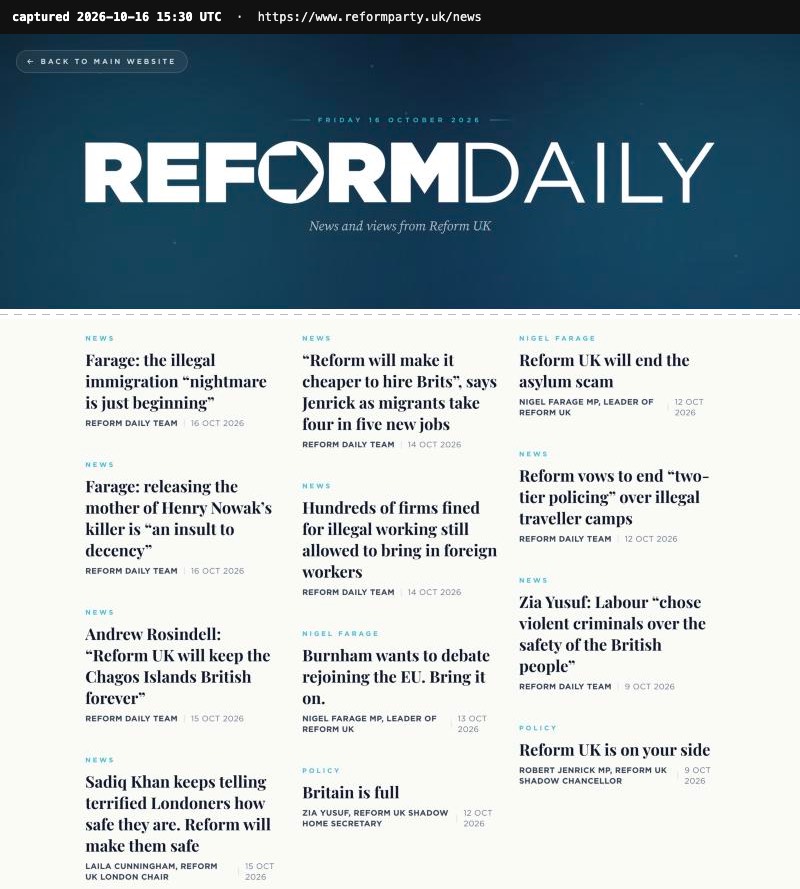
And the party writes about little else. NewsCord counted every item on Reform's own news site, Reform Daily, since it launched in May 2026. Of 246 items, 71 were about immigration, three about housing and one about the NHS. Immigration outnumbered the economy, energy, housing, welfare and the NHS put together, and in August it filled more than half of everything the party published. At its conference in September, Farage told the co-founder of Raise the Colours, "What your campaign has done is wake up vast parts of this country."
What Reform Daily wrote about, 8 May to 14 October 2026
One main topic for each of the 246 items on Reform UK's news site. Immigration was the subject of 71, housing of three and the NHS of one. The party writing about itself, its candidates and its elections made up 76.
See the figures
| Topic | Items |
|---|---|
| Party, elections and personalities | 76 |
| Immigration, asylum and borders | 71 |
| Crime, policing and justice | 29 |
| Islam, extremism, culture and identity | 14 |
| Economy, cost of living, jobs and tax | 14 |
| EU, Brexit, defence and foreign policy | 13 |
| Other | 10 |
| Welfare and pensions | 9 |
| Energy and net zero | 6 |
| Housing | 3 |
| NHS, health and social care | 1 |
How we did this
How we counted
We collected every item Reform UK published on its news site, Reform Daily, from its first item on 8 May 2026 to 14 October 2026, 246 in all. Each was given one main topic from its headline, under rules we wrote down before counting, with the first paragraph read wherever the headline alone did not settle it. Two coders worked independently, both of them AI models, and neither saw the other's codes. They agreed on 242 of the 246 items. The four disagreements were settled against the written rules, each time taking the reading less favourable to our argument. The rules, every item and every code are published with this piece, in the downloads at the foot of the page.
On the streets, in the polls and on its own website, the movement that claims to love Britain gives its attention to one issue above every other.
What immigration gets blamed for
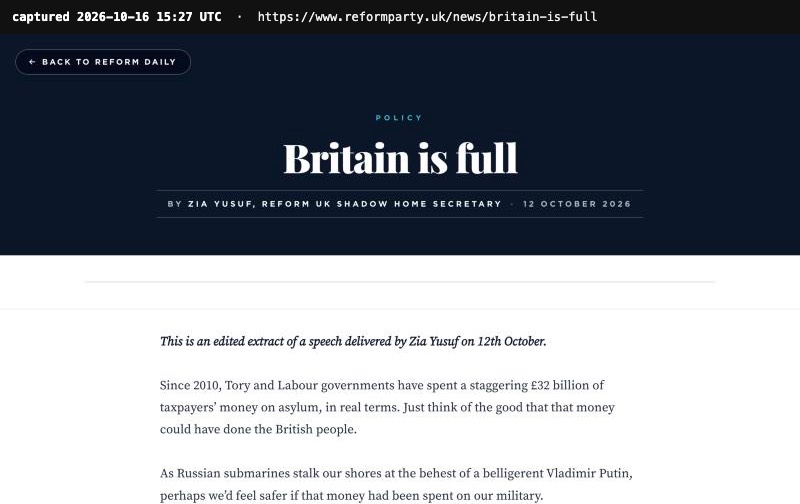
Immigration is blamed for problems it did not cause, and housing is the clearest case. "Britain is full," Reform's Zia Yusuf declared this month. A Conservative government said otherwise. Its 2017 housing white paper called the housing market "broken" and said the cause was simple. "For too long, we haven't built enough homes," it said. "This isn't because there's no space, or because the country is 'full'."
Migration does add to the demand for homes, most of all where planning makes building hard. But the shortage is half a century old. Britain fell behind the rest of Western Europe on homes per person between 1955 and 1979, years when more people left the country than arrived. House prices doubled relative to pay between 1997 and 2007, long before the migration rise of 2021 to 2023. Councils once built more than 120,000 social homes a year. In 2024-25, England built 12,198 for social rent, and more than two million council homes have been sold under Right to Buy since 1980. Even the right-leaning Centre for Policy Studies calculates that holding migration to the tens of thousands since 1997 would have closed only about a third of the gap. Nor are newcomers being handed the homes that exist. Nine in ten new social lettings go to UK nationals.
The same pattern holds elsewhere. The government's Migration Advisory Committee found that migration is not a major factor in the wages of UK-born workers. Foreign nationals make up 12% of prisoners and about 13% of convictions, roughly their share of the adult population, though they are over-represented in some offences. And the NHS, which migrants are said to overwhelm, depends on them. One in five NHS staff in England reported a non-UK nationality in January 2026.
Cutting migration does not build a home, raise a wage or staff a ward. Blaming it lets the people who could fix the causes off the hook.
What happened when migration fell
If the fixation were about the numbers, the numbers should have eased it. Net migration peaked at 944,000 in the year to March 2023 and had fallen to 171,000 by the end of 2025, down by "three-quarters of a million people", in the ONS's words.
Concern moved the other way. In November 2023, with net migration near its height, 22% of people named immigration as one of the most important issues facing Britain, according to Ipsos. By September 2025, months after the ONS had reported that net migration had more than halved, the figure was 51%, the highest in a decade. It is 44% now.
As net migration fell, concern about immigration rose
Share of adults naming immigration, unprompted, as one of the most important issues facing Britain, Ipsos Issues Index. Net migration peaked at 944,000 in the year to March 2023 and was 171,000 in the year to December 2025 (ONS). The months shown are not evenly spaced.
See the figures
| Month | Naming immigration |
|---|---|
| November 2023 | 22 |
| August 2025 | 48 |
| September 2025 | 51 |
| September 2026 | 44 |
Small boat crossings did rise in 2024 and 2025, and asylum claims hit a record before both began to fall. But the total is what changes the size of the population, and it fell by three-quarters. The fixation grew anyway.
What they do with good news
The populist right says it cares about safety. When the evidence shows things getting safer, it rejects that evidence.
Crime in England and Wales has fallen a long way. The ONS's Crime Survey puts theft, violence and criminal damage around four-fifths below their peaks in the mid-1990s. Homicides fell to 499 in the year to March 2026, the lowest since current police recording began in 2003, and London's 97 homicides in 2025 were the fewest since 2014.
The populist right's answer has been to deny the figures. "London is in a state of collapse. Crime is out of control," Farage posted in July 2025. Eleven days later he told a press conference, "The crime survey for England and Wales is based on completely false data." Laila Cunningham, now Reform's candidate for Mayor of London, accused Sadiq Khan of posting "fantasy graphs". When the Mayor launched a campaign against online disinformation about London, she accused him of "suggesting that victims are liars". The campaign called no victim a liar. And when an interviewer told Elon Musk that the crime figures disproved his warnings of civil war in Britain, he replied, "What numbers?"
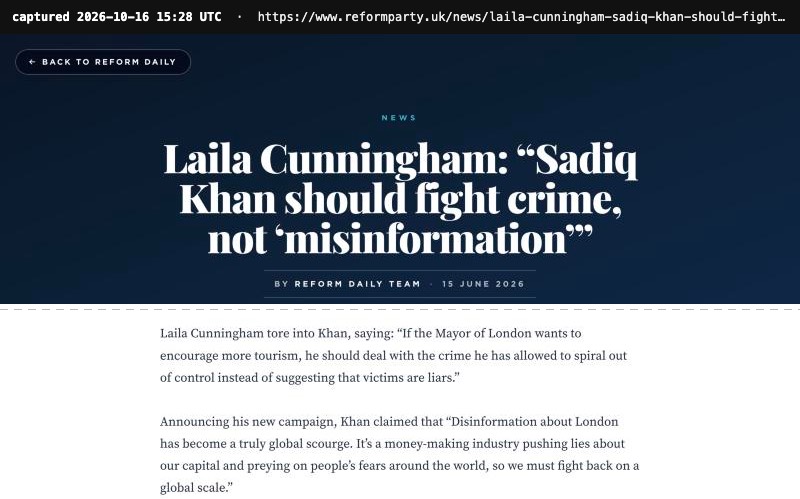
Not all the news is good. Shoplifting hit a record in 2025, and London's homicides this year look level with last year's. A patriot would want to know that too. But a person who wants their country safe wants to know what is working, so it can be kept. Refusing the good news keeps the fear alive, and the fear is what they campaign on.
How far the mainstream has moved
None of this has stayed on the fringe. The party that governed Britain for fourteen years now follows the populist right's priorities, borrows its language and has lost some of its own people to it.
As a Treasury minister in 2020, Kemi Badenoch said that cutting emissions to net zero by 2050 was "crucial". As Conservative leader in March 2025 she said, "Net zero by 2050 is impossible." In her 2024 leadership campaign she said leaving the European Convention on Human Rights would not be a "silver bullet". A year later she announced, "It is time for Britain to leave the ECHR."
Her language has moved too. Launching her leadership bid, she said that while everyone was talking about Reform's five new MPs, she was "far more worried about the five new MPs elected on the back of sectarian Islamist politics". In January 2025 she said Britain "is not a hotel". By June 2026 Reform's Robert Jenrick was saying the same thing. "We're not a hotel, we're a country," he said.
The policies have followed. In June 2026 Farage promised to remove foreign nationals from social housing. In August the Conservatives announced much the same, and Labour called it "copied from Reform". So have the people. Danny Kruger left for Reform in September 2025. Robert Jenrick, sacked by Badenoch in January 2026, joined Reform the same day and is now its shadow chancellor. Eleven days later Suella Braverman, the former home secretary who had called the Gaza marches "hate marches", followed him. "I feel like I've come home," she said.
What began on the fringe now sets the agenda for the opposition.
What Britons should prioritise
What would a substantive love of country look like? The philosopher Stephen Nathanson, in Patriotism, Morality, and Peace, describes patriotism as involving "special affection for one's own country", "a sense of personal identification with the country", "special concern for the well-being of the country" and "willingness to sacrifice to promote the country's good".
The flag-wavers have the first two in abundance. The question is the third. A country's well-being is measured in the price of a home, the cost of food and energy, secure and well-paid work, public services that are there when people need them, and safe streets. These are the things that decide the conditions in which Britons live, and anyone who professes to love Britain should put them first.
Start with homes. A home in England now costs 7.6 times typical full-time pay, according to the ONS, against 3.5 times in 1997. A record 135,580 households are living in temporary accommodation, with 177,530 children.
Young people are being shut out of work as well as homes. The unemployment rate among 16 to 24 year olds is 16.4%, and 981,000 young people are not in work, education or training. Pay has barely grown in 18 years, leaving average earnings £278 a week below where pre-2008 growth would have taken them, by the Resolution Foundation's estimate. Prices are about 29% higher than in July 2021, and food about 40% higher. Inflation has slowed, but slower inflation does not mean lower prices.
A love of country with substance would put these problems first. The populist right puts immigration first, and immigration, as we have seen, did not cause them. That is a love without substance.
What the fixation costs
A politics this fixed on one issue costs the country it claims to love in two ways.
The first is that the real causes go unfixed. Every problem blamed on immigration is a problem whose cause is left alone. Reform's answer to the housing crisis is to reorder the queue, putting British-born workers at the front, and to scrap the contributions developers make towards affordable homes on brownfield sites outside five big cities. The Chartered Institute of Housing says those contributions have "historically" delivered "almost half of all new affordable housing". Reform does promise 50,000 social homes a year, which it says would need no new taxes or borrowing. Its welfare plan would cut £50 billion from benefits, £22 billion of it from disability benefits alone.
The second cost is division. In the year to March 2026, religious hate crimes against Muslims rose 15%, with a rise in September 2025 that the Home Office says "coincided with a number of protests and incidents of public disorder". The British Muslim Trust counted 78 attacks and incidents against mosques in a single year, one about every five days. In Rotherham in August 2024, people inside a hotel housing asylum seekers "were told by police officers to hide in bedrooms" as rioters set it alight.
And the anger is aimed at people who share the very problems the populist right says it cares about. Of the households in England assessed as homeless or at risk of homelessness, 78% are headed by a UK citizen and 22% by someone who is not. Migrants and the populist right's own supporters pay the same rents, earn the same stagnant wages and wait on the same lists. Setting them against each other leaves what hurts them all in place.
What love of country would look like
A patriotism with substance would not need a lamppost. It would start with the things that decide how people live, whether a young couple can afford a home, whether a wage covers the bills, whether the hospital can see you and whether the street is safe. It would judge the country by the evidence, good news included. It would go after causes rather than culprits, by building homes, raising pay and staffing the services. And it would refuse to blame neighbours, and refuse the violence that follows the blame.
That kind of patriotism asks more of people than a flag does. It means what Nathanson called "special concern for the well-being of the country", and the country is everyone who lives in it. The patriotism on Britain's lampposts falls short of that.
A love of country with substance is measured in what it fixes.
The data behind this piece
- Every Reform Daily item, 8 May to 14 October 2026, with both coders' codesCSV, 246 rows
- What Reform Daily wrote about, 8 May to 14 October 2026CSV, 11 rows
- The most important issues facing the country, Reform voters and all adultsCSV, 4 rows
- Immigration named as an important issue facing BritainCSV, 4 rows
Sources
Office for National Statistics, Housing affordability in England and Wales 2025, labour market and NEET releases (August and September 2026), consumer price inflation, Crime in England and Wales (year ending March 2026) and long-term international migration (year ending December 2025). Ministry of Housing, Communities and Local Government, statutory homelessness (January to March 2026), social housing lettings 2024/25, Right to Buy sales and replacements 2025-26 and Fixing our broken housing market (2017). Home Office, hate crime in England and Wales (year ending March 2026) and immigration system statistics. Metropolitan Police, 12 January 2026. Ministry of Justice, offender management statistics, June 2026. Migration Advisory Committee, EEA migration in the UK (2018). Lords written answer HL15949. Migration Observatory. Resolution Foundation. Centre for Policy Studies (2025). Chartered Institute of Housing (3 September 2026). YouGov, Big YouGov Voter Study (June 2026) and England flag survey (21 November 2025). Ipsos Issues Index. NewsCord count of all 246 Reform Daily items, 8 May to 14 October 2026, with the dataset published alongside this piece. Reform UK website. British Muslim Trust, A Year of Division (2026). Crown Prosecution Service, 12 December 2024. AFP, Anadolu Agency, Arab News, CNN, Euronews, GB News, LBC, PA, ITV, City AM, The Guardian, The Economist. Stephen Nathanson, Patriotism, Morality, and Peace (1993).