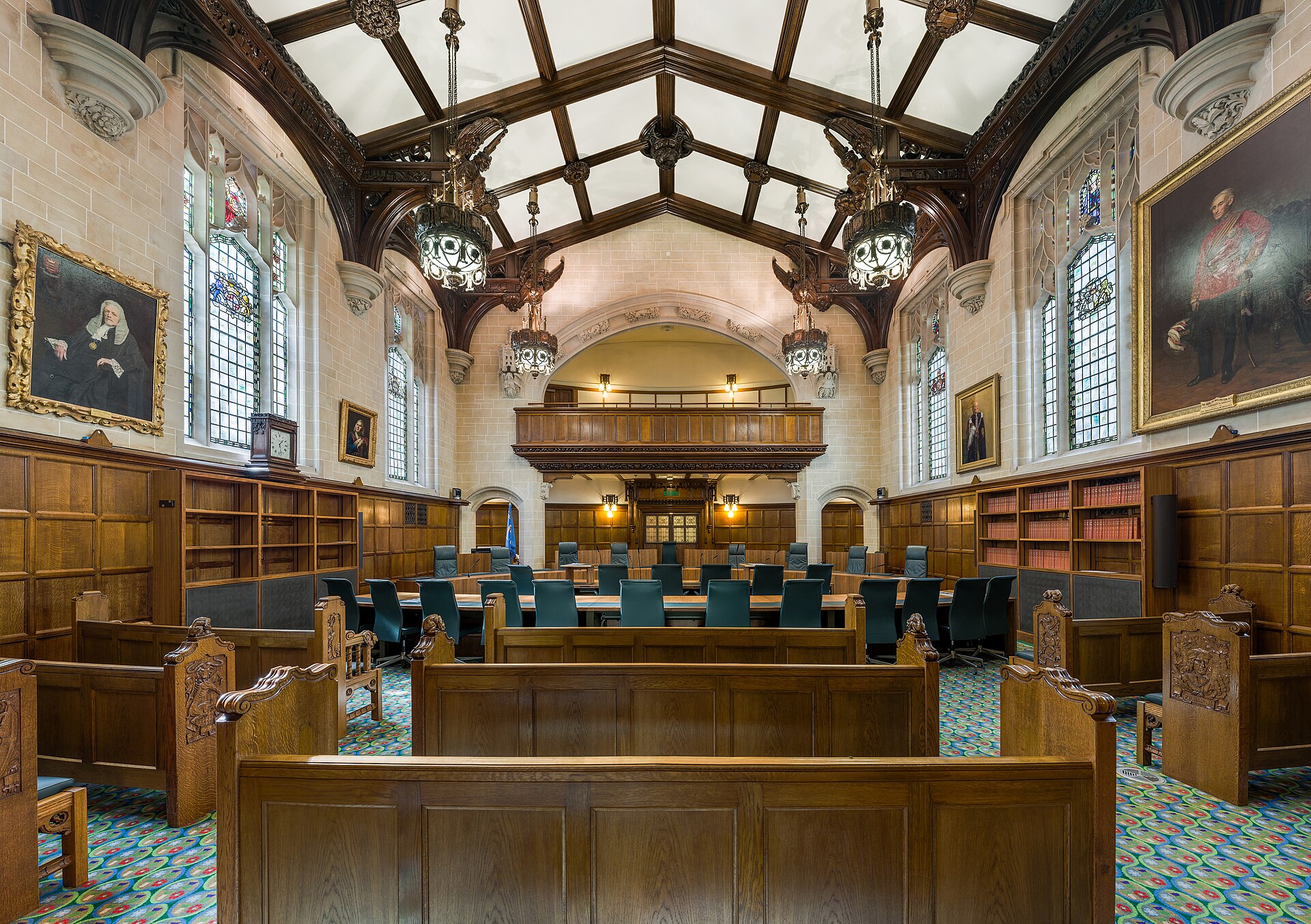
At the Supreme Court, the lawyers challenging Palestine Action’s proscription faced sustained pressure to defend their arguments. Our provisional transcript audit counts 151 substantive judicial challenges to Raza Husain KC and Henry Blaxland KC, representing Huda Ammori, against nine to Sir James Eadie KC, representing the Home Secretary. Allowing for the different lengths of submissions, that is 35.3 challenges per hour against 3.4.
The questioning was heavily one-sided. Husain and Blaxland were defending the distinction between punishing criminal acts and banning an organisation with consequences for people who had committed no crime. The bench repeatedly pressed them to explain why criminal law was enough. The government’s case for going further received a fraction of that scrutiny. That imbalance favoured the case for the ban.
How we did this
About the evidence
These are provisional counts of substantive judicial challenges identified through AI-assisted transcript review, not a certified count of judges speaking over counsel. Quotations are transcribed from the public recordings and still require final audio verification. The full method, uncertain cases and complete machine transcript are below.
Seven exchanges that reveal the imbalance
The bench’s challenges to Ammori’s counsel
- Making Husain defend why Brize Norton was not terrorism. “Spraying paint could in some circumstances cause serious damage to property. So just saying it’s spraying paint doesn’t lead us anywhere. Could you please explain why it isn’t terrorism?” Husain was disputing the damage assessment and asking the government to justify its decision. The bench pressed him to establish why the incident should escape the terrorism label. 4 November morning, 00:30:28 to 00:30:41.
- Treating continued offending as evidence that criminal law was insufficient. “Does that not demonstrate that the criminal law is not sufficient to meet the threat that is posed?” Blaxland had pointed to prosecutions and defendants in custody. Failure to prevent another offence does not establish that proscription’s additional restrictions are necessary. 4 November afternoon, 00:35:33 to 00:35:40.
- Pushing the protest-history argument back towards an excluded ground. “And why is that different from the discrimination ground, which has been found to be unarguable in the lower courts?” Husain was explaining why the history of prosecuted, but unproscribed, direct action mattered to proportionality. He repeatedly had to distinguish that argument from a separate discrimination claim. 4 November morning, 01:26:25 to 01:26:32.
- Questioning Husain on a presumed witness quotation. “presumably in a witness statement”. Later in the same turn: “That’s all there is to it, isn’t it?” The bench suggested the Court of Appeal was quoting Ammori. Husain disputed it. The cited judgment quotes the Divisional Court’s description of her case; it does not establish those words as her witness testimony. 4 November morning, 01:31:30 to 01:31:48.
The government’s most revealing submissions
- Asking the court to defer rather than decide the alternatives solely on its own assessment. “But you don’t need to judge it objectively.” Eadie had argued the alternatives failed on their merits, then said the question was whether the Home Secretary could reject them within the appropriate margin. He was seeking deference on the necessity of the ban. 5 November, 02:42:59 to 02:43:14.
- Describing the effect on supporters as a consequence of Parliament’s choices. “a sidewind of the judgments that Parliament has made”. Eadie acknowledged supporters’ rights, then invoked Parliament’s fixed prohibitions. For people whose previously lawful association was restricted, that effect was central to the case. 5 November, 02:51:09 to 02:51:17.
- Making degradation of the organisation the objective. “You’re after degrading the organisation precisely because it is concerned in terrorism”. This is the circularity Husain challenged: if disabling the organisation is the objective, alternatives that leave it functioning will always appear inadequate. The government still had to establish why that disabling was necessary. 5 November, 02:30:27 to 02:30:42.
Who was arguing, and what was the appeal about?
The formal appellant is Huda Ammori, a co-founder of Palestine Action. Husain and Blaxland are counsel for the appellant, or appellant’s counsel. The Secretary of State for the Home Department is the respondent, represented in the public oral submissions by Sir James Eadie KC, or respondent’s counsel. “Palestine Action’s lawyers” is understandable shorthand, but the named appellant is Ammori. This is a public-law appeal, so “defence lawyers” and “prosecution” would give the wrong impression. Official case record.
The Supreme Court permitted the appeal on compatibility with Articles 10 and 11 of the European Convention on Human Rights, which protect expression and assembly or association. It refused permission on the separate policy ground. The Divisional Court had found the proscription unlawful; the Court of Appeal reversed that result. The hearing therefore concerns whether this exercise of the power was justified, within the grounds the Supreme Court allowed. It is not a criminal trial of every person associated with Palestine Action. Permission decision; agreed statement of facts and issues, paragraphs 22 to 26.
The panel comprised Lord Reed, Lord Sales, Lord Lloyd-Jones, Lord Briggs and Lord Stephens. Judicial quotations are attributed to the bench where the individual justice’s identity has not been established. Counsel are identified from the court roster, spoken forms of address and formal handovers.
The count: turns, episodes and time
A judicial intervention is a distinct contribution by the bench during counsel’s submissions. A substantive challenge tests or disputes an argument, presses for an answer, or advances a contrary proposition. A clarification seeks meaning or evidence without a discernible contrary premise. Page references, handovers and time management are procedural. An interruption is narrower: it requires evidence that a judge cut across continuing speech. Machine punctuation cannot establish that, so this draft does not report an interruption total.
Every advocate, across all public sessions
Swipe or scroll sideways to compare columns. The first column stays in view.
Judicial challenges per hour of submissions
Husain: 89 challenges in 182.77 minutes. Blaxland: 62 in 73.64 minutes. Eadie: 9 in 157.65 minutes. These are elapsed submission windows, including the bench’s contributions.
See the figures
| Advocate | Clear challenges per submission hour |
|---|---|
| Raza Husain KC | 29.22 |
| Henry Blaxland KC | 50.52 |
| Sir James Eadie KC | 3.43 |
Ammori’s counsel and the Home Secretary’s counsel
Swipe or scroll sideways to compare columns. The first column stays in view.
The difference is not produced solely by counting repeated follow-ups. Grouping connected turns into questioning episodes gives 34 episodes containing a challenge to the appellant and three to the respondent. Their rates are about 8.0 and 1.1 per submission hour. Episode boundaries require judgement: a long discussion of one legal issue can contain several subtopics. The downloadable ledger shows the grouping rather than treating it as uniquely correct.
A broader measure includes challenges, clarifications and supportive interventions, while excluding procedural exchanges. That gives 199 substantive interventions to the appellant and 29 to the respondent, or 46.6 and 11.0 per hour. The difference therefore persists when the measure depends less heavily on classifying a question as adverse.
Where the questioning was concentrated
Swipe or scroll sideways to compare columns. The first column stays in view.
The concentration matters. Blaxland received 50 challenges in approximately 45 minutes on the afternoon of 4 November. Eadie received two during approximately 130 minutes of submissions the following morning. Husain’s short reply contained four clear challenges, all in one exchange about whether the Bristol assault had been condemned. That is four questioning turns, not four independent controversies.
The uncertain candidates add seven possible challenges to the appellant’s 151 and one to the respondent’s nine. Including those candidates gives 158 and ten, without resolving them. These are coding sensitivity totals, not statistical confidence limits: imperfect transcription could conceal additional words or speaker changes. As a deliberately overinclusive check, treating all 18 uncertain respondent turns as challenges would give the government 27, compared with 151 clear appellant challenges. The corresponding rates would still be approximately 10.3 and 35.3 per hour.
The imbalance survives each comparison: raw turns, time-adjusted rates, grouped exchanges and the broader count that includes neutral clarifications. Ammori was appealing an adverse judgment, so the two sides did not occupy identical procedural positions. But the figures cannot be explained away simply by pointing to her counsel’s longer submissions. The quoted exchanges show what the unequal scrutiny required them to defend.
Criminality does not make proscription proportionate
Failure to deter someone does not turn that person into a terrorist. Under section 1 of the Terrorism Act 2000, the conduct must satisfy one of the listed serious-harm conditions, which include serious damage to property. Ordinarily it must also be designed to influence a government or international governmental organisation, or intimidate the public or a section of it, and be done to advance a political, religious, racial or ideological cause. Firearms and explosives carry a specific exception to the design requirement. A repeat offender does not meet this definition merely by committing another offence.
Serious property damage can satisfy the conduct condition without personal injury. That is why Husain and Blaxland’s distinction matters: the breadth of the terrorism definition does not remove the government’s obligation to justify proscription. An act falling within a statutory definition and a proportionate decision to impose the full organisational ban are separate questions. Sections 1 and 3.
The Home Secretary’s power under section 3 is discretionary, subject to the condition that she believes the organisation is concerned in terrorism. Satisfying that condition does not automatically establish that every consequence of proscription is proportionate. The Bank Mellat framework asks whether the objective is sufficiently important, the measure is rationally connected to it, a less intrusive measure could achieve it without unacceptable compromise, and the rights burden is fairly balanced against the benefit. The last questions require evidence about this decision. Bank Mellat (No 2), paragraphs 20 and 74 to 76.
The weakness in the deterrence argument is the step from “an offence still happened” to “existing law is insufficient”. If continued offending were enough to justify stronger powers, almost any criminal prohibition could be pronounced inadequate. The government had to show why the additional restrictions were necessary in this case, including their cost to people who had committed no offence.
The demand that Husain explain why spray paint was not terrorism
“Spraying paint could in some circumstances cause serious damage to property. So just saying it’s spraying paint doesn’t lead us anywhere. Could you please explain why it isn’t terrorism?”
The bench, addressing Husain, UK Supreme Court public hearing, 4 November 2026, morning at 00:30:28 to 00:30:41Read the original
Short-window machine transcription; apostrophe and sentence punctuation normalised. The question concerns the Brize Norton incident, not all use of spray paint.
The bench was discussing Brize Norton and serious property damage, not declaring every use of spray paint terrorism. The revealing part is the demand placed on Husain: explain why the incident was not terrorism. He had disputed the seriousness of the damage and argued that the Home Secretary had not assessed it that way. The bench then compared paint on a Van Gogh with paint on a railing, and Husain accepted that seriousness depends on what is damaged.
Blaxland later described paint applied through fire extinguishers to the exterior and two aircraft turbines, while disputing the extent of damage and pointing to the pending criminal proceedings. Eadie relied on paint in turbines, additional damage and the aircraft’s operational functions. The extent and significance of that damage were part of the dispute. Calling the substance paint did not settle it; neither did calling the incident terrorism.
Husain was asking the government to justify its decision. The bench instead pressed him on a categorisation that he said the government had not previously relied on, answering that a fresh proportionality assessment was for the court. The chronology matters: the original assessment identified three incidents, and Brize Norton came later. The Court of Appeal said it materially influenced the eventual decision whether or not it was itself terrorism. Influence on a decision is not the same thing as an established terrorist classification. Agreed facts, paragraphs 4 to 11; Court of Appeal, paragraph 54.
The court can assess the incident’s relevance. It still has to identify the evidence, establish what the damage proves and explain why it justifies these restrictions. Husain’s insistence that the state substantiate its case was central to the appeal. The pressure to explain why the incident was not terrorism placed the practical burden of that exchange on the lawyer challenging the ban.
“Does that not demonstrate that the criminal law is not sufficient?”
“But are ordinary criminal charges sufficient if somebody knowing they’re going to be charged nonetheless does it?”
The bench, addressing Blaxland, UK Supreme Court public hearing, 4 November 2026, afternoon at 00:07:58 to 00:08:06Read the original
Short-window machine transcription. Blaxland replies that this applies to every protest case and refers to substantial custodial sentences.
“Does that not demonstrate that the criminal law is not sufficient to meet the threat that is posed?”
The bench, addressing Blaxland, UK Supreme Court public hearing, 4 November 2026, afternoon at 00:35:33 to 00:35:40Read the original
The preceding point is that Brize Norton followed earlier incidents and prosecutions. Blaxland accepts further conduct occurred while maintaining his argument for existing powers.
Criminal law does not prevent every offence. A prosecution can punish the offender and deter others even though the prospect of punishment failed to stop the original act. Treating that failure as sufficient proof that ordinary law is inadequate sets a test it can never consistently pass. Continued offending may show a continuing risk. It does not establish that proscription is necessary or that its wider restrictions will prevent the conduct.
Blaxland was making precisely that distinction. Some participants expected or volunteered for arrest; others were already in custody. He pointed to substantial custodial sentences and the use of the National Security Act as well as criminal-damage charges. The bench returned to the fact that the offences had happened anyway. His answer concerned the sufficiency of existing powers. The questions repeatedly pressed the different point that those powers had failed to prevent every incident.
Eadie’s answer relied on covert cells, concealed planning, recruitment, finance and people evading arrest. Blaxland addressed prevention too: conspiracy, encouragement offences and other existing powers can operate before the intended substantive offence is completed. His case was therefore not limited to punishment after the event. The government needed to establish a gap in those preventive powers and justify the additional interference with supporters’ rights.
The Court of Appeal had concluded at paragraph 139 that ordinary criminal prosecutions could never have been a satisfactory less intrusive measure in place of this proscription decision. Its reasoning relied on network disruption and the difficulty of detecting covert plans. This makes Blaxland’s challenge essential: the greater reach of a new power cannot itself establish that the existing powers are insufficient. Otherwise, the very rights removed by the broader power become a reason to prefer it. Court of Appeal, paragraphs 124 to 141.
The bench also compared proscription with disqualifying a company director whom the prospect of punishment had not deterred. That analogy bypasses the disputed reach of this ban. A restriction on the director’s own conduct does not explain why criminal prohibitions affecting an organisation’s supporters are necessary. Blaxland was asking the court to examine that additional reach, rather than assume that an example of one preventive restriction justified another.
Banning the organisation cannot supply the whole reason to ban it
Husain’s written case identifies a central circularity: if “disrupting and degrading Palestine Action” becomes the objective, a measure that leaves the organisation functioning will inevitably look inadequate. The comparison then rewards proscription for achieving the very destruction whose necessity is disputed. His proposed reference point is preventing relevant harm, within the statutory purpose and the Convention’s permitted aims. Appellant’s written case, paragraphs 97 to 102.
The bench tested whether disrupting the organisation could be an immediate objective within a wider aim of preventing terrorism. It distinguished the Convention’s broad legitimate aims from the later proportionality questions and acknowledged that a hypothetical ban to stop vandalism could fail at another stage. That leaves Husain’s central objection intact: the alternatives must be judged against the harm the government needs to prevent, rather than their ability to reproduce the organisation’s destruction.
Eadie described preventing terrorism as the overarching aim and degrading the organisation as the more direct aim. The full prohibitions were designed to achieve that degradation. But a power’s design cannot establish the necessity of using it. The government still had to show why disabling the whole organisation was necessary to prevent the identified terrorist risk, including why measures directed at criminal conduct would not suffice.
The UN Special Rapporteur’s intervention supports this distinction: the proscription power cannot be justified simply by wanting to prevent ordinary misconduct outside the terrorism definition. The government relied on the organisation’s activities as a whole. Husain’s answer was to demand a connection between that wider activity and the terrorist risk said to justify the ban. Without that connection, disruption risks becoming a means of suppressing activity beyond the reason for invoking the power. UN Special Rapporteur, paragraph 2(b); respondent’s written case, paragraphs 74 to 77.
The government asked the court to defer on the alternatives
“But you don’t need to judge it objectively. The question for you is whether the Secretary of State applying the appropriate margin was able consistently with her obligations under the Convention to conclude that none of those were.”
Sir James Eadie KC, UK Supreme Court public hearing, 5 November 2026, public session at 02:42:59 to 02:43:14Read the original
“Those” refers to the proposed less intrusive alternatives. Immediately before this, Eadie argues they fail even on an objective assessment; afterwards he relies on expert advice.
Eadie was asking the court to defer to the Home Secretary’s assessment of less intrusive alternatives. He first argued that the alternatives failed on their merits, then offered a further reason to reject them: the latitude owed to her judgment. This is a request to limit independent scrutiny at the very point where Husain and Blaxland were asking the court to examine whether the ban was necessary.
The government defines the threat, selects the objective, assesses the alternatives and then asks the court to respect its balance. That is a serious problem when the disputed decision restricts expression and association. Expertise about intelligence does not confer superior judgment about every effect on individual rights. Shvidler retains a substantive proportionality assessment and warns against drifting too far towards rationality review. Husain and Blaxland were asking for that scrutiny. Shvidler, paragraphs 123 to 126.
“107 suggests, Sir James, that perhaps less deference should be due in an assessment of impact on individuals as opposed to the threat.”
The bench, addressing Eadie, UK Supreme Court public hearing, 5 November 2026, public session at 02:24:01 to 02:24:13Read the original
Eadie replies: “My Lord, I am not seeking to dissent from that.” He maintains that a margin still applies to the ultimate fair balance.
Eadie accepted the distinction. That concession supports the appellant’s insistence that the rights assessment must have substance of its own. The Home Secretary’s access to security advice cannot answer what the ban does to people’s expression and association. Giving her judgment weight does not relieve the court of assessing those losses for itself.
The government called the effect on supporters a “sidewind”
Eadie argued that criminal conduct lies outside the core protection of Articles 10 and 11, reducing its weight in the balance. The bench then identified the people that reasoning did not answer: supporters who had not committed crimes before proscription. The judge described the focus as people at the periphery rather than those committing the underlying offences. Eadie accepted the point before returning to Parliament’s decision to provide a fixed set of prohibitions.
“the people in the penumbra rather than the people at the centre”
The bench, addressing Eadie, UK Supreme Court public hearing, 5 November 2026, public session at 02:49:47 to 02:49:53Read the original
The surrounding question concerns people wishing to support, encourage or fund who had themselves committed no crime before proscription.
“a sidewind of the judgments that Parliament has made”
Sir James Eadie KC, UK Supreme Court public hearing, 5 November 2026, public session at 02:51:09 to 02:51:17Read the original
Eadie is describing the effect on supporters. He also says the government does not diminish those rights and later discusses their impact.
For a supporter exposed to criminal liability, the restriction is direct. Calling it a “sidewind” describes it from the government’s perspective, as an effect of the decision to disable the organisation. For the person whose previously lawful association is restricted, it is the decision’s central consequence. Parliament’s creation of the powers explains their reach; it does not establish that imposing them on this organisation and its supporters was proportionate.
Eadie acknowledged that supporters’ rights mattered and relied on the Court of Appeal’s conclusion that the benefits outweighed the harm. He also began to call the impact relatively light, then corrected himself because that understated the seriousness the Court of Appeal attached to it. His correction confirms the point the appellant’s counsel were pressing: the rights burden was serious. The dispute was whether the government had justified imposing it.
The continued ability to support Palestinians or oppose Israeli government conduct does not restore the freedom to associate through Palestine Action. The two freedoms are not interchangeable. Nor does the continued existence of demonstrations establish how much expression the ban has discouraged. Husain pointed to the absence of an adequate baseline for that comparison. Saying people can protest another way does not answer his case. Appellant’s written case, paragraphs 113 to 115; Amnesty and Liberty, paragraphs 28 to 31.
Opposing the ban, discussing the group and supporting it are different
On the morning of 4 November, the bench repeatedly tested Husain’s claim about the risks of speaking against proscription. It distinguished disagreement with the government’s decision from support for the organisation, and warned against treating every police interpretation as a correct statement of the law. Husain accepted the bare-opposition distinction while arguing that explanations of that opposition could be treated as intellectual support, and that the risk of arrest could chill speech even without an eventual conviction.
The relevant authority, R v ABJ; R v BDN [2026] UKSC 8, requires attention to the particular offence elements and context. For section 12(1A), bare expression of support does not alone suffice: the judgment addresses knowing organisational support, encouragement risk, subjective awareness and unreasonable risk-taking. Its academic-debate example is contextual, not a blanket exemption for academics. Once all elements are established, the court does not conduct a separate assessment of the proportionality of conviction, although sentencing remains subject to proportionality. ABJ, paragraphs 38, 57 to 82 and 130 to 138.
English PEN and PEN International identify people speaking about the organisation: writers, journalists, academics and artists, together with their readers and audiences. Their intervention addresses reporting, teaching and commentary withheld through fear even where a conviction would not follow. They take no position on the disputed underlying facts or the weight of national-security considerations. Their point is that the rights burden reaches beyond the people whose conduct the government invokes to justify the ban. PEN submission, paragraphs 1 to 6.
The possibility of lawful opposition is no answer to every chilling effect. Husain’s argument concerned people deciding what they dare say when support for the organisation can expose them to criminal proceedings. A court assessing the restriction must examine that practical effect, alongside the precise offence elements. Reassurance about the eventual outcome of a prosecution does not undo the risk of arrest or the speech already discouraged.
Three incidents did not make every other action terrorism
The appellant’s written case puts the record at 385 actions over five years. Appellant’s written case, paragraph 29. The original assessment identified three incidents within that wider record. The agreed facts identify Glasgow, Kent and Bristol as the incidents on which the March assessment relied. They also record a later report of 158 direct-action events, including 28 involving significant property damage, none assessed there as meeting section 1(2). Those figures help distinguish the government’s statutory case from general disapproval of the organisation. Agreed facts, paragraphs 4 and 9.
A small number of serious acts can carry substantial weight. But three qualifying incidents do not make every other action terrorism, and the government cannot replace the required connection with general disapproval of the organisation. The breadth of the statutory definition makes scrutiny of the necessity and consequences of proscription more important.
Husain’s argument was that the wider material needed a sufficient connection to terrorist risk. Eadie presented the opposing case as looking only at the three or four incidents. Husain expressly rejected that description in reply. Requiring the government to explain the connection is different from excluding all other evidence. His actual argument addressed relevance and weight, not a demand to ignore the organisation’s wider activities.
The bench also helped Eadie identify the underground manual’s burner-phone and encryption provisions, at about 01:24:51 on 5 November. The audit records this as supportive intervention. The manual’s public availability did not make concealed planning impossible, but that was not the end of the necessity question. Evidence that people can conceal wrongdoing still needs to be connected to the claimed inadequacy of existing criminal and preventive powers.
A judicial description briefly became a presumed quotation from Ammori
The bench pressed Husain over the description “ordinary protest group” and a “well-established tradition of peaceful protest”. It suggested the Court of Appeal’s quotation marks reflected words Ammori had used, “presumably in a witness statement”. Husain disputed that attribution. The judgments support his objection to treating those quotation marks as proof of her words.
At paragraph 150, the Court of Appeal expressly refers back to paragraphs 29 and 30 of the Divisional Court judgment. Paragraph 30 presents the phrase as the lower court’s own description of the picture the claimant was seeking to paint. It does not present it as a direct quotation from her witness statement. The appellate quotation marks therefore establish quotation of a prior judicial characterisation; they do not, by themselves, establish Ammori’s exact words. Court of Appeal, paragraph 150; Divisional Court, paragraph 30.


A further judicial contribution pointed back to the Divisional Court. That correction matters: the appellate judgment was quoting a judicial description, rather than establishing the source of an alleged witness quotation. Husain had been required to defend his client against an attribution the cited passage did not substantiate. The exchange shows how an assumption adverse to the appellant can enter the questioning before its evidential basis is established.
Husain’s historical comparison concerned criminal direct action undertaken on conscientious grounds. He accepted that such acts could be prosecuted and punished. His argument was that this history mattered to whether an organisational ban was proportionate. The bench repeatedly questioned whether that revived a discrimination ground outside the appeal. Husain explained that he was rebutting the Court of Appeal’s characterisation of Palestine Action and the weight attached to it. The substance of his comparison remained: criminal punishment can coexist with restraint in the use of proscription.
Parliament authorised the framework. The particular ban still required justification.
The bench repeatedly invoked democratic accountability and Parliament’s choices. Husain pointed out that Palestine Action was packaged with other organisations in an instrument Parliament could not amend to remove one group. The answer was that Parliament could reject the entire instrument and the government could return with another. That possibility does not turn the vote that actually took place into a separate assessment of each restriction on Palestine Action’s supporters.
The agreed facts record that the same order covered Palestine Action, the Maniacs Murder Cult and the Russian Imperial Movement. Parliamentary approval is relevant to the institutional argument. It cannot be treated as though Parliament had written primary legislation specifically resolving every proportionality question about Palestine Action. The distinction between the statutory framework, approval of the instrument and judicial scrutiny of this executive decision remained central to the hearing. Agreed facts, paragraphs 13 to 16.
Seven of the nine challenges to Eadie concerned one continuing discussion about whether the Supreme Court should make its own proportionality assessment. The bench pressed him on why this court should not reassess the balance if the Court of Appeal had been entitled to do so, while distinguishing that exercise from reopening every factual finding. Eadie accepted a narrower position. The government was challenged, but seven turns on that procedural approach should not be mistaken for equivalent scrutiny of its substantive case for the ban.
The concentrated demand to condemn the Bristol assault
“And is it presently condemned by Palestine action?”
The bench, addressing Husain, UK Supreme Court public hearing, 5 November 2026, public session at 03:07:45 to 03:07:49Read the original
The question refers to the Bristol assault. Husain says it had not been condemned and refers to a challenge to the sentencing ruling and due-process grounds.
During Husain’s reply, the bench asked whether the Bristol assault had been condemned, returned to whether it was presently condemned, said it did not follow the answer, and pressed again. Four clear challenge turns fall within this single episode. Husain answered that it had not been condemned, while referring to the pending challenge. He then returned to his case that violence against people was rare and not advocated by the organisation.
Whether an organisation endorses violence can bear on future risk. It still requires an evidential connection to the decision under review. Husain’s reference to a pending challenge was an answer about the status of criminal proceedings, not a concession that every allegation could be treated as settled. The hearing itself distinguished a section 20 offence from a section 18 offence. Repeated demands for condemnation cannot resolve those legal distinctions or substitute for assessing the necessity of proscription.
All four clear challenges during Husain’s reply fell within this condemnation exchange. Afterwards, following a clarification about violence against people, he developed his final submissions for several minutes without another identifiable substantive judicial turn. The pressure was concentrated on obtaining an answer about condemnation. His case about the necessity of the ban still required an answer of its own.
“Jewish-owned” does not by itself establish why a business was targeted
Eadie invoked the Home Secretary’s reference to an attack on a Jewish-owned business in North London and to incidents investigated as hate crimes. That brings an additional implication into the case: that the organisation threatens people because they are Jewish. The description of ownership and the fact of an investigation do not, by themselves, establish that implication.
The Community Security Trust and Jewish Leadership Council argue that the group’s activities threatened Jewish institutions and that these interests deserve weight in the balance. Ammori’s reply rejects allegations of anti-Jewish targeting, disputes the factual and procedural basis for extending the justification, and says relevant targets were connected with the arms trade or related political institutions. These are opposing submissions, not findings by the Supreme Court. CST and JLC submission, paragraphs 1 to 8; appellant’s reply, paragraphs 2 to 12.
The Jewish Bloc’s intervention rejects the equation between opposition to Zionism or Israeli state action and antisemitism. It describes Jewish supporters of Palestine Action whose own rights were restricted by proscription. Those people disappear when “the Jewish community” is treated as having a single position on the ban. Their intervention directly challenges that assumption. Jewish Bloc submission, paragraphs 1 to 5.
Ownership identifies whose business was attacked. Establishing that it was selected because it was Jewish requires evidence of motive or discriminatory targeting. An investigation as a possible hate crime is not a finding that such a motive has been proved. The appellant’s counsel were entitled to insist on that distinction rather than allow a description of the owner to do the work of evidence about the offence.
Unequal scrutiny favoured the case for the ban
Across this public hearing, the appellant’s lawyers faced far more sceptical questioning than the government defending the ban. The difference remained after allowing for time and grouping repeated follow-ups. The direction of the questions matters as much as their number: Husain and Blaxland were repeatedly required to defend the distinction between criminal punishment and proscription, while the government’s appeal to stronger powers and executive judgment received markedly less challenge. That is one-sided scrutiny in the government’s favour.
Husain and Blaxland were defending a basic limit on state power: criminality does not remove the obligation to justify the necessity and consequences of an organisational ban. The government should have been pressed at least as hard to explain why existing powers were insufficient, why the additional restrictions were necessary and why people who had committed no offence should bear their cost.
Method, source record and reproducibility
This editorial criticises the direction and intensity of the public questioning. It does not determine an individual judge’s motives or the separate legal test of apparent bias. Judicial questions are evidence of the hearing’s scrutiny, not a substitute for the judgment. The closed afternoon hearing on 5 November is outside the public record analysed here.
Three AI reviewers read every machine-transcript segment sequentially under one codebook. They classified judicial turns in context rather than counting question marks or selected keywords. A coordinating review checked the combined figures, handovers, selected difficult exchanges, source documents and all government challenge rows. This was AI-assisted review; no human inter-rater agreement score or complete human audio listen is claimed.
One continuous judicial contribution can span many transcript segments. A new contribution after a substantive counsel response normally begins another turn. Bare acknowledgements do not automatically split a turn. Repetitions caused by requests to hear a sentence again are merged. Possible switches between unidentified judges are not manufactured from punctuation. A challenge can contain several questions and still count once. The same rules apply to both sides.
“Clear” describes confidence in the textual role, target and category, not perfect acoustic timing or certified wording. Uncertain candidates remain in the ledger with reasons. Exact boundaries can be uncertain even where the challenge is clear. Every row preserves the recording, original segment indices, approximate start and end, target, category, episode, source excerpt and coding rationale. The excerpts retain original ASR spelling, including errors.
The exposure denominators total 256.41 minutes for Ammori’s counsel and 157.65 for the respondent. They cover identified submission windows, including judicial discussion, document reading and ordinary pauses. They exclude handover gaps and the 314.32-second adjournment on 5 November. They do not measure counsel-only speaking time. Including that recess would lower the government’s challenge rate slightly rather than remove the difference.
The archive preserves the three source recordings, individual timestamped transcripts, captions, raw transcription checkpoints and SHA-256 hashes. The finished 5 November capture was checked against the ended source playlists, including both audio and video. That establishes coverage of the captured media; it does not establish that automatic speech recognition recovered every audible word. The 5 November file includes long opening and closing periods without hearing speech.
The frozen transcript contains 51,406 machine-recognised words in 5,620 segments. Selected short-window re-transcriptions recovered a repeated hallucination around 00:30 in the first session and speech omitted at chunk boundaries in the afternoon and on 5 November. Those repairs are displayed separately beside the raw transcript, so the original record and counting anchors remain inspectable. A possible missing negation in Husain’s closing submission remains unresolved; the raw line is not used as a quotation or evidence of his position.
Individual names in the transcript remain incomplete. The reading tools show the submission phase and the judicial-turn annotations, not an invented identity for every voice. A segment may contain both bench and counsel. The appendix’s phase label must not be read as saying the named advocate spoke every word. Headline quotations use the confirmed counsel context or “the bench”; named attribution to a particular justice requires additional textual or documentary evidence.
All three public recordings are included below. The court expressly excluded the afternoon of 5 November from public attendance and livestreaming, so no closed-session transcript is claimed. Times are elapsed within the preserved source file. The original requested marker 02:21:01 was retained, not used to cut away earlier material; a live player and a later archive can have different origins. Court hearing notice.
Contains Supreme Court information licensed under the Open Supreme Court Licence v1.0. This is an unofficial research transcript and editorial analysis, not an official court publication or endorsement. Source video and official documents remain the authority for what was said and decided.
Download the figures and complete turn ledger
- All three advocatesCSV, 3 rows
- Comparison by sideCSV, 2 rows
- Session and advocate breakdownCSV, 7 rows
- Every coded candidate judicial turnCSV, 352 rows
Inspect the complete coding ledger
Swipe or scroll sideways to compare columns. The first column stays in view.
- Official case page and recordings
- Agreed facts and issues
- Appellant’s written case and reply to interveners
- Respondent’s written case
- Divisional Court judgment and Court of Appeal judgment
- Amnesty and Liberty, UN Special Rapporteur, PEN, Jewish Bloc, and CST and JLC
- Bank Mellat (No 2), Shvidler, and ABJ and BDN
Full public-hearing machine transcript
The following three readers contain the entire frozen transcript, rather than selected extracts. Search each session, scroll within its transcript, or select its text to copy. Original segment IDs make it possible to locate every audit row. Re-transcription supplements appear beneath each reader. The original files remain unchanged, including recognised errors, so quotations should be checked against the source recording before publication.
4 November: morning transcript
Full machine transcript, 4 November: morning: 2,127 timestamped segments, search, submission-phase context and provisional judicial-turn annotations. Includes original ASR errors and separate correction supplements. Not an official transcript.
4 November: afternoon transcript
Full machine transcript, 4 November: afternoon: 1,854 timestamped segments, search, submission-phase context and provisional judicial-turn annotations. Includes original ASR errors and separate correction supplements. Not an official transcript.
5 November: complete public recording transcript
Full machine transcript, 5 November: complete public recording: 1,639 timestamped segments, search, submission-phase context and provisional judicial-turn annotations. Includes original ASR errors and separate correction supplements. Not an official transcript.
Conversation
Be specific, respectful and constructive. Comments are public to readers who can access this article. Publishers can hold or remove comments.
Loading the conversation…