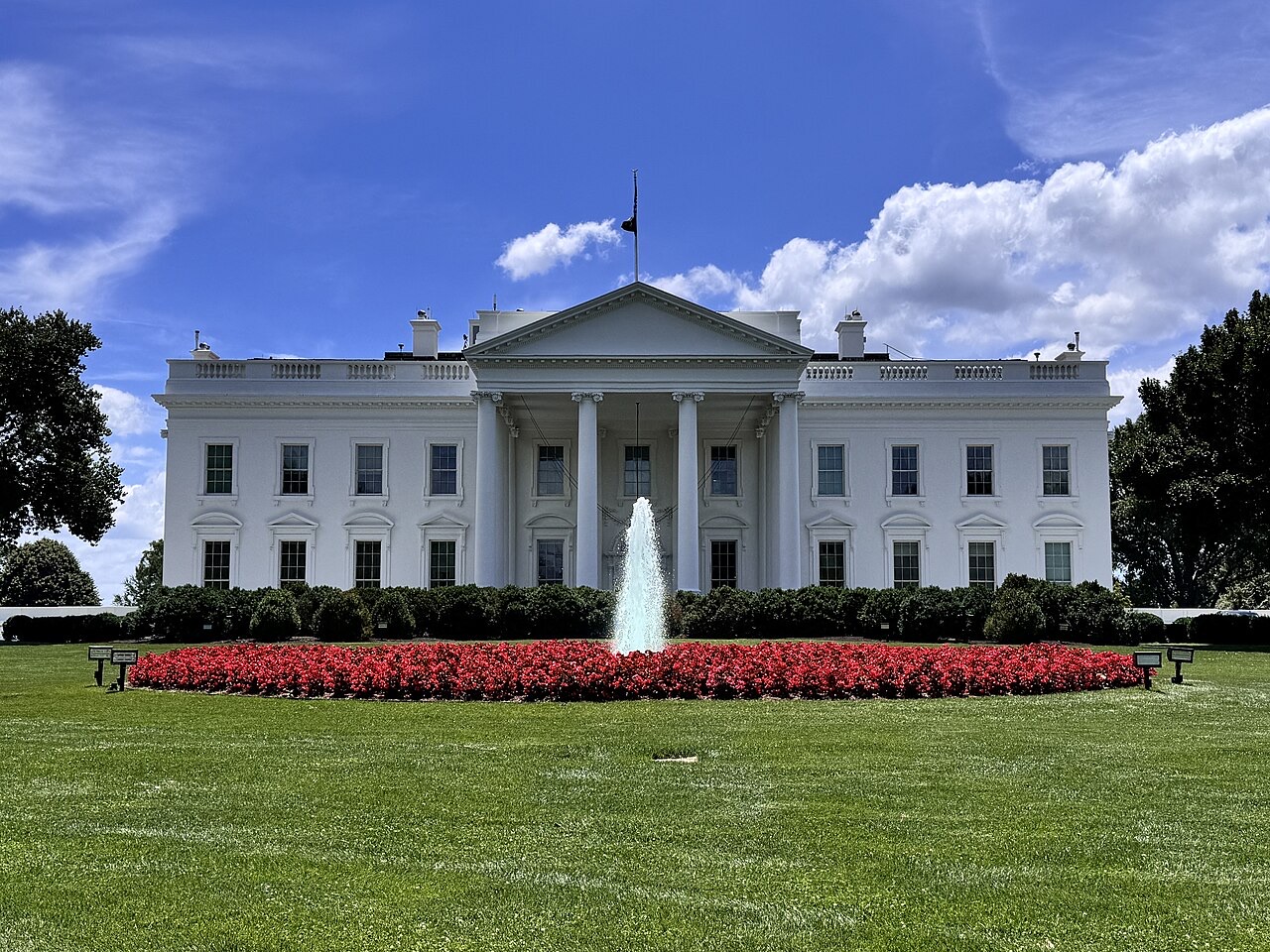
The blue tsunami
On Tuesday, a blue tsunami swept Trump's party out of control of both houses of Congress, and the war on Iran was a big part of it. 63% of voters told the NBC News exit poll that attacking Iran was the wrong decision, and the Vice President, JD Vance, wrote the next day, "The reason we lost is the war."
The war's defenders insist the war is not why they lost. Ben Shapiro, who co-founded the Daily Wire, wrote that Republicans "got crushed last night because of three things in combination", which he listed as "unaffordability, chaos, and corruption". Mark Levin, who hosts Life, Liberty & Levin on Fox News, blamed the war's opponents instead. "It's they who extended the war up to and through the mid-terms", he wrote. Yet when the President's own deputy blames the war for the defeat, they can hardly claim it played no part.
One might have expected the war's loudest backers to take the hint. Of course, they did not. Before election night was over, Laura Loomer, one of the war's most vocal supporters and someone with the President's ear, had tagged him in a post.
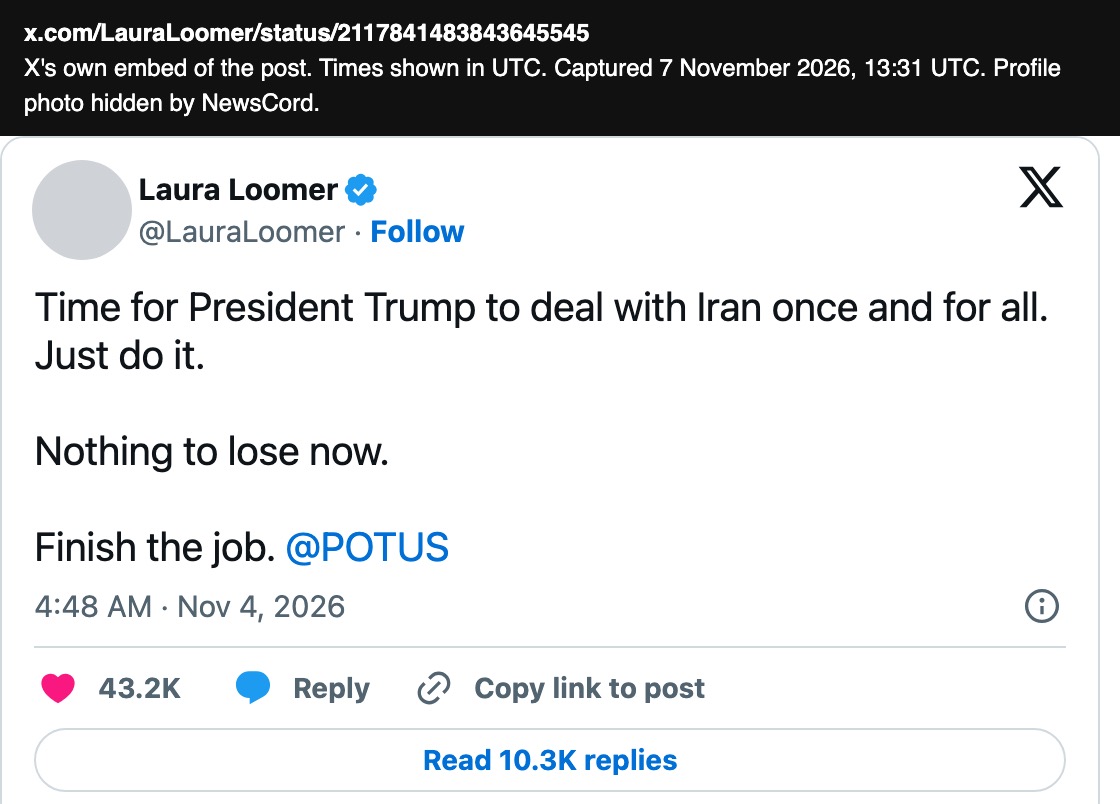
The voters had just turned against the war, and her answer was "Just do it."
She was saying in public what others were saying in private. On Thursday, two sources told Reuters they believed Trump was still likely to order resumed hostilities. "He is planning to bomb Iran. Don't listen to what he's saying. He held off because of the midterms. We asked him to hold off until the midterms," said one. The other, Reuters reported, "said Trump did not have anything to lose politically now that the midterms were over". Reuters ran it near the end of a story headlined "Tankers hit in Hormuz as Iran keeps up pressure after US vote".
This is the nothing-to-lose attitude, and it is underpinned by Tucker Carlson's claim, two days before the vote, that "the Trump administration may be within days of launching a nuclear strike on Iran". His post has been seen 96 million times.
So why do they believe there is nothing to lose? Because for Trump, there is no vote left to lose.
Two years with nothing to lose
Under the 22nd Amendment Trump can never stand for president again, and his party will not face another midterm while he is in office. From January he will be a lame duck at home, with a Democratic Congress able to block much of what he wants to do. Abroad, he still has a free hand, and the war's backers want him to use it on Iran.
They have been waiting for this moment for months. As early as 8 April, Loomer wrote, "We are already losing the midterms due to the incompetence of GOP Reps who refused to codify President Trump’s agenda in my opinion, so you might as well destroy the regime." On 18 June Levin set out the timetable. "We should consider slow walking the enemy, building up our munitions, our oil reserves, get the price of gasoline down, get through the midterms, then knock them out." Five days later Brian Kilmeade said on Fox & Friends, "The closer it gets to the midterms, I think the less likely the president [is] to act. ... But after the midterms, the gloves come off."
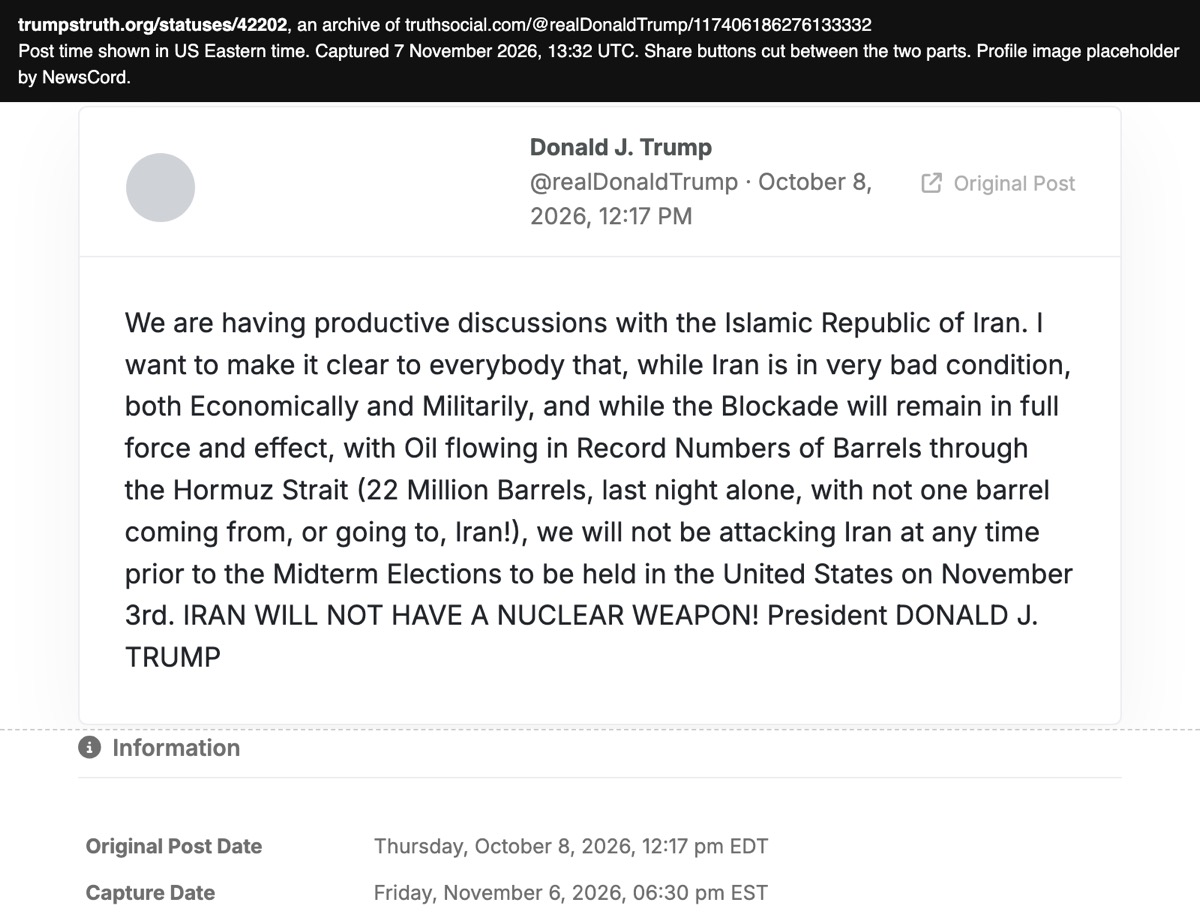
Trump gave the same timetable in public. On 8 October he promised that "we will not be attacking Iran at any time prior to the Midterm Elections to be held in the United States on November 3rd."
Two days before the vote, he told a rally in Iowa, "The only reason why I'm not finished with Iran is I want to be nice. I want to try and save all those lives if I can," adding, "But at some point we're going to have to give them the hammer."
The vote is now over, and his own advisers want him to use the time he has left. NBC News reported on 6 November that "Administration and defense officials have told President Trump that he should act within the next eight weeks, before the new Democratic-controlled Congress takes office". Two US officials told NBC that his advisers had warned him "his window for restarting major combat operations in Iran is closing".
The voters said stop. His advisers said hurry.
NBC's report should have been on every front page. It was not. We could not find a single other major news outlet in Britain or the United States that followed it up. The press wrote plenty about whether Trump might return to war. It barely reported that his own officials had told him to do it within eight weeks, before the new Congress takes its seats. A free hand abroad is easier when almost nobody is reporting what the President is being urged to do with it.
And fewer people are left to tell him no. CNN reported in June that he cut the National Security Council's staff from about 200 to less than half, "at least in part, at the behest of" Loomer. The person telling him there is nothing to lose is the one whose demands, CNN reported, were partly behind those cuts.
A war in all but name
Trump calls the war "Military Operations". His White House says there are not even any hostilities. There is a reason for that choice of words. The Constitution gives Congress, not the President, the power to declare war, and under the War Powers Resolution a president who takes the country into hostilities has 60 days before he needs Congress's approval.
Congress has already tried to use that power. In June the House voted 215 to 208, and the Senate 50 to 48, to direct Trump to remove US forces from hostilities with Iran. "We're past the 60 days, so you have two choices. You either follow the law or you change the law," said Brian Fitzpatrick, one of the four Republicans who voted for it in the House.
Trump called it "a meaningless vote". His White House said the resolution had "no significance", because "there are no hostilities from which to remove U.S. forces, as hostilities terminated with the ceasefire on April 7th". ABC News reported that the resolution "does not carry the force of law".
Even his promise not to attack Iran before the vote held only in public. In the weeks before it, The New York Times reported, US forces carried out attacks "which neither Iran nor the United States publicly acknowledged". The Guardian, reporting the Wall Street Journal's account, said they had been "purposefully kept secret by the Trump administration so as not to signal any intent of resuming the military campaign against Iran".
On 2 November, the eve of the vote, US forces struck Iran's Qeshm Island. That same day, Trump told Sean Hannity on Fox News, "We're not fighting a war. Everyone says 'you're at war!' Well, when was the last time we fired anything?"
A US official called that day's strike "defensive", and much of the American press put the word straight into its headlines. ABC News used it five times, never in quotation marks, and never once called it a war. CNN and The New York Times credited the word to officials in their headlines, Reuters and The Washington Post put it in quotation marks, and the Associated Press opened its report with it. The New York Times, CNN and the AP all call it a war in their own reporting. On the day Trump broke his promise, they reached for the administration's word. In Britain, the Telegraph's headline said "US bombs Iran's Qeshm Island", the Times led on "secret strikes", and the Independent's headline said Trump had broken his promise not to bomb Iran before the midterms.
How the strike of 2 November was headlined
On Thursday, Trump went further. "I don't know if it's a war because there hasn't been anybody killed in many months," he told reporters. Three American soldiers were killed by an Iranian strike on a base in Jordan in July. On Friday, US forces struck Iran again, and Trump called it "minor". "They built a little bit of an anti-aircraft device and we knocked it out in about 15 minutes, maybe five," he said.
That is the point of avoiding the word. A war that is never called a war never has to be approved, and a president with two years left and no election to face can do almost whatever he wants with it.
What nothing to lose means for Iran
The people who say there is nothing to lose are not the ones who would lose. Iranians are, and Trump has told us in his own posts what he would take from them. On 30 March, in the same post in which he spoke of ending "our Military Operations in Iran", he threatened, if no deal was reached, "blowing up and completely obliterating all of their Electric Generating Plants, Oil Wells and Kharg Island (and possibly all desalinization plants!)", which he called "retribution". On 5 April he announced that "Tuesday will be Power Plant Day, and Bridge Day, all wrapped up in one, in Iran." Two days later he went further. "A whole civilization will die tonight, never to be brought back again. I don’t want that to happen, but it probably will."
Desalination plants turn seawater into drinking water. The Arab Center in Washington estimates that Iran's Gulf coast desalination plants and pipelines "provide water to a total of some 30 million people", a third of the country, and that if the southern plants were knocked out, "these regions would be left without water immediately". When Trump threatens "possibly all desalinization plants", he is threatening to cut off the water of millions of ordinary Iranians. The UN's human rights chief, Volker Türk, said of threats "to annihilate a whole civilisation and to target civilian infrastructure", "This is sickening. Carrying through on such threats amounts to the most serious international crimes."
We already know what this war does to people, because it has already done it. On its first morning, 28 February, missiles identified by munitions experts as US Tomahawks hit the Shajara Tayyiba elementary school in Minab. Airwars counts at least 155 people killed there, 123 of them children aged 13 or younger. Liana Mohammadi was one of them. She was 7. Her mother, Mandana Salari, a first-grade teacher, was killed too. She was 29. By 9 October the Pentagon counted 21 US service members dead and 865 wounded.
A restarted war would also be a wider one. As the results came in, Iran's parliament speaker, Mohammad Bagher Ghalibaf, wrote, "Conscience or the cost of living, Americans said NO TO WAR, and we endorse this message. If the US govt betrays their public will to serve international paymasters and blackmailers, it will learn our NO comes with a Nightmare." Its supreme leader, Mojtaba Khamenei, said on 4 November, "Should such aggressions be repeated, the war's scope will become much wider." The Wall Street Journal reported that America's own Gulf allies "are steeling themselves for a heavy U.S. bombardment of Iran that they expect to trigger a vicious cycle of retaliation against their own economic and civilian infrastructure".
A president who will never face voters again, advised by people who say there is nothing to lose, has eight weeks to decide whether to restart a war in which he has already threatened Iran's power plants, its bridges and its water. That is reckless, and it is Iranian families like Liana's, and the Americans sent to fight, who would pay for it.
What happens next
Trump has not said what he will do. On Thursday he told reporters in the Oval Office that he "would rather not destroy the rest of the country", and that "you'll know soon enough".
There is another way out. A senior Iranian official told Reuters on Thursday that Tehran had sent Washington a nuclear proposal through Qatar, to be discussed only once Washington meets seven demands. Whether Trump takes it up will show whether the vote meant anything to him.
In January, the Congress the voters chose takes its seats. Chuck Schumer, the Senate's top Democrat, said on Wednesday, "This war must end. It must end," and pointed to Congress's "power of the purse", which he called "one of the ways of deterring a president who does war without the consent of the American people." That is precisely what Trump's advisers want him to act before.
Americans voted against this war on Tuesday. The people around Trump answered that there is nothing left to lose. The people of Iran have everything to lose.
How we did this
Sources
NBC News exit poll (3 November 2026) and NBC News (6 November). X posts by JD Vance (4 November), Laura Loomer (8 April, 3 November), Mark Levin (18 June, 4 November), Ben Shapiro (4 November), Tucker Carlson (1 November) and Mohammad Bagher Ghalibaf (4 November). Truth Social posts by Donald Trump (30 March, 5 and 7 April, 8 October). Newsweek (Iowa rally, 1 November). Media Matters (Fox & Friends, 23 June). CNN (17 June, and Trump on Fox News, 2 November). NPR (House war powers vote, 3 June, and Trump's response, 4 June). ABC News (Senate vote and White House statement, 23 June, and the Qeshm strike, 2 November). Associated Press (2 November, as published by PBS NewsHour). Fox News (5 November). The Wall Street Journal (2 November). The New York Times, The Washington Post, NBC News and Reuters (2 November). BBC News, Sky News, The Telegraph, The Times and The Independent (3 November). The Guardian (3 and 7 November). Arab Center Washington DC (28 April). UN Office of the High Commissioner for Human Rights (7 April). AFP (4 November). Airwars, Minab incident record (updated 22 October). Task & Purpose (Pentagon casualty figures, 10 October). Reuters (5 November, as published by AsiaOne). Our search of major British and American outlets for any follow-up of NBC's report, 8 November. US Constitution, Article I and the 22nd Amendment. War Powers Resolution (1973).
Conversation
Be specific, respectful and constructive. Comments are public to readers who can access this article. Publishers can hold or remove comments.
Loading the conversation…