Syria15 September, 20263 min read
Ahmed Al Sharaa Says Sanctions Lifted Will Revive Syria’s Economy After Dubai Summit
This article is an automated aggregation of coverage from news outlets. Our editorials offer in-depth analysis curated by the NewsCord team.
Sanctions lifted opened door to investment and economic recovery in Syria. Syria aims to grow economy to about $200 billion within five to ten years.
7 outlets told this the same way.
Outlets did split on Asad Al-Shaibani Meets Saddam Haftar in Benghazi Over Syrian Consulate And Missing Syrians →
Sanctions lifted, economy reset
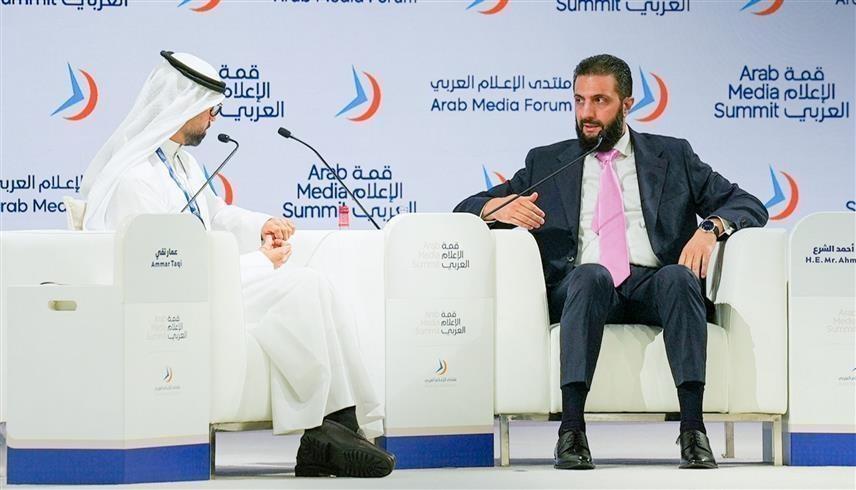
Syrian President Ahmed al Sharaa said on Tuesday at the Arab Media Summit 2026 in Dubai that Syria was “born again” after sanctions against the country were lifted, arguing that the removal opened the way for economic recovery, foreign investment and a stronger regional role. He said Syria had faced an exceptionally extensive sanctions regime with some restrictions dating back to 1979, leaving generations unfamiliar with international financial transactions and banking guarantees. Al Sharaa described a shift from an economic system resembling a socialist model, characterized by bureaucracy and corruption, toward a more liberal economy supporting the private sector, while warning the transition could initially require difficult decisions.
He put the Syrian economy at around $60 billion in 2010 before falling to roughly $20 billion by 2024, then growing to $32 billion in 2025, and said it could reach $50 billion this year and return to its 2010 level by 2027. He added that “Our programmes aim to bring the economy to around $200 billion over the following five to 10 years,” provided international conditions remain stable.

Regional diplomacy and autonomy
Al Sharaa said mediation efforts involving Arab and regional leaders, as well as Turkish President Recep Tayyip Erdogan in contact with US President Donald Trump, contributed to what he described as a “historic decision” to lift the sanctions.
He told the summit, “I believe Syria was born again after the sanctions were lifted and the road ahead was opened. In other words, the restrictions were broken,” and said “What remains now is to adopt the right policies and procedures and make sound choices.”

He stressed the independence of Syrian decision-making, saying Damascus does not intend to become subordinate to any outside power and that “Syria does not necessarily need to be aligned with any particular side. Syria follows its own interests,” while stressing the importance of Syria’s Arab and Islamic surroundings.
He cited the operation that eventually led to the capture of Damascus as evidence of independent Syrian decision-making, saying “When we made the decision to liberate Damascus, we were on our own.”
Al Sharaa also warned that Syria’s recovery could be affected by expanding wars and instability elsewhere in the Middle East, saying “What concerns us most is the possibility that the wars could expand further and create broader instability across the region.”
Investment, ports, and food
Al Sharaa said investors from the UAE, Saudi Arabia, Qatar and Kuwait are among those moving into Syria, with several memoranda of understanding signed and some projects already under implementation. He cited planned investments involving Emirati businessman Mohamed Alabbar and DP World’s investment in the Port of Tartus on Syria’s Mediterranean coast, and said Syria’s geographical position could make it an important part of alternative trade, energy and supply routes linking East and West. He described Syria as a potential regional food basket, saying it could produce enough food for 70 million to 75 million people without advanced agricultural technologies and more than 100 million with modern technology.
In parallel, Al Sharaa said Syria is rebuilding state institutions and public trust following decades of poor governance and years of war, while dealing with damaged infrastructure, energy shortages, economic difficulties and risks of internal division. Turning to media, he urged media professionals to prioritize credibility and reliable information and avoid politicisation, saying “People’s minds are, in a sense, entrusted to journalists,” and asking, “How can people be expected to remain patient with something they do not fully understand?”