
Anthropic Finds AI Skills Gap Widening as Power Users Pull Ahead
Key Takeaways
- Power users pulling ahead as AI skills gap widens, says Anthropic.
- No broad AI-driven job losses yet; early adopter advantages persist.
- Workplace winners concentrate gains among early AI adopters, risking inequality.
AI Skills Gap Emerges
Anthropic's latest economic impact report reveals a widening AI skills gap in the workplace.
Early adopters are gaining significant advantages while other workers face growing challenges.

Despite no evidence of widespread job displacement so far, there's a sharp divide between everyday users and power users.
Peter McCrory, Anthropic's head of economics, notes that labor markets remain resilient.
Workers in AI-exposed roles are not seeing higher unemployment than peers in less-exposed jobs.
This apparent stability masks underlying shifts that could accelerate quickly.
The report serves as an early warning about adoption patterns determining who benefits.
CEO Dario Amodei cautions that displacement effects could materialize very quickly.
Proper monitoring frameworks are needed to track these developments.
Most Exposed Professions
The research identifies specific professions where AI automation is already occurring.
These serve as leading indicators for broader displacement across the economy.
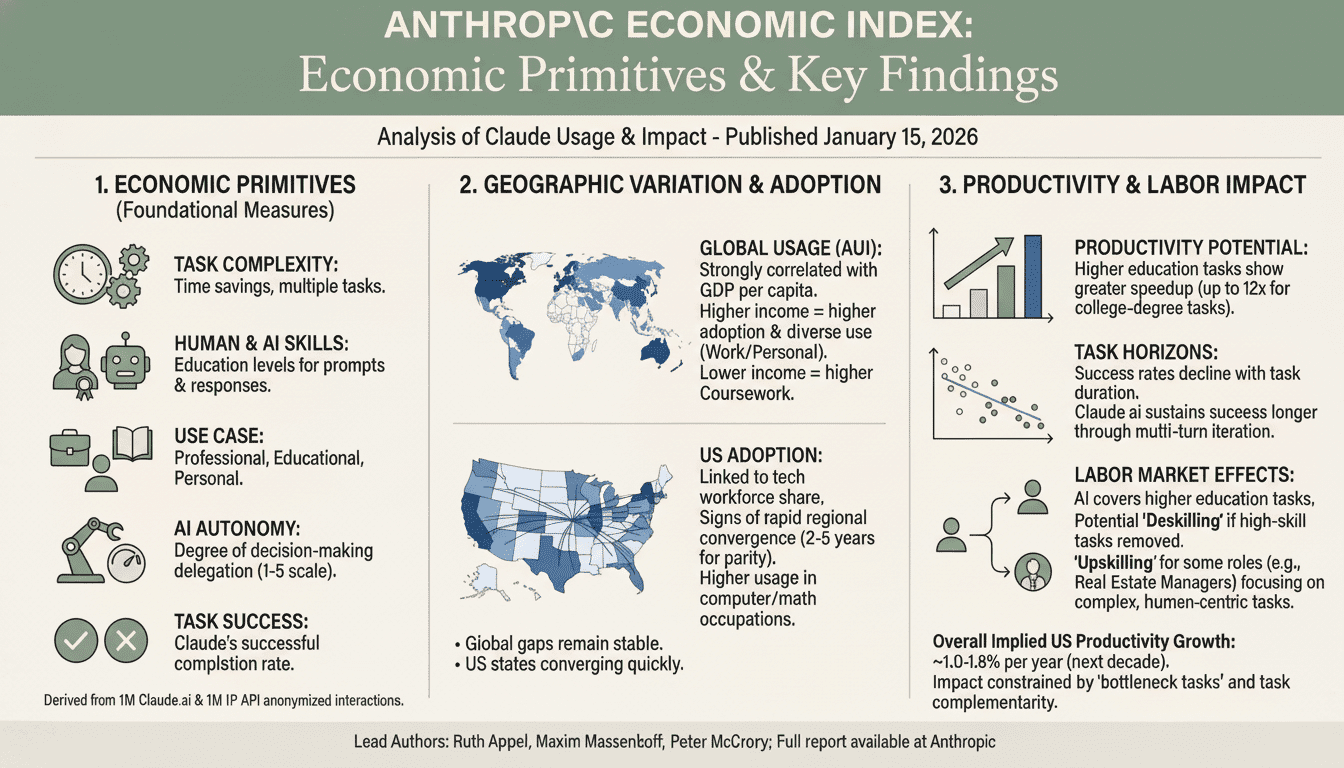
Jobs involving language, pattern recognition, and digital manipulation are most exposed.
Technical writing, customer support, data entry, and software development face significant AI impact.
These roles represent the front lines of workplace transformation.
AI systems are already automating central tasks rather than peripheral functions.
Theoretical AI capabilities are vast, but practice shows selective adoption.
Organizations are experimenting with specific functions rather than overhauling entire workflows.
This creates a transitional phase requiring careful observation.
Broader economic impacts may emerge as AI capabilities advance.
Power Users vs Casual Adopters
A clear distinction is emerging between power users and casual AI adopters.
“Anthropic’s latest research suggests that while AI is rapidly changing the way work gets done, it hasn’t meaningfully eliminated jobs”
Power users gain substantial competitive advantages through deeper integration.
They don't simply prompt; they design processes and chain prompts together.
Power users create reusable templates and connect models to data sources.
They automate repeatable work through sophisticated approaches.
This transforms routine tasks into near-real-time systems providing continuous value.
A marketing analyst might build automated daily performance briefs.
Casual users typically ask for isolated ideas or one-off queries.
The gap in usage intensity creates a compounding advantage over time.
Power users refine workflows while others fall further behind.
Adoption Disparities
The report reveals significant geographic and demographic disparities in AI adoption.
More intensive AI usage occurs in high-income countries.
Within the U.S., usage is concentrated in regions with knowledge workers.
This geographic clustering suggests AI may widen economic disparities.
Those with education and resources are better positioned to benefit.
Younger and entry-level workers face the greatest risk.
They must learn to collaborate productively with AI tools.
This aligns with Amodei's warnings about entry-level automation.
Entry-level white-collar roles could be automated within a few years.
The uneven distribution could exacerbate existing social and economic divides.
Policy Recommendations
The research underscores the need for sophisticated economic monitoring frameworks.
Proactive policy responses are needed to manage the AI transition effectively.
Tracking AI growth, adoption, and diffusion is crucial for timely policy responses.
This support can help workers through transition periods.
Key areas requiring attention include AI-integrated curricula development.
Retraining programs for vulnerable occupations are essential.
Policy tools like wage insurance should be considered.
Funding ongoing study of AI's economic impacts is necessary.
Without interventions, market forces could exacerbate inequality.
Proactive measures could distribute benefits more equitably.
Human-AI Collaboration Future
Despite concerns about automation, human skills remain crucial.
Workers who use AI to augment human abilities will be in high demand.
The future belongs to effective human-AI collaboration, not replacement.
Valuable skills include critical thinking for evaluating AI outputs.
Creative problem-solving is needed to define problems for AI.
Emotional intelligence helps manage teams and client relationships.
Ethical reasoning guides AI applications toward positive outcomes.
Combining technical AI proficiency with human skills is the new frontier.
The immediate crisis of mass job displacement hasn't materialized yet.
The growing AI skills gap demands attention from all stakeholders.
More on Technology and Science

Google Unveils TurboQuant Compressing KV Cache Sixfold, Sparking Memory-Chip Selloff
11 sources compared

US Demands Mexico End Cuban Medical Missions
14 sources compared

NASA Pauses Gateway to Focus on Building Permanent Moon Base
44 sources compared

OpenAI shuts down Sora, ends Disney partnership
31 sources compared