
CENTCOM Data Undercuts Hegseth's Escalation Claim About Iran Strikes
Key Takeaways
- CENTCOM data show strike tempo fluctuating, with peaks and dips over three weeks.
- Hegseth claims increasing frequency and intensity of strikes.
- CNN and Mezha.net report data contradict escalation claims, noting fluctuating strike tempo.
Hegseth's Escalation Claims
Secretary of Defense Pete Hegseth has repeatedly claimed that U.S. strikes on Iran are escalating in both frequency and intensity.
“While Defense Secretary Pete Hegseth has repeatedly stated that the number and intensity of the strikes the US is carrying out against Iran is only increasing, data provided by the US military shows a pace of operations that has ebbed and flowed over the last three weeks”
He asserted that 'larger and more powerful waves' of strikes are approaching and that the Pentagon 'is accelerating, not slowing down.'

These bold assertions were made in public briefings alongside General Dan Cain.
They directly conflict with publicly available CENTCOM data which reveal a more complex and variable operational tempo.
Hegseth specifically promised 'the greatest number of strikes against Iran' and claimed each subsequent day would bring 'the most intense day of strikes.'
This created an impression of continuous escalation that the data simply do not support.
The discrepancy between rhetoric and reality raises fundamental questions about the accuracy of official communications regarding military operations in the region.
Data vs Rhetoric
The CENTCOM data paints a starkly different picture from Hegseth's rhetoric.
The operation began with a dramatic peak on the first day when more than 1,000 targets were struck.
Since then the daily average has fluctuated significantly, ranging from roughly 250 to 333 strikes per day.
This data pattern directly contradicts Hegseth's repeated assertions about constant acceleration.
The actual strike numbers demonstrate that the operational tempo has been variable rather than steadily increasing.
There have been periods of higher activity followed by periods of lower intensity.
This fluctuation suggests a more nuanced military reality than the public pronouncements would indicate.
Expert Analysis
Military experts have provided explanations for why the strike tempo might fluctuate rather than accelerate steadily.
“While Defense Secretary Pete Hegseth has repeatedly stated that the number and intensity of the strikes the US is carrying out against Iran is only increasing, data provided by the US military shows a pace of operations that has ebbed and flowed over the last three weeks”
Mark Cancian, a former United States Marine Corps colonel and senior adviser at the Center for Strategic and International Studies, offers key insights.
He notes that 'the rate of attacks has practically moderated to a level below 1,000 a day'.
He explains that 'the tempo of attacks can both decrease and increase depending on intelligence and available targets.'
This expert perspective suggests the variable pace could be due to several factors.
These include the need to maintain aircraft and ships during operations.
They also include the initial use of a pre-existing target list that has since been depleted.
The ongoing process of identifying and confirming new targets may also contribute to the fluctuation.
The military may be deliberately pacing operations to ensure sustainable operations.
Specific Discrepancies
Specific examples from the timeline illustrate the clear disconnect between Hegseth's pronouncements and the actual strike data.
On March 10, Hegseth declared that day would be 'yet again our most intense day of strikes inside Iran, the most fighters, the most bombers, the most strikes.'
The actual data from that period showed a different reality.
Similarly, on March 13 he claimed it would be 'the highest volume of strikes that America has put over the skies of Iran and Tehran.'
The CENTCOM data from that period showed an average of roughly 250 strikes per day.
These high-profile claims occurred during periods when actual strike counts were significantly lower.
They were also below the 1,000-strike threshold that Hegseth repeatedly suggested as the new normal.
Broader Implications
The gap between official rhetoric and operational reality has broader implications for public understanding of the Iran campaign.
“While Defense Secretary Pete Hegseth has repeatedly stated that the number and intensity of the strikes the US is carrying out against Iran is only increasing, data provided by the US military shows a pace of operations that has ebbed and flowed over the last three weeks”
While Hegseth claimed a 'victory' for the United States and a mandate for significant strikes against Iran's defense infrastructure, the actual data indicate a more complex picture.
The tempo and scale of operations remain variable and depend on multiple factors.
These include maintenance schedules, intelligence gathering, and target availability.
This discrepancy suggests that military operations may not always follow straightforward escalation narratives presented to the public.
The failure of official spokespeople to provide comments on the discrepancies further complicates the picture.
This leaves observers to question whether the rhetoric reflects strategic reality or serves other purposes.
These purposes might include managing public perception or diplomatic positioning.
More on Iran
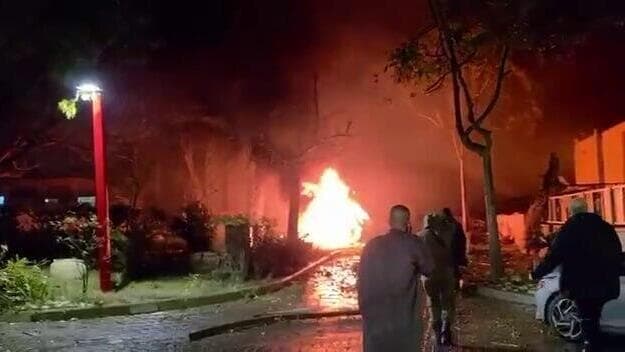
Iran Attacks Israeli Towns Dimona and Arad Near Israel's Main Nuclear Research Center, Dozens Wounded
43 sources compared
Iran Attacks Dimona in Retaliation for Natanz Strike
44 sources compared

Iran Attacks Diego Garcia with Long-Range Missiles, Targeting U.S.-UK Base
82 sources compared
Trump Defends Iran War by Citing Pearl Harbor
12 sources compared