Full story
Daniela Largo freed
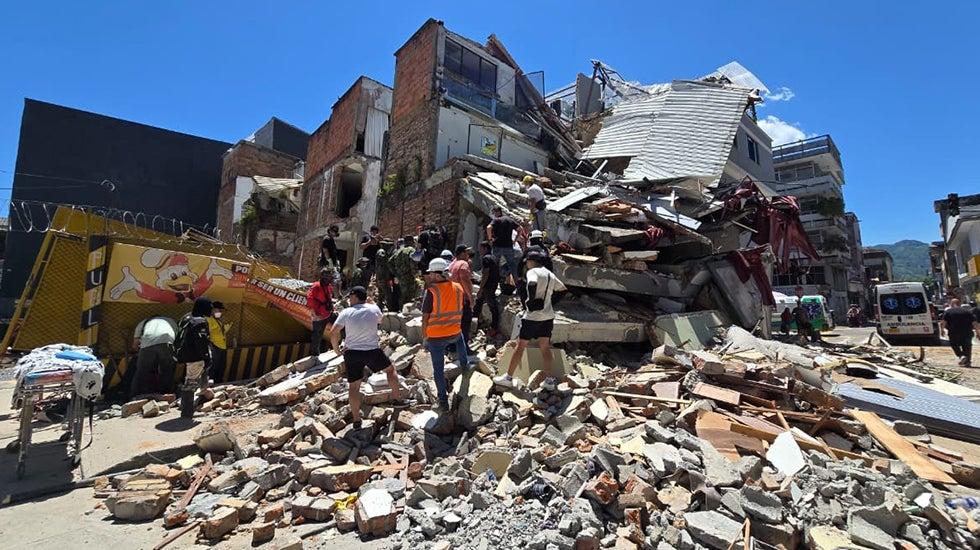
A 7.4-magnitude earthquake shook western Colombia on Monday, and a 32-year-old woman, Daniela Largo, was pulled alive from beneath a collapsed building in Pereira after being trapped under rubble for 36 hours.
“A 32-year-old woman, who had been trapped under rubble for 36 hours”
BBC reported that Largo was freed after a 10-hour-long rescue operation in which firefighters reached her via a tunnel they dug below four concrete slabs blocking the way.

Colombian President Abelardo de la Espriella said at least 265 people died in the quake and that 496 others remained missing, while in Pereira 79 people were confirmed dead and in Cali 95 were dead, according to figures by the Association of Colombian Capital Cities (Asocapitales).
The rescue was complicated by the four heavy concrete slabs, and firefighters aided by colleagues deployed from Bogotá and the disaster response team of the national police force dug two tunnels to reach her, providing oxygen through one opening before freeing her through the second tunnel.
Largo’s mother told AFP news agency that a local resident had heard her daughter cry out for help from beneath the rubble, and De la Espriella celebrated the rescue on social media describing it as "news which fills us with hope".
Rescue window and missing
As rescue teams continued to search for survivors in Cali, Pereira, Manizales and Quibdo, Reuters said the search entered a critical period, with Cali Mayor Alejandro Eder telling reporters, "The next 20 hours are the most critical to find and rescue people alive."
PBS reported that by Tuesday de la Espriella said at least 181 people died and 2,595 more were injured, while civilian-run databases put the number of missing at more than 4,100.

GMA Network, citing Reuters, said the 7.4-magnitude quake struck just after 7 a.m. local time on Monday and that official estimates suggested it also injured 3,770 people, destroyed more than 9,550 homes, and impacted more than 30,300 families.
In Pereira, PBS described Largo’s rescue as a complex 12-hour operation in which crews carved a small opening in the debris to free her pinned arm and a doctor administered IV fluids to stabilize her.
PBS also quoted Alejandro Eder saying, "Every minute is vital," as teams raced against the clock to find signs of people alive under rubble.
Aid, aftershocks, and stakes
The earthquake response strained Colombia’s new government as aid from regional partners began to roll in, while Colombia’s geological service documented 130 aftershocks since the quake.
“"This earthquake compounds an already severe humanitarian situation, and there is a need for increased support for the humanitarian response"”
NPR reported that by Tuesday de la Espriella said the 7.4 magnitude earthquake had killed at least 181 people and left 2,595 more injured, with at least 195 missing but civilian-run databases putting that number closer to 4,000.
NPR quoted Giovanni Rizzo, Colombia director for the Norwegian Refugee Council, saying, "This earthquake compounds an already severe humanitarian situation, and there is a need for increased support for the humanitarian response," as teams pushed through the rubble.
In Cali, the mayor declared a night-time curfew and said soldiers would be on patrol in the worst-hit areas, with the goal of ensuring rescue work could be carried out safely.
BBC reported that the 7.4-magnitude quake struck at 07:34 local time (12:34 GMT) on Monday, had its epicentre near the village of San José del Palmar in Chocó province, and was followed by more than 100 aftershocks.