Full story
Economic D-Day Threat
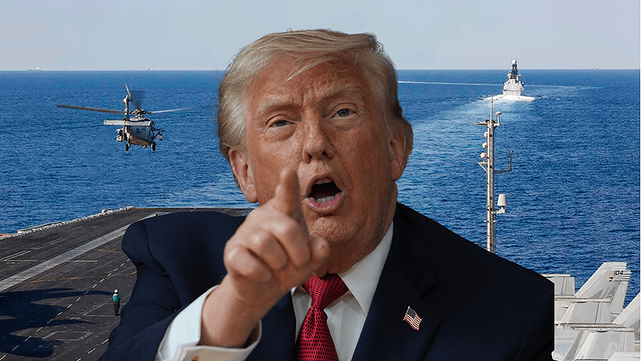
U.S. President Donald Trump announced severe new economic sanctions against Iran on Wednesday, calling the measures an "ECONOMIC D-DAY" and warning that any country that allows its financial institutions, businesses, airports, or government entities to provide a "lifeline to Iran" would face "TREMENDOUS Economic Consequences."
“called on allied nations to join in the sanctions effort”
Trump said the pressure would target "Oil smuggling, swap lines, cash transfers, exchange houses, ship registries, front companies — It all needs to stop NOW," while also describing Iran as being "against the cuerdas" in a separate Spanish-language report that quoted his Truth Social post.
Iran dismissed the threat of an "Economic D-Day" as it sought a deal to end the war, with Iranian Foreign Minister Seyed Abbas Araghchi saying, "The so-called 'Economic D-Day' is a diversion from America’s own crisis: unprecedented debt & surging interest costs."
Araghchi added that "US economic terrorism threatens global economy and sovereignty worldwide," as the U.S. did not provide immediate detail on the nature of expected sanctions.
The standoff unfolded as Trump suggested the economic pressure could increase, saying, "Right now, the strait is open. A lot of boats are coming through," even as the UAE announced it would stop trade and financial transactions with Iran after accusing Iran of launching ballistic missiles at the Gulf nation this week.
Iran Rejects, U.S. Presses
Iran’s response framed the sanctions push as extraterritorial coercion, with Iranian foreign ministry spokesman Esmaeil Baghaei saying the imminent U.S. announcement was an "assertion of extraterritorial sovereignty over every independent member state of the United Nations."
Baghaei added, "Such secondary sanctions find no foundation in international law," as the U.S. continued to warn partners about providing any "lifeline" to Iran.

U.S. Treasury Secretary Scott Bessent warned Iran it could face what he called the "greatest coordinated economic isolation in the history of the world," saying the United States was preparing additional economic measures aimed at cutting Iran off financially.
Bessent said, "This is going to be the greatest coordinated economic isolation in the history of the world," while the AAPNews report described the U.S. and Iran exchanging defiant messages before the scheduled announcement.
The AAPNews account also said the Strait of Hormuz remained bottled up with thousands of seafarers stranded on hundreds of vessels, while only four commodity ships sailed along the strait on Thursday, none of them large crude carriers or liquefied natural gas tankers.
Pressure, Talks, and Stakes
As the U.S. signaled long-term economic warfare, ABC News described how a 60-day memorandum of understanding between the U.S. and Iran to lay the groundwork for an end to the war had expired and there was no other agreement to replace it.
“there were "no talks or conversations going on" with Iran”
The analysis said Trump wrote in a social media post that there were "no talks or conversations going on" with Iran, while Fox News reported Trump told the network he is "not in a hurry" to bring about a solution.
ABC News also quoted Treasury Secretary Scott Bessent saying, "We are going to apply measures like have never been seen in the history of economic isolation on a country," describing a "one-two punch" alongside the U.S. blockade.
The same analysis reported that data from Kpler showed 28 vessels transited the Strait in a three-day period between Friday and Sunday, and that an average of about 13 ships crossed the Strait each day last week, down from more than 100 ships per day before the recent conflict.
In parallel, Mohammad Ghalibaf, the speaker of Iran's parliament and its lead negotiator with the U.S., wrote on X that Bessent was "way out of [his] league" and that the U.S. was "trying to pull a rabbit out of their hat," as the stakes were framed around whether economic pressure could shift Tehran’s position at a future negotiating table.