Iran01 May, 20267 min read
Donald Trump Threatens Iran Infrastructure as Hamadan Neighborhood Attacked and MQ-9 Destroyed
This article is an automated aggregation of coverage from news outlets. Our editorials offer in-depth analysis curated by the NewsCord team.
The US-Israel war against Iran persists, prompting calls for a permanent regional ceasefire. Tanker movements near Hormuz reflect escalatory naval pressure and blockade concerns.

War on Day 38
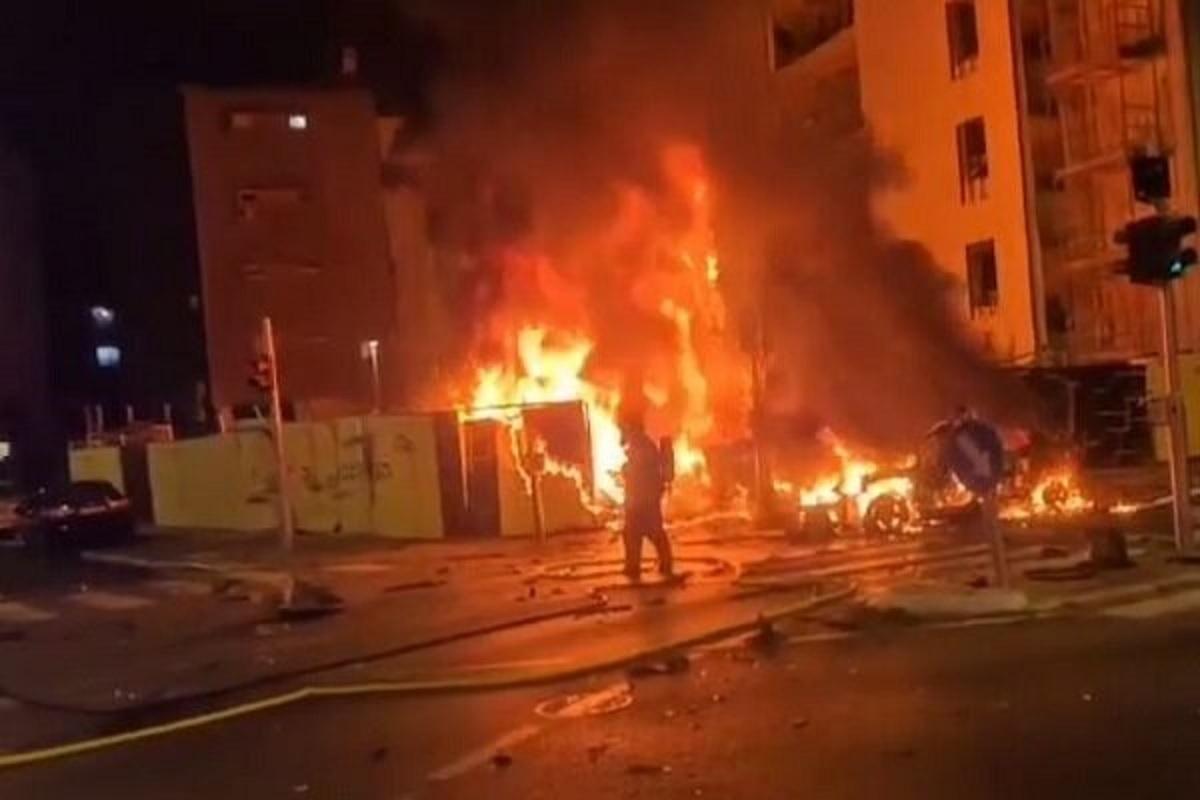
The US–Israel war against Iran entered its thirty-eighth day as Donald Trump renewed threats to attack Iran's infrastructure and claimed that the confrontation should end within a few days, not weeks, according to Entekhab. Entekhab also said The Wall Street Journal reported that Iran rejected a proposal to open the Strait of Hormuz in exchange for a temporary ceasefire. In Entekhab’s timeline for the “latest war updates on the thirty-eighth day (17 Farvardin 1405),” the political-security deputy governor of Hamadan said a residential neighborhood in Hamadan was attacked by “hostile enemy forces,” with Hamza Amrā’ī saying “two people sustained minor injuries.”
Entekhab further reported that Sardar Seyed Majid Mousavi, commander of the IRGC Aerospace Force, wrote that by abandoning the northern occupied cities “the regime had effectively accepted a breakdown of the balance of power,” and that in the last 24 hours “the refinery, electrical facilities, ports and rails of Haifa Bay were struck by Iranian missiles.” Entekhab added that there were “no reports of intercepting the missiles,” and it also included Trump’s statement that NATO's stance is a stain that will never be erased “as long as I live.”
The same Entekhab update said Iran’s foreign minister had telephone conversations since Friday evening with counterparts in Turkey, Austria, Pakistan, Egypt, Russia, India, France, Japan, and Qatar. It also said Mizan News Agency reported hearing “the sounds of several explosions in Tehran,” and that the IRGC Public Relations announced that a MQ-9 drone was destroyed over Qeshm Island in a joint operation by the Navy's New Air Defense System and the IRGC Ground Forces.
Diplomacy, threats, and talks
Alongside the battlefield updates, Entekhab framed the war’s diplomatic track as a mix of proposals and rejected terms, while other outlets emphasized legal and political objections. Entekhab said The Wall Street Journal reported that Iran rejected a proposal to open the Strait of Hormuz “in exchange for a temporary ceasefire,” and it also described Trump renewing threats to attack Iran's infrastructure. In a separate report, خبرگزاری آنا quoted Spain’s Prime Minister Pedro Sánchez telling reporters that the “U.S. war against Iran is illegal” and that “It does not seem that there is enough trust between Washington and Tehran to enable reaching an agreement in the near future.”
خبرگزاری آنا also reported Sánchez warning that “These clashes undermine the international order and weaken the foundations of cooperation between countries,” and it added that “the cost of importing fossil fuels has risen by nearly 24 billion euros.” Another Iranian state-linked report, خبرگزاری دفاع مقدس, quoted an ambassador of the Islamic Republic of Iran to the Russian Federation, Jalali, saying “The United States does not demonstrate sufficient seriousness for nuclear negotiations.”
In that same report, Jalali said that “in the period of a ceasefire, Iran has repeatedly stated that it adheres to real diplomacy in order to reach a lasting and long-term solution,” while “on the other side we do not see the seriousness and the will to reach an agreement.” خبرگزاری دفاع مقدس also placed Jalali’s remarks at a ceremony commemorating Army Day of the Islamic Republic of Iran held on Thursday evening, and it specified that “Designating 29 Farvardin (April 18) as Army Day” was one of the enduring actions of the founder of the Islamic Republic.
Women, hijab, and enforcement
As the war with the United States and Israel against Iran continued, قناة ومنصة المشهد described how Iran’s mandatory hijab rules remained a central issue for women, even as some residents in Tehran appeared to tolerate more visible unveiling. The report said that “Recently in Tehran, scenes of women strolling in the streets or sitting in cafes without a veil have spread,” but it quoted Elnaaz, a 32-year-old painter living in Tehran, warning that “this is by no means an indicator of a change on the part of the government,” and adding “no progress has been made on women's rights.” قناة ومنصة المشهد said the mandatory hijab law, adopted after the revolution in 1979, “remains in force despite the flexibility observed after protests 2022-2023 under the slogan 'Woman Life Freedom.'”
It linked the current atmosphere to Mahsa Amini’s death on 16 September 2022 during her detention by the morality police for not complying with strict dress standards, and it said protests later continued “during the June 2025 war with Israel” and “during the latest protests that began in late December in Tehran.” The report also described how authorities can still summon unveiled women and require hijab in banks, schools, and government buildings, even as morality police patrols were described as “nearly absent from the streets.”
Zahra, a 57-year-old housewife in Isfahan, said “This was just a dream three years ago,” and added “I no longer wear the hijab, but I would have liked to have lived through that when I was young.” Nagin, who runs a cafe in Tehran, said cafe owners “have paid a heavy price,” explaining “We faced extremely harsh treatment over these years, and the situation remains the same today,” and adding “Our cafes have been closed repeatedly and fined, and we had to pay bribes.”
Energy blockade debate
فرارو reported an economic analyst’s argument that a naval blockade against Iran is “neither operational nor sustainable,” while also warning that such threats would still trigger immediate market effects. The report said Hossein Razavi Pour, an economic analyst, spoke about the “recent move by the U.S. president to impose a naval blockade on Iran aimed at applying political and economic pressure on Tehran.” Razavi Pour argued that “first we must see whether such a blockade is technically feasible,” and he said that when Iran blocks movement through the Strait of Hormuz, “the Strait of Hormuz is a narrow waterway whose passage can be observed even with the naked eye.”
فرارو added that Razavi Pour said ship movements could be controlled and that “these routes can be deterred with the simplest tools, including cheap but capable drones, which can threaten ships that pass through.” He also said that farther from the Strait of Hormuz, where seizing ships would occur, “the enforcing military force must be within range of the ships,” and he argued that “It is unlikely that the United States would want to engage China directly.”
On markets, فرارو said “immediately after Trump announced the decision, global energy prices began to rise,” and it gave a specific example: “gas futures in Europe rose by 18 percent in a single day.” It concluded that the blockade would “add to the energy shock,” and it said Europe and Southeast Asian countries “such as Japan, Hong Kong, China, and South Korea, as well as the United States itself, will be affected by stagflation resulting from higher energy prices.”
Cafés, repression, and international reaction
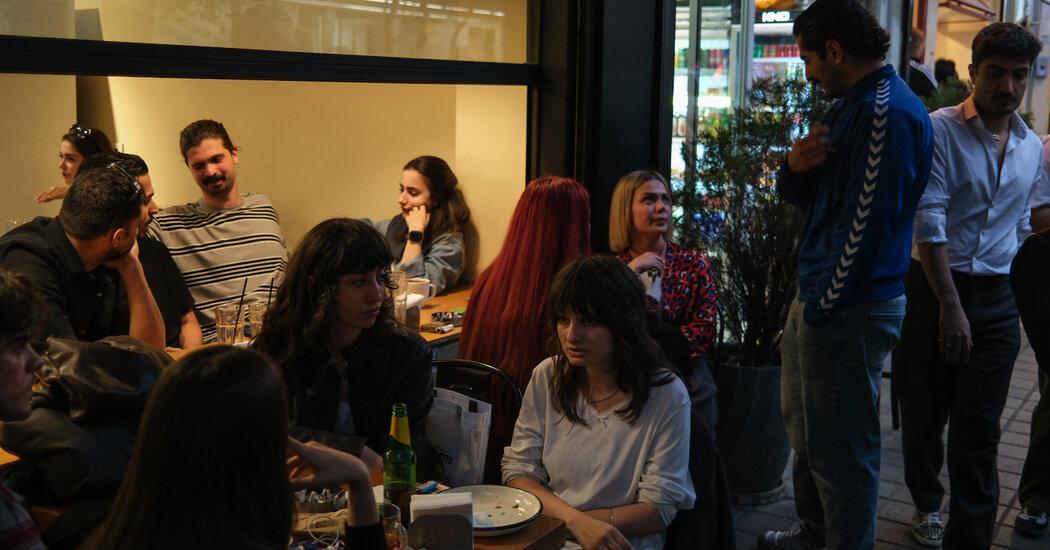
The war’s pressures also surfaced in reporting about daily life and international human-rights concerns, with multiple outlets describing how civilians and public spaces are affected. New York Times reported that “Three weeks into a fragile cease-fire with the United States, Iranians are seeking to reclaim fragments of normal life,” and it said “cafes have emerged as the focal point of social gatherings in Tehran and many other Iranian cities.” The Times described men and women “pack the coffee shops that dot the sprawling capital,” and it quoted the idea that “a cup of coffee is still affordable and cafes provide escape,” while also noting “These are tough economic times and many people have been laid off.”
“Iran closes a famous cafe chain in Tehran over 'suspicious cups'.”
In a different angle on public life, سكاي نيوز عربية reported that Iranian authorities ordered the closure of Lemiz coffee shop chain branches in Tehran over “suspicious cups,” saying the designs were deemed to reference the assassination of Supreme Leader Ali Khamenei. That report said Tasnim and Mehr news agencies reported the closure of Lemiz branches in Tehran “by order of the judiciary,” and it included the cafe’s denial: “The cups have nothing to do with the recent events at all; their production took several months from final design approval to printing, and they were fully delivered to the warehouses before these events began.”

Internationally, DW reported Amnesty International warning that “temporary ceasefires between the United States and Iran, and between Israel and Lebanon, are not enough to protect civilians,” and it called for “a 'permanent and comprehensive regional ceasefire'.” DW also reported Amnesty’s figures that “by 7 April in Iran at least 3,375 people have been killed and about 25,000 injured,” and it said “hundreds of whom are children.”