Europeupdated 1h ago2 min read
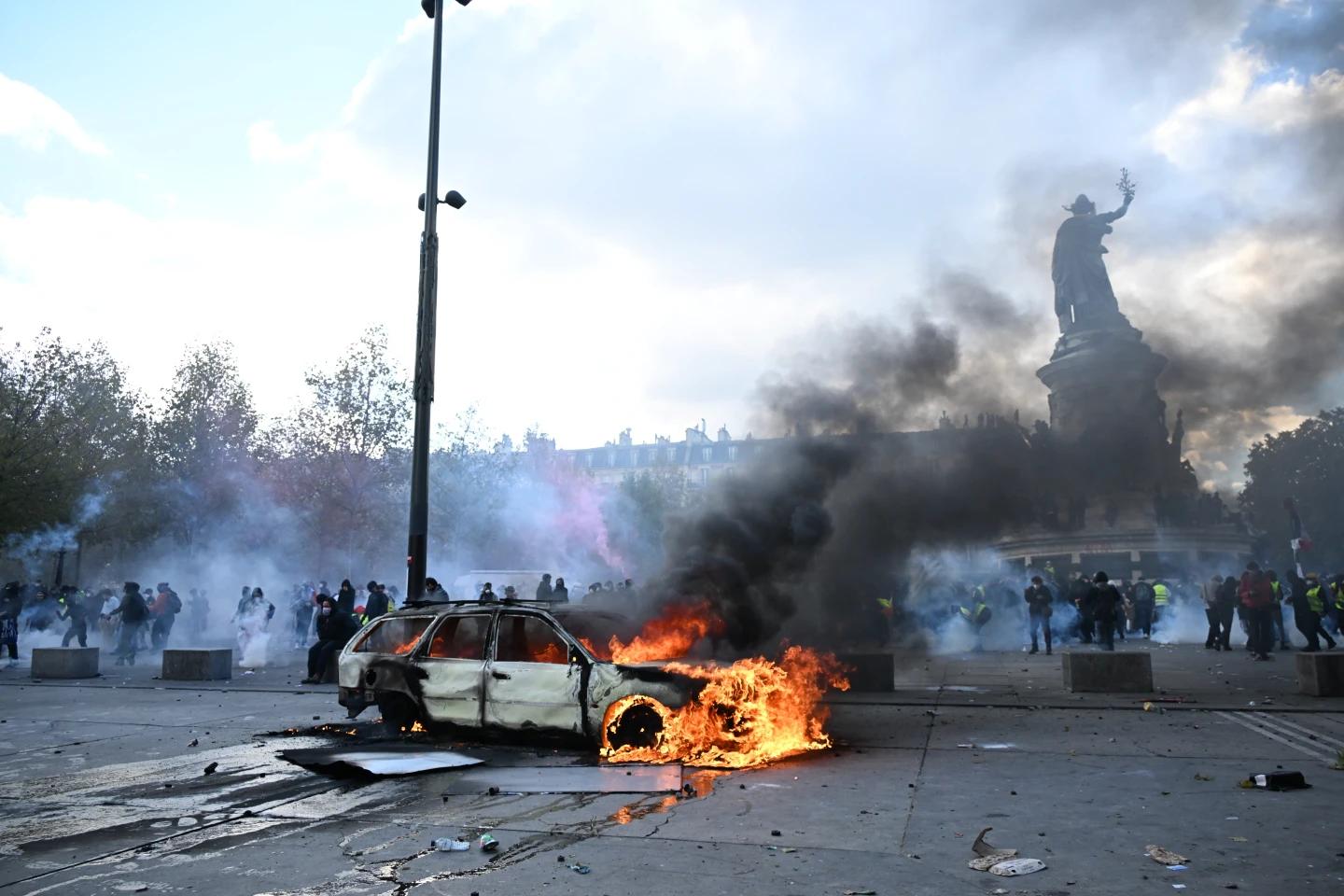
France Cost Of Living Protests Turn Violent As Police Fire Tear Gas And Detain 400
This article is an automated aggregation of coverage from news outlets. Our editorials offer in-depth analysis curated by the NewsCord team.
Hundreds of thousands joined nationwide protests against the cost of living. Police fired tear gas and made hundreds of arrests across the country.

19 outlets told this the same way.
Outlets did split on Russian Drones Enter NATO Airspace, NATO Jets Scramble Across Romania, Poland, Germany, Belgium, France →
France turns violent
Hundreds of thousands of people took to the streets across France on Saturday to denounce the rise in the cost of living, and the unrest degenerated into clashes, looting, and fires in multiple cities. Prime Minister Sébastien Lecornu said about 400 people had been detained following the violence, and he said nearly 550,000 people participated in the demonstrations across the country. French President Emmanuel Macron condemned attacks on institutions and urged punishment for perpetrators, while police used tear gas in several districts of Paris.
In Limoges, protesters set the town hall on fire, and in Lyon, protesters torched the city’s tourist office. In Brussels, police fired tear gas and water cannon to disperse protesters, whom they accused of launching missiles at them and setting fires.

Numbers and arrests
The French Interior Minister Laurent Nunez said 1,200 people were arrested and 150 police officers were hurt, and he said, "It’s a miracle the toll wasn’t higher." The General Confederation of Labor (CGT) put the mobilization at around 800,000 people, while the Interior Ministry reported nearly 550,000 people participated. The protests also triggered clashes in Italy, where Italian police reported that protesters threw stones and clashed with officers, and Italian media reported several injuries and arrests.
In Portugal, tens of thousands of protesters marched in Lisbon against the cost of living crisis, low wages, and an inability to access housing in major cities. In Albania, police fired what appeared to be rubber bullets at protesters during a mass student protest day demanding the resignation of Prime Minister Edi Rama.
What Europe faces next
Alberto Alemanno said France was the epicentre of the movement and that there were signs it was spreading beyond France, adding that Saturday’s protests may not be the last in many of these countries. Alemanno said the unrest was not a single movement but several protests happening at the same time with shared grievances including underfunded education and rising living costs. In Portugal, the General Confederation of Portuguese Workers (CGTP) organized demonstrations in Lisbon, Porto, and Coimbra demanding a general wage increase of 15% and a minimum increase of 150 euros.
In Italy, the Italian General Confederation of Labour (CGIL) announced a general strike for November 20, as marches in Milan, Turin, Bologna, and Rome converged in opposing Prime Minister Giorgia Meloni. In Brussels, thousands of young people marched toward the European Union headquarters with slogans tied to a larger education budget and policies for labor inclusion, and police clashes lasted for hours causing traffic blockages at the entrances to the Belgian capital.