Full story
Rafah housing plan
A Gaza-based company is set to build a real estate complex financed by the United Arab Emirates in Rafah, in the portion of the enclave under Israeli military control, Reuters reported on Wednesday citing two Israeli officials and two Palestinian businessmen.
“The housing crisis in Gaza City has worsened, pushing dozens of families to reside on the upper floors of damaged and collapsing buildings, amid a lack of housing alternatives and a shortage of tents and basic aid, despite the daily risks from ongoing bombardment and the serious damage to their homes”
The plan Reuters reviewed says the complex would be built near Rafah at Gaza’s southern border in a depopulated and devastated area destroyed during the war against Hamas, and it would cover nearly 30 hectares with housing for tens of thousands of displaced Gazans.

Prime Minister Benjamin Netanyahu has repeatedly stated that Israel would not allow reconstruction to begin until the enclave’s terrorist groups had laid down their arms, in line with the second phase of the ceasefire plan put forward by former U.S. President Donald Trump.
The Reuters report also said the four sources identified the company as Masoud & Ali Contracting Co. (MACC), based in Gaza, and that MACC declined to comment while the IDF and Hamas spokespeople had not responded to requests for comment.
An official from the United Arab Emirates declined to comment directly on the initiative but said his country was 'firmly committed to supporting all international humanitarian aid and reconstruction efforts in Gaza, in close cooperation with its partners, to ensure that vital aid reaches those in need quickly and effectively.'
UN access and rubble
UN officials marked Nakba Day by denouncing the situation in Gaza as a tragedy that endures, calling for a permanent ceasefire and total humanitarian access, UNRIC said in its French-language UN news brief.
The same UNRIC brief said humanitarian aid shipments unloaded at crossings controlled by Israel fell in early May, and that the Kerem Shalom and Zikim crossings remain the only operational access points for humanitarian and commercial goods to Gaza.
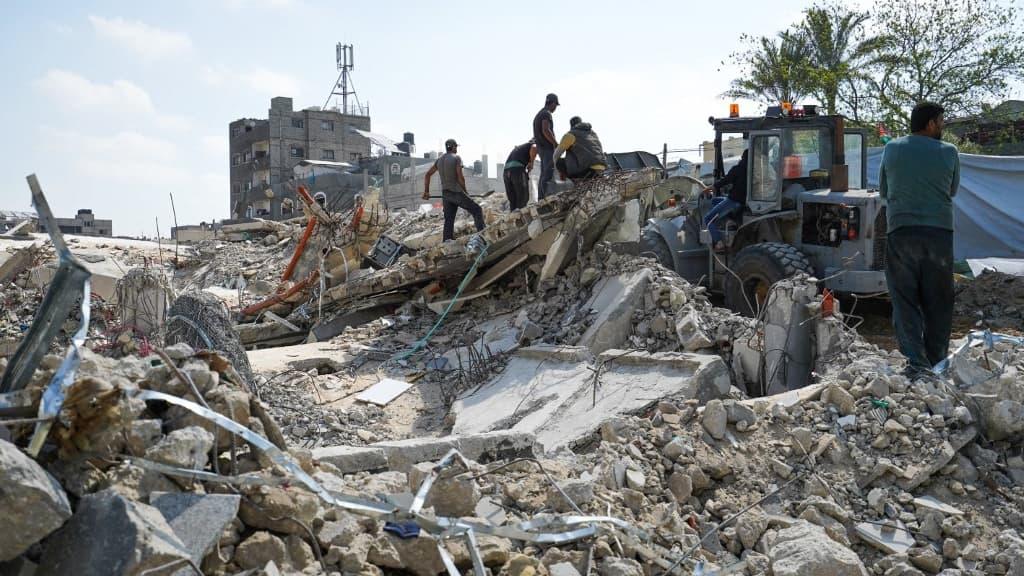
It added that the United Nations Environment Programme is studying reconstruction scenarios for Gaza using rubble accumulated in the territory, where it said there are about 57 million tons of rubble and most buildings have been destroyed.
In a separate report, BFM said the UN estimates the territory is buried under nearly 57 million tons of debris and cited Nikolai Mladenov speaking from Jerusalem about the situation of the million people in need of some form of permanent shelter and basic access to water and sanitation.
BFM also described a local initiative named Green Rock, where Wired reported the workshop currently produces between 1,000 and 1,500 bricks per day, aiming to turn debris into interlocking bricks Lego-style.
Families living on collapse
As housing alternatives remain scarce, Al-Jazeera Net reported that Gaza City families are risking their lives by residing on upper floors of damaged and collapsing buildings, citing a lack of tents and basic aid amid ongoing bombardment.
“Gaza: 'Our flotillas carry humanitarian aid, but also a political battle' 23 French sailors on their way to open the humanitarian corridor to Gaza call for a united front against Israel's genocidal colonialism”
Fadel Rahim told Al Jazeera Mubasher that he was forced to stay with his family inside their damaged home despite fearing its collapse after he did not receive a tent or tarp shelter, bedding, or coverings.
Majed Al-Khuli said his four-story building was completely destroyed and that after removing large amounts of rubble he set up a space not exceeding 60 to 70 square meters, but he confirmed that bricks and rubble continue to fall inside the place repeatedly.
Al-Khuli added that rodents and reptiles spread inside the building, that the municipality did not provide materials to combat them, and that family members have to travel long distances to fetch water because water networks in the area are out of service.
He called for providing temporary housing units or caravans until the rubble is removed and homes are rebuilt, and for solar panels and batteries to provide at least a minimum level of lighting.