
Full story
Glacier collapse triggers floods
A flash flood and mudslides struck the Nepal-Tibet border region on Wednesday, with the disaster tied to a glacier collapse high in the Himalayas that set off a chain of events downstream.
“At about 8:40am local time (02:55 GMT) on Wednesday”
Al Jazeera reported that at about 8:40am local time on Wednesday, flash floods and mudslides swept through mountainous areas along the Nepal-Tibet border, killing at least 360 people in Nepal and three in Tibet and leaving nearly 1,500 people missing across the region.
The U.S. Geological Survey said the seismic signal was generated by the landslide itself rather than an earthquake, and that the landslide eventually registered as a magnitude 5.2 seismic event.
ABC News also reported that the flooding occurred at around 8:40 a.m. local time Wednesday and that a landslide about 12 miles northeast of the Rasuwagadhi border post along the Nepal-China frontier was reportedly responsible for triggering the flood.
In Kathmandu, experts at the Integrated Mountain Development International Centre (ICIMOD) said the collapse of ice in mountainous areas led to a glacial outburst flood that caused the flooding.
Numbers shift as search continues
As recovery efforts continued, Nepalese and Chinese officials gave different tallies, with ABC News saying authorities reported at least 543 bodies recovered across the region and over 2,000 people missing as of Friday.
ABC News also said Nepal’s National Disaster Risk Reduction and Management Authority confirmed 1,924 people remained missing in Nepal as of Friday, while five were reported dead in China and Xinhua reported three confirmed killed and 558 remained missing in Tibet’s Gyirong County.

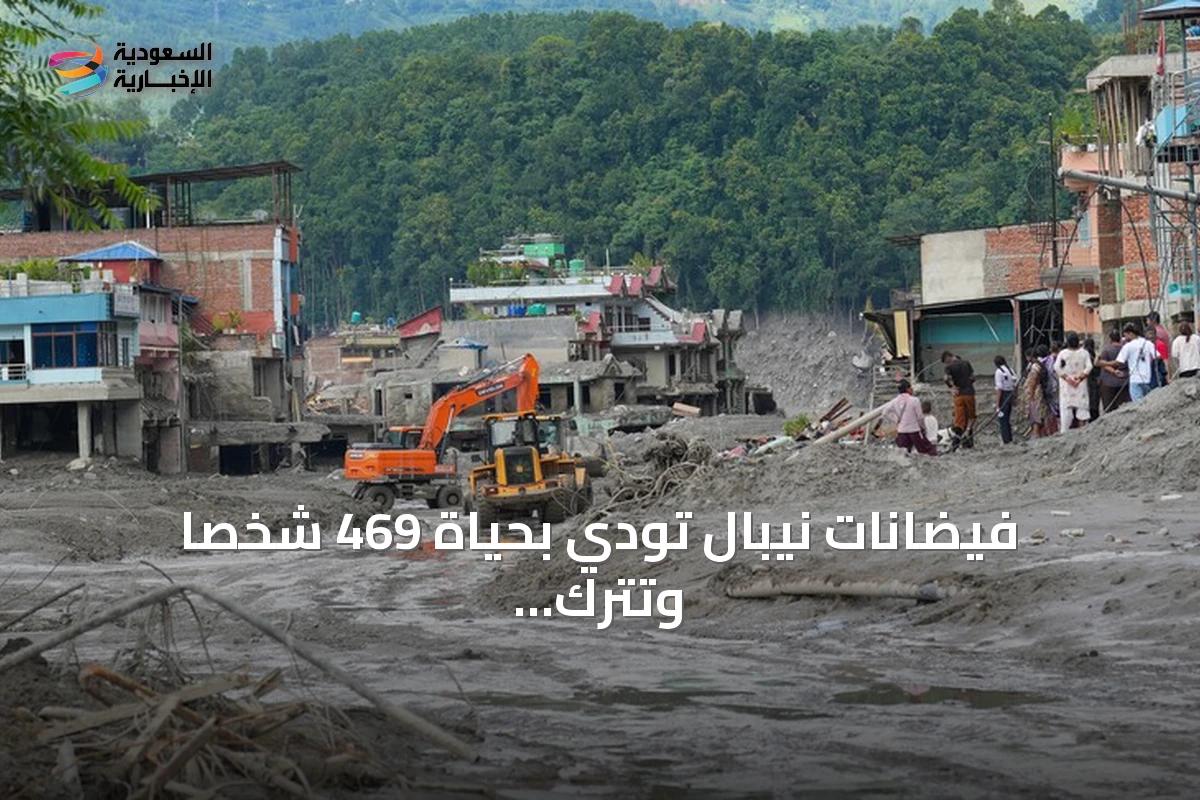
On the Nepal side, the Global Times, citing Nepal Police and Xinhua, said search and rescue teams recovered 469 dead bodies as of Friday morning following Wednesday’s flash flood.
The Global Times also reported that as many as 1,545 people had been rescued so far and that, as of 10 p.m. local time on Thursday, the total number of people out of contact stood at 977.
In the midst of the shifting figures, the U.S. Geological Survey had earlier detected an earthquake before revising its data to indicate the seismic event of magnitude 5.2 was actually caused by an ice collapse.
New lake threat and risks
Two days after the Wednesday flood, Al Jazeera reported that a newly formed river breach on Friday halted rescue operations in Nepal’s Rasuwa district after flash floods and mudslides caused by glacial collapse led to 469 confirmed deaths.
“a lake has formed by the buildup of debris at the border of Nepal and China”
Al Jazeera said a lake had formed by the buildup of debris at the border of Nepal and China at the flood site, and as it continued to rise it increased the flood risk.
Rasuwa’s senior official Narendra Pariyar told Al Jazeera, "We can see that the level of water in the river is rising," while adding, "We do not know how big it is and how high is its water level."
The article also described how scientists said the disaster created not one but two new lakes, including a larger, more dangerous lake on a river in Nepal where a huge landslide blocked the valley and dammed the river.
Al Jazeera warned that the danger was not just the lake itself but the possibility of sudden dam failure, noting that in a steep valley even a short-lived breach could generate a fast-moving debris-laden flood with very little warning for downstream communities.