Lebanon30 April, 20266 min read
Hezbollah Fibre-Optic Drones Threaten Israeli Helicopter and Kill Idan Fooks in Taybeh
This article is an automated aggregation of coverage from news outlets. Our editorials offer in-depth analysis curated by the NewsCord team.
Hezbollah deployed fibre-optic guided drones over Taybeh to challenge Israeli defences. Drones bypass electronic countermeasures, reducing effectiveness of Israel's air defences.
Al Jazeera was read line by line by the Watchdog: 3.7. See the score →
Taybeh drone attacks
Hezbollah deployed fibre-optic guided first-person view drones in southern Lebanon, and the incident that Israeli reporting tied to the new threat unfolded over the Lebanese town of Taybeh. The Israeli daily Yedioth Ahronoth (Ynet) described an episode in which an Israeli medical evacuation helicopter carrying wounded soldiers came under threat from a drone during a rescue operation, and ground troops reportedly opened fire at the approaching UAV before it detonated close to the aircraft. In the same Taybeh sequence, an explosive-laden fibre optic drone struck an Israeli armoured unit, killing Idan Fooks and wounding six other soldiers, according to the account that multiple outlets traced to Ynet.
Al Jazeera reported that when the helicopter arrived, Hezbollah launched two more drones, and “one of which exploded just metres from the aircraft,” with soldiers forced to point their rifles at the sky before the drone detonated. The Economic Times similarly described that Hezbollah’s fibre-optic drones are cable-guided attack drones used against Israeli troops, with the operator steering the drone to a target using a thin fibre-optic cable.
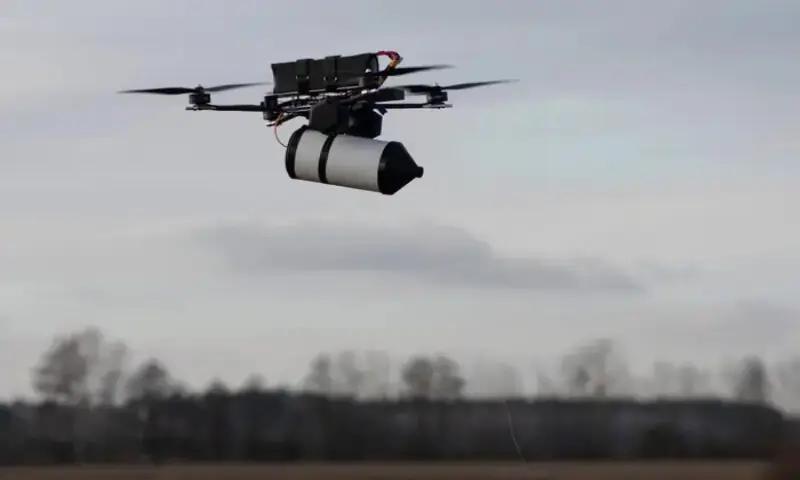
Across the accounts, the drones were described as resistant to electronic jamming because they do not rely on radio or GPS links, and the cable can extend between 10 and 30 kilometres. The Space Daily account also tied the tactical implications “to the Lebanese town of Taybeh,” describing the same kind of layered response when additional drones were sent in after the first strike.
How the wire works
Multiple reports framed Hezbollah’s fibre-optic drones as a shift in drone warfare because the control link is physical rather than wireless. The Economic Times described fibre-optic drones as “small unmanned aircraft connected to an operator using a thin fibre-optic cable that sends control signals and video in real time,” adding that the operator steers the drone directly to a target without radio or GPS links. Aaj English TV similarly said the drones are “first-person view (FPV) systems operated via fibre-optic cables rather than radio signals,” and it described a cable that “extends for tens of kilometres,” allowing operators to guide drones directly to targets.
Al Jazeera’s account of the Taybeh episode emphasized that the drones are tethered to the operator’s control station by a fibre optic thread, and it stated that “the cable can extend between 10–30km [6.2 to 18.6 miles].” Space Daily explained the underlying air-defence problem in terms of architecture, writing that “The drone trails a hair-thin glass fibre back to its operator,” carrying control signals one way and “uncompressed high-resolution video the other.”

The same Space Daily piece described the airframe as fibreglass, stating that “Fibreglass returns almost no radar energy and produces a thermal signature too faint for most infrared trackers to lock on to.” Al Jazeera Net’s Arabic-language report likewise described the tether as “via a fiber-optic tether extending 10 to 30 kilometers,” and it linked that tether to immunity from jamming because “there is no radio signal to intercept.”
Trophy and countermeasures
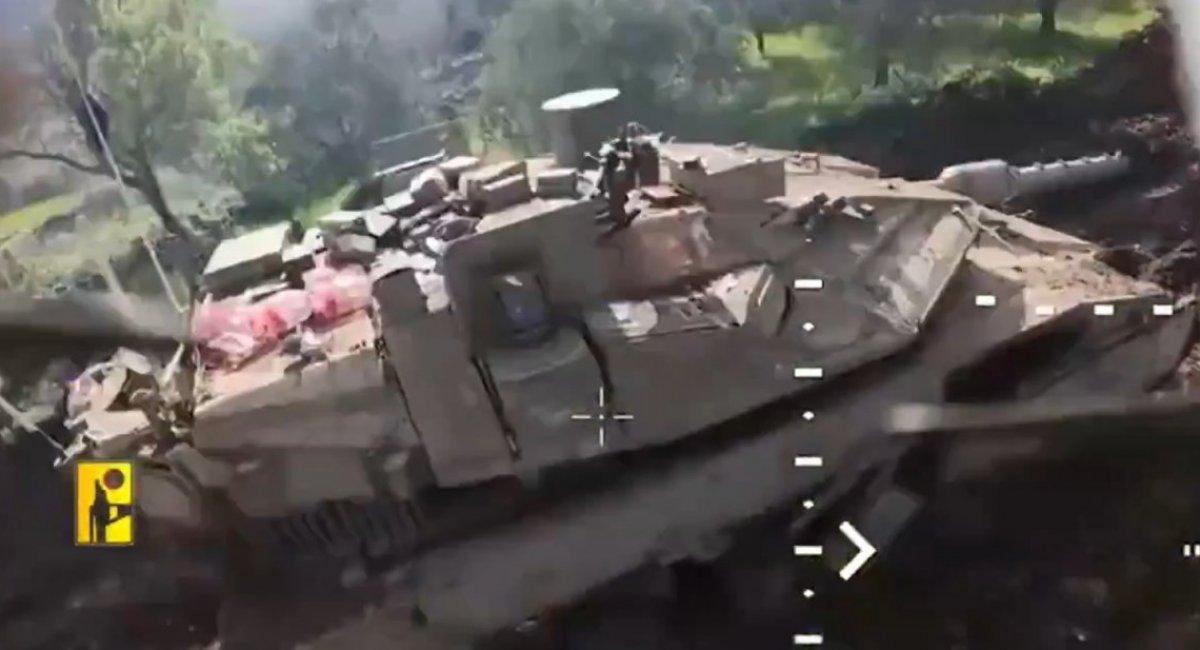
The Taybeh attacks also became a focal point for how Israeli systems such as the “Trophy” active protection system performed against the fibre-optic threat. The Economic Times stated that “These drones have bypassed the Trophy protection system on Merkava tanks,” and it described operators using high-resolution cameras connected through the cable to guide drones into weak points such as tank turrets and tracks. Al Jazeera reported that the drones “have even managed to bypass the “Trophy” active protection system installed on Israeli Merkava tanks,” and it tied the bypass to manual steering using high-resolution optical cameras transmitting uncompressed video through the cable.
Space Daily added that the Merkava tanks struck in these engagements carry the Trophy active protection system, but it argued that “A slow-flying fibreglass drone steered manually into a turret seam or track assembly is not the threat profile Trophy was optimised against.” In contrast, Defense Express and Defensemirror framed the Trophy question through video evidence and claims about advertised capability.
Defense Express wrote that “Rafael company back in 2024 announced Trophy APS capability to intercept strike unmanned systems,” and it claimed that “as we can see, in real combat Trophy appeared absolutely helpless against FPV drones.” At the same time, Israeli field responses described across outlets leaned on improvised physical countermeasures, including netting and visual engagement.
Competing narratives on preparedness
Outlets diverged in how they portrayed Israeli preparedness and the significance of the fibre-optic drone tactic. The Economic Times described the technology as a “change in drone warfare and military defence planning” and said it “mirrors battlefield tactics from Ukraine,” while it quoted military expert Robert Tollast describing the drones as “deadly when operated properly.” It also included a claim about Israeli responses, saying “Some say Israel entered the conflict without enough tools to counter fibre-optic drones.”
Al Jazeera’s report, by contrast, emphasized the immediate tactical frustration on the ground, quoting an Israeli commander currently in Lebanon telling Doron Kadosh: “There isn’t much to do about it,” and adding that “The briefing the forces get amounts to: ‘Be alert, and if you spot a drone, shoot at it’.” Al Jazeera Net’s Arabic-language piece similarly stressed a gap between promotional claims and battlefield reality, describing “the contradiction between the propaganda of military superiority on the ground and the reality on the battlefield.”
Space Daily framed the issue as a “structural blind spot” in “one of the most heavily instrumented air defence networks on Earth,” and it argued that “Counter-drone systems optimised for radio-frequency detection do not adapt easily to threats that emit nothing.” Defense Express and Defensemirror focused on the specific question of Trophy’s performance, with Defense Express writing that “two variants exist” and suggesting either the system was disabled or it was not capable of intercepting such targets.
Escalation and wider stakes
The fibre-optic drone tactic was presented across the reports as part of a broader escalation affecting both battlefield operations and civilian routines near the border. TRT عربي described an Israeli “security zone” up to 10 kilometres deep into Lebanese territory, extending “from the Mediterranean coast west to the Mount Hermon area in the east,” and it linked the drone threat to ground operations in southern Lebanon. In the same TRT عربي account, it said Yedioth Ahronoth reported “the death of a tank crew member with the rank of sergeant, Idan Fox” near the village of Al-Tayiba, along with injuries to six other soldiers, including an officer and three in serious condition.
TRT عربي also reported that “heads of Israeli settlement councils near the border with Lebanon decided to suspend schooling and bus movement starting Tuesday,” tying the decision to Hezbollah’s rockets and drones and to “Tel Aviv's ceasefire violations,” as described by the Israeli Public Broadcasting Authority. Meanwhile, the Economic Times and Al Jazeera Net framed the stakes in terms of the cost and accessibility of the weapon, with the Economic Times saying the drones cost about 300 to 400 dollars each and describing them as a “growing challenge for modern military defence systems.”
United24 Media and Le Parisien described Israel adopting Ukraine-style anti-FPV drone nets on vehicles, with United24 Media citing Defense Express on April 29 and describing an Israeli HMMWV fitted with a lightweight frame covered by mesh netting. Defense Express and Defensemirror also raised the question of whether active protection systems can be adapted or whether the battlefield will keep shifting toward low-cost countermeasures, with Defense Express noting that “its real-world effectiveness against FPV systems in current operations remains unclear.”