Full story
Economic D-Day Threats
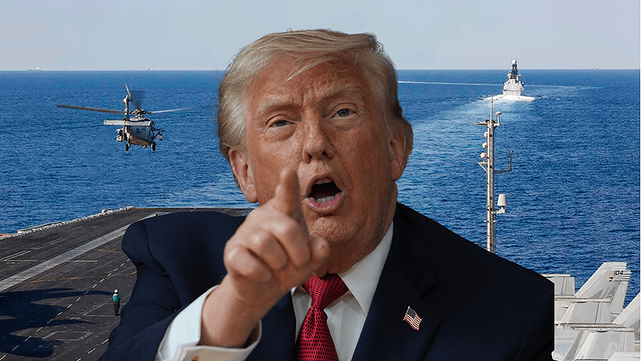
President Donald Trump announced severe new economic sanctions against Iran on Wednesday, calling the measures an "ECONOMIC D-DAY" and warning that any country allowing its financial institutions, businesses, airports, or government entities to provide a "lifeline to Iran" would face "TREMENDOUS Economic Consequences."
“ECONOMIC D-DAY”
In a separate post, Trump said "Oil smuggling, swap lines, cash transfers, exchange houses, ship registries, front companies — It all needs to stop NOW," while also describing Iran as being "against the cuerdas" and insisting "IRÁN NUNCA TENDRÁ UN ARMA NUCLEAR."
Iran dismissed the threat of an "Economic D-Day" as a diversion, with Iranian Foreign Minister Seyed Abbas Araghchi saying, "The so-called ‘Economic D-Day’ is a diversion from America’s own crisis: unprecedented debt & surging interest costs."
Araghchi added that "US economic terrorism threatens global economy and sovereignty worldwide," while Trump said the U.S. was observing "what happens" in the conflict as the Strait of Hormuz remained under pressure.
The U.S. also framed the pressure as part of a longer effort, with Treasury Secretary Scott Bessent warning Iran it could face "the greatest coordinated economic isolation in the history of the world."
Reactions and Rival Claims
Iranian officials rejected the U.S. sanctions pressure as extraterritorial, with Iranian foreign ministry spokesman Esmaeil Baghaei saying the imminent U.S. announcement was an "assertion of extraterritorial sovereignty over every independent member state of the United Nations."
Baghaei also said, "Such secondary sanctions find no foundation in international law," while Trump warned that the U.S. would be "observing 'what happens'" as it watched Iran’s response.

In Washington, Scott Bessent told reporters that "This is going to be the greatest coordinated economic isolation in the history of the world," and said the U.S. was preparing additional economic measures aimed at cutting Iran off financially.
The dispute over leverage extended to shipping through the Strait of Hormuz, where AAPNews reported that "Only four commodity ships sailed along the strait on Thursday," and that thousands of seafarers were stranded on hundreds of vessels.
In Tehran’s view, the sanctions campaign is doomed to fail, with Iranian Foreign Minister Javad Zarif writing on X that "The United States described 14 years ago the sanctions imposed on Iran as the harshest sanctions in history, but they failed."
What’s at Stake Next
The pressure campaign is unfolding alongside the Strait of Hormuz standoff, with AAPNews saying oil shipments through the strait had "virtually halted" as Tehran threatened to strike any unauthorised oil tankers attempting to transit.
“no talks or conversations going on”
U.S. Energy Secretary Chris Wright said the U.S. military helped move a seven-day average of eight million barrels a day of oil through the strait, which AAPNews said was down from more than 20 million per day before the war.
The economic squeeze is also tied to the timing of negotiations, with ABC News reporting that a 60-day memorandum of understanding between the U.S. and Iran to lay the groundwork for an end to the war had expired and there was "no other agreement to replace it."
ABC News added that Trump wrote there were "no talks or conversations going on" with Iran, while Mohammad Ghalibaf, the speaker of Iran’s parliament and its lead negotiator with the U.S., wrote on X that Bessent was "way out of [his] league" and that the U.S. was "trying to pull a rabbit out of their hat."
In Iran, officials and residents linked the sanctions threat to domestic strain, with Aajil reporting that Iran’s annual inflation rate reached 66% in July and that food prices were up 128% year-over-year, as the country feared renewed protests amid economic pressure.