
Iran Still Threatens With Missiles, Experts Warn Despite Overstated Capabilities.
Key Takeaways
- Iran warns of extensive retaliatory strikes against US-Israel if attacked.
- Experts say Iran's missile capabilities may be overstated but remain a threat.
- Iran claims missile production continues under war conditions; analysts cite tests and advancements.
Capability Assessment
Iran's missile capabilities have become a subject of intense debate among international experts following recent Israeli and U.S. attacks.
“ANI |Updated:Mar 21, 2026 17:27IST Tehran [Iran], March 21 (ANI):Iranon Saturday issued a strong warning to the United States and Israel, stating that any attack on its infrastructure would be met with more extensive retaliatory strikes amid escalating conflict in the region,Iranian State Media Tasnim News Agency reported”
Israeli Prime Minister Benjamin Netanyahu declared on Thursday that Iran's missile and drone capabilities were 'massively degraded' with hundreds of launchers destroyed.

Western defense analysts caution that while Iran may be overstating its technological prowess, the nation still possesses sufficient capabilities to pose significant regional security concerns.
The assessments range from significantly degraded to still posing a meaningful threat in the context of ongoing Middle East tensions.
Expert Analysis
Military experts are divided on Iran's actual remaining capabilities following recent attacks.
William Alberque, former NATO arms control director, noted that Iran's above-ground missile production has been damaged or destroyed.

Alberque emphasized that 'we don't know what we don't know' regarding underground production capacity.
Gary Samore, director of the Crown Center for Middle East Studies, believes Iran can continue producing drones during the war since they can be manufactured from simple components.
Samore doubts Iran can still produce larger ballistic missiles after the destruction of known facilities.
Regional Strategy
Despite reduced capabilities, Iran's missile program continues to play a pivotal role in its regional strategy.
“Iran immediately began to retaliate by launching barrages of missile and drone attacks on the Israeli-occupied territories as well as on US bases and interests in regional countries”
The program serves as both a deterrent against external threats and a means of projecting power through proxy groups in Iraq, Syria, and Yemen.
The Atlantic Council's Plitsas estimated that Iran's capacity to build missiles was reduced from about 300 a month at the start of the war to approximately 40 a month.
Plitsas emphasized that 'they only need to get a single missile or a few drones to destroy oil and gas and wreak havoc.'
Iranian officials maintain a defiant stance, with Colonel Zolfaqari stating that 'the shift in the balance of power, which occurred some time ago, is now audible as the 'siren of death.'
Global Threat
While Iran's threat to international targets beyond the Middle East appears limited, experts caution that the country could still attempt to strike Western interests through proxy networks.
William Alberque confirmed that Iran doesn't have intercontinental ballistic missiles and couldn't strike targets in the U.S.
He noted that anything launched toward NATO members in western Europe would likely be intercepted by missile defense systems.
Alberque dismissed Iranian generals' claims about targeting worldwide tourist destinations as 'baffling, pointless bravado.'
Despite these limitations, concerns remain about Iran's ability to support proxy groups with missile technology and the potential for terrorist sleeper cells.
More on Iran
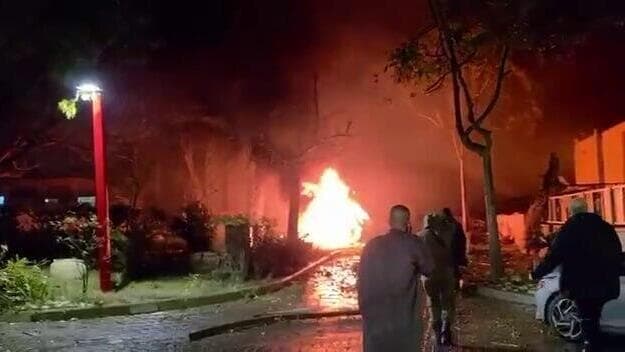
Iran Attacks Israeli Towns Dimona and Arad Near Israel's Main Nuclear Research Center, Dozens Wounded
43 sources compared
Iran Attacks Dimona in Retaliation for Natanz Strike
44 sources compared

Iran Attacks Diego Garcia with Long-Range Missiles, Targeting U.S.-UK Base
82 sources compared
Trump Defends Iran War by Citing Pearl Harbor
12 sources compared