Iran17 April, 20266 min read
Iran’s Mosquito Fleet Harasses Shipping and Threatens Navigation in Strait of Hormuz
This article is an automated aggregation of coverage from news outlets. Our editorials offer in-depth analysis curated by the NewsCord team.
Iran's IRGC Navy employs a mosquito fleet of small fast boats to threaten Hormuz shipping. Tehran seeks tolls or crypto payments for ships transiting Hormuz during ceasefire.
ynetnews was read line by line by the Watchdog: 4.7. See the score →
Mosquito fleet in Hormuz
Iran’s so-called “mosquito fleet” is described by multiple outlets as a potent naval threat in the Strait of Hormuz, built around small, fast, and hard-to-track boats that can harass shipping and complicate navigation. Folha de S.Paulo says the flotilla “lurks in the shadows” and is “the heart of the naval forces commanded by the Islamic Revolutionary Guard Corps,” adding that it is “a force separate from Iran’s regular navy.” The same report quotes Saeid Golkar, an IRGC specialist and professor at the University of Tennessee at Chattanooga, saying, “The IRGC Navy functions more like a guerrilla force at sea,” and that it “depends on hit-and-run attacks.”
Israelhayom similarly frames the IRGC’s approach as asymmetric, quoting Golkar again: “The IRGC's navy operates more like a guerrilla force at sea,” and “It focuses on asymmetric warfare and hit-and-run tactics instead of classic naval battles.” In the Reuters-linked framing inside Folha de S.Paulo, the threat is tied to missiles and drones that the IRGC Navy can launch from the boats or from “camouflaged locations on land,” with the report saying these capabilities have been “the main threat hindering navigation through the Strait of Hormuz.” The outlets also connect the fleet’s operational style to the geography of the gulf, describing boats moored along piers inside “deep caves carved into the rocky coast,” ready to be deployed “in minutes.”
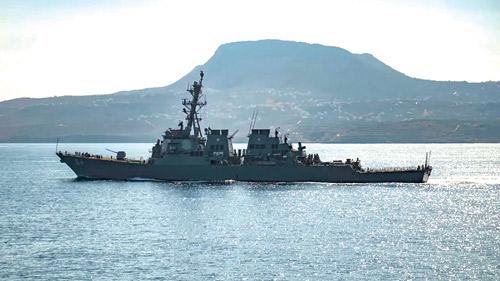
Damage claims and retained assets
The reporting also centers on the contrast between U.S. claims of severe damage to Iran’s conventional navy and the continued operational activity attributed to the IRGC’s smaller forces.
Folha de S.Paulo says that on April 8, after the announcement of a two-week ceasefire, General Dan Caine, chairman of the U.S. Joint Chiefs of Staff, stated that “more than 90% of Iran's regular navy fleet, including its main warships, were at the bottom of the ocean.”

The same article adds that it is “estimated that half of the Revolutionary Guard's fast attack boats have been sunk,” while noting that Caine “did not specify how many.”
Israelhayom likewise says Caine “said that more than 90% of Iran's regular navy had been destroyed,” and it quotes the claim that “about half of the organization's fast attack boats had been destroyed,” while also asserting that “the rest, whose numbers are difficult to estimate and range from hundreds to thousands, are operating as a 'shadow army.'”
In the same vein, Israelhayom says U.S. intelligence sources told CNN that “the naval arm of the Islamic Revolutionary Guard Corps retained about 50% of the assets it had before the war.”
Folha de S.Paulo describes the difficulty of counting the remaining boats, saying “Estimates of the total number range from hundreds to thousands—it is hard to count them,” and it links that uncertainty to the boats’ small size and concealment.
Seizures and the 'shoot and kill' order
Recent incidents described across outlets portray the IRGC’s small-boat tactics as continuing despite the earlier U.S. and Israeli strikes. Firstpost says Iran has expanded its retaliation in the Strait of Hormuz by deploying what U.S. officials call “mosquito fleet,” and it describes “the latest incident” in which “Iranian forces fired on three vessels and seized two, claiming navigation violations.” Ynetnews reports that Iran’s Islamic Revolutionary Guard Corps seized the vessels EPAMINODES and MSC FRANCESCA on Wednesday in the Strait of Hormuz, and it ties the episode to U.S. escalation language.
In that same report, Trump is quoted ordering: “I have ordered the United States Navy to shoot and kill any boat, small boats though they may be, that is putting mines in the waters of the Strait of Hormuz.” Ynetnews also says the Pentagon released video showing U.S. forces boarding the tanker M/T Majestic X, which it said was carrying Iranian oil, and it quotes the Pentagon’s statement about “global maritime enforcement.” The report adds that CNN cited U.S. intelligence sources saying the IRGC still retains about 50% of its prewar assets despite “six weeks of intense fighting,” and it includes a warning from Iran’s judiciary chief, Gholamhossein Mohseni Ejei: “The IRGC navy, equipped with boats and drones, is waiting for the invading American ships — to completely destroy them.”
Staged footage and competing narratives
The outlets also diverge on how to interpret Iran’s public presentation of seizures and the U.S. response, with analysts quoted about whether footage reflects real-time events. Ynetnews says that after Iran released footage of what it claimed was the seizure of the ships, “the United States also published its own documentation,” and it describes the Pentagon’s video of boarding the tanker M/T Majestic X. It then reports that analysts cited by CNN said the IRGC video appeared staged and “not filmed in real time,” and it says the video was posted on the Telegram account of Iran’s state broadcaster IRIB (Islamic Republic of Iran Broadcasting).
Ynetnews quotes Carl Schuster saying, “It looks staged to me,” and adding that it “looks like a training exercise or a publicity stunt.” The report says Collin Koh also said the footage did not appear to have been created in real time, citing “the absence of crew,” while Iranian media praised the footage, claiming the ship had “violated the law in the Strait of Hormuz.” It also states that satellite images showed a sharp course change by another tanker, EUPHORIA, after it was attacked by Iran, and it describes EPAMINONDAS, sailing under a Liberian flag, being attacked by a small IRGC boat carrying three individuals who fired rifles and rocket-propelled grenades.

Why it matters for shipping
Beyond the immediate seizures, the sources connect the “mosquito fleet” concept to broader risks for commercial shipping and the strategic logic of raising the cost of transit.
Folha de S.Paulo says the boats and “especially, the missiles and drones” that the IRGC Navy can launch from them or from land have been “the main threat hindering navigation through the Strait of Hormuz,” and it describes the arsenal as “a major threat to commercial vessels in the gulf and the Strait.”
It quotes Admiral Gary Roughead, former head of U.S. Naval Operations, retired, saying, “It remains a disruptive force,” and “You never know exactly what they were plotting and what their intentions were.”
Israelhayom similarly says Roughead summarized the situation by saying it is a “disruptive force” whose intentions remain ambiguous, allowing Iran to keep the Strait of Hormuz effectively closed because “of shipowners' fears, even without large warships.”
Business Today frames the same concept as an escalation driver, describing “the swarm tactic behind Hormuz crisis” and saying the objective is “to raise the risk of transit to a level where economic pressure does the rest.”
It also ties the tactic to the chokepoint nature of the strait, stating that “A large share of global oil flows through this narrow passage,” and that ships have “limited room to manoeuvre.”