Full story
Missiles at US warships
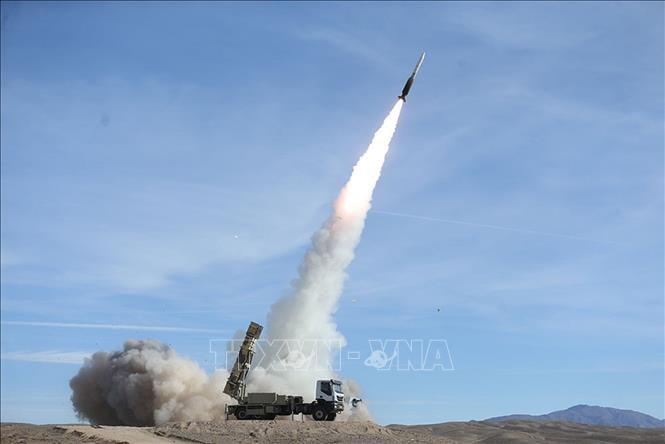
On Saturday, Iran’s Islamic Revolutionary Guard Corps (IRGC) Aerospace Force claimed it fired several ballistic missiles at a US aircraft carrier and a US destroyer, alleging the warships were harassing Iranian ships and participating in a naval blockade against the Islamic Republic.
“The two warships were forced to flee the conflict area after sustaining damage and fearing another attack”
ANI News said the IRGC statement, carried by Iranian state broadcaster Islamic Republic of Iran Broadcasting (IRIB), added that “The two warships were forced to flee the conflict area after sustaining damage and fearing another attack,” while also describing the targeting as retaliation amid renewed military tensions.

The BBC reported that the US military said it had “permanently disabled” two Iran-linked oil tankers, including one near Kharg Island, and “completely destroyed” a third in the Gulf of Oman, after the IRGC launched ballistic missiles toward two US Navy warships.
CENTCOM’s account, as relayed by the BBC, said the US aircraft carrier and guided-missile destroyer successfully evaded multiple attacks and that no American troops were harmed, setting up a rapid exchange of claims and counterclaims.
In parallel, Anadolu Ajansı reported that the IRGC said it targeted the two warships with ballistic missiles, claimed both were damaged, and said they withdrew from the “engagement area” after sustaining damage.
Competing accounts and warnings
Iran’s IRGC framed the missile attack as part of a broader maritime confrontation, with ANI News saying the Aerospace Force targeted the carrier and destroyer amid “continued hostile actions againstIranian shipping,” while also warning Washington that further hostile actions would bring “fierce responses” from Iran’s armed forces.
The BBC, meanwhile, described the exchange as a tit-for-tat sequence of retaliatory attacks on ships, saying Iran’s state media confirmed Tehran attacked three US-affiliated vessels in response to the US strikes on Iranian oil tankers.

In a separate account, Anadolu Ajansı said the IRGC statement published by IRNA reported that CENTCOM acknowledged two navy warships were targeted, and it added that the IRGC warned continued US action would draw “heavier” responses.
Kurdistan24 quoted CENTCOM commander Adm. Brad Cooper saying, “Let the message to the IRGC be clear: If you shoot at two of our ships, we will impose an even higher economic cost — taking out three of yours,” tying the US strikes directly to the earlier missile attack claims.
CNN reported that the US Central Command said the carrier and destroyer “successfully evaded multiple unprovoked Iranian attacks,” and it also relayed Iran’s foreign affairs ministry condemnation of the US actions as “illegal and aggressive” and an “overt threat to international peace and the security of commercial shipping.”
Oil shipping stakes rise
The immediate consequence of the latest exchange, according to the BBC, was a renewed focus on the Strait of Hormuz, which it said has been “effectively closed since the war began in February,” and described as a major source of leverage for Iran.
“effectively closed since the war began in February”
CNN reported that Kharg Island has typically handled roughly 90% of the country’s crude oil exports, and it said the island has been attacked throughout the conflict while US President Donald Trump previously threatened to capture it.
In CENTCOM’s account relayed by CNBC and other outlets, the US struck three Iranian crude oil carriers on Sept. 5, with CENTCOM saying it permanently disabled the M/T Downy off the coast of Kharg Island and the M/T Stark 1 near Jask, and that the M/T Kylo, also known as the “Noxen,” was “completely destroyed” in the Gulf of Oman.
The BBC also said the conflict has continued since the US and Israel launched wide-ranging strikes on Iran on 28 February, and it noted that a 60-day ceasefire between the US and Iran formally expired last month with little sign of a further diplomatic settlement.
As the cycle of attacks continued, the BBC reported that Trump dismissed the conflict as “small potatoes” and that he had not commented on Saturday’s attacks, while the BBC said the US resumed attacks last Sunday after a month of relative calm and that disputes over the Strait of Hormuz remained unresolved.