Technology and Scienceupdated 2h ago2 min read
Japan Launches H3 Rocket With MMX Toward Mars Moon Phobos, JAXA Targets Sample Return
This article is an automated aggregation of coverage from news outlets. Our editorials offer in-depth analysis curated by the NewsCord team.
JAXA launches MMX on H3 rocket from Tanegashima to Phobos, aiming sample return. Five-year mission to study Phobos and Deimos and return samples.
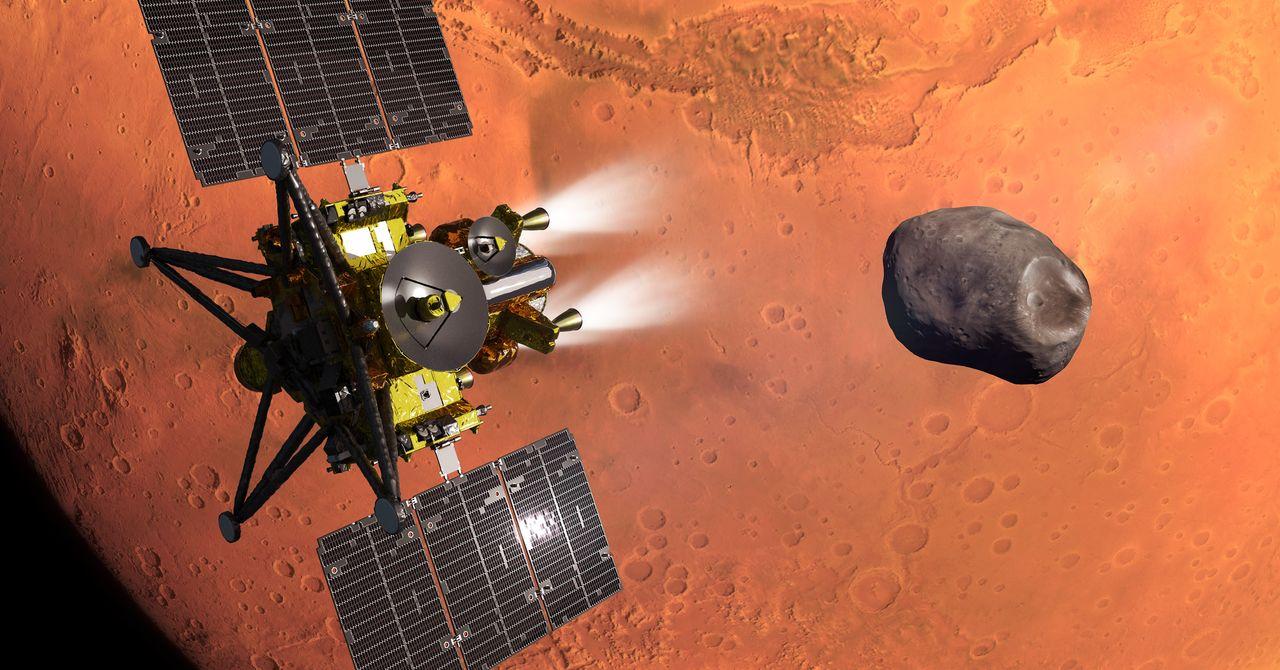
MMX Launch to Phobos
Japan launched an H3 rocket carrying the Martian Moons eXploration (MMX) spacecraft toward Mars, with JAXA placing the unmanned probe on a trajectory toward Mars after the rocket released it about 71 minutes after liftoff.
JAXA launched MMX aboard H3 rocket No. 10 at 4:41 a.m. local time from the Tanegashima Space Center in southwestern Japan, and the mission is designed to land on Phobos, collect at least 10 grams of surface material, and return the samples to Earth.

The spacecraft is expected to reach the Martian system in 2027 and conduct detailed observations of Phobos, including from a quasi-satellite orbit, while it will also observe Deimos during the mission.
The spacecraft is scheduled to arrive at Phobos in August 2027.
Rover, Sampling, and Timing
MMX will deploy a small rover named Idefix to explore Phobos' surface and support the landing and sampling operations, and JAXA aims to return the samples to Earth in 2031. The rover will scout out a landing site so that the MMX spacecraft itself can later touch down on Phobos, and it added that the rover will deploy a robotic arm and two samplers to grab some moon dust.
Prof Sara Russell, from the Natural History Museum, said, "There hasn't yet been a successful mission to go to Phobos and bring a bit back to Earth." Dr Chrysa Avdellidou of Leicester University said, "It's a very small [amount] actually," while adding that the team can still do several studies even on individual grains.
What the Samples Could Settle
MMX is designed to address competing explanations for how Mars's moons formed, with one idea involving a space rock impact that created Phobos and Deimos from debris and another involving captured asteroids. Prof Sara Russell said the returned material would let scientists look in detail at its chemistry and mineral composition, and she said, "It should be pretty much immediately obvious.. whether it's the product of this dramatic impact".
“Returning samples from a Martian moon is a world-first challenge that is not easy.”
The mission is hoped to solve the mystery of how Mars's moons formed, and it framed the sample return as the first time a sample has been returned from Mars or its moons to be analysed in laboratories on Earth. Kiyoshi Kuramoto said, "Returning samples from a Martian moon is a world-first challenge that is not easy."