Israeli Politics · 16 August, 2026 · 2 min read
Kan Poll Ties Netanyahu’s Likud With Gadi Eisenkot’s Yashar, Coalition Projected at 52 Seats
Kan poll ties Likud with Eisenkot’s Yashar party. Poll projects coalition at 52 seats, anti-Netanyahu bloc at 57.
Polls give conflicting projected Likud seat counts and bloc totals.
6 of 8 outlets skipped it: US President Trump did not endorse Netanyahu.
The Jerusalem Post was read line by line by the Watchdog: 9.1. See the score →
12outlets compared
Same story, two versions
tap a side to read it in full
Israel National News
“Likud would take 30 seats - a two-seat increase compared to last week’s i24NEWS poll.”Read the original ↗
The Jerusalem Post
“coalition bloc lost one seat this week and now stands at just 48 Knesset seats”Read the original ↗
Seat/projection differences can change which bloc is seen as governing-capable.
Poll Shows Tight Race
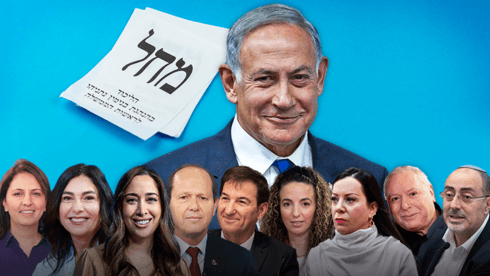
A new Israeli opinion poll conducted on Sunday by the Israeli Public Broadcasting Corporation (Kan) shows Prime Minister Benjamin Netanyahu’s Likud tied with the Yashar party led by former Israeli Chief of Staff Gadi Eisenkot, with Likud dropping to 23 seats, the same number as Eisenkot’s party. The Kan 11 poll surveyed 1,103 Israelis aged 18 and over, including Arab citizens, with a margin of error of 2.9 percent, and projected that Yashar surpasses Netanyahu in a polling index assessing party suitability for the premiership.
“Likud lost one seat, dropping to 23, the same number as Eisenkot’s party.”
Haaretz reported that the same Kan 11 poll projects 57 seats for Jewish parties opposed to Netanyahu, up one seat from last week, while the coalition bloc is projected to win 52 seats. Haaretz also said the anti-Netanyahu bloc still falls short of a majority without Arab parties, which are projected to win 11 seats, unchanged from last week, divided between Hadash-Ta'al and Ra'am.

Primaries and Turnout
As Likud primaries to choose candidates for Israel’s general election approached their end, Al-Jazirah Net reported that polling stations closed without an extension after an 11-hour voting day and that vote counting began with results expected to be announced the next morning. Al-Jazirah Net said party figures reported a final turnout of 53.5%, an increase of about 10% compared to the same voting hours in the 2022 primaries, and that about 75,177 voters participated, representing 53% of eligible primary voters.
Haaretz reported that Likud primary voting ended with turnout at 53.5 percent, down from 58 percent in the 2022 primary. In the middle of the voting, Israel National News said voting in the Likud primaries was continuing with 14,307 party members having already cast their ballots—10.07% of eligible voters—and that Jerusalem recorded the highest number of voters with 564 having voted by 12:15 p.m.I

Coalition Math and Stakes
Election polling described by The Jerusalem Post shows Netanyahu’s coalition slipping behind Eisenkot’s Yashar, with a Maariv poll published on Friday putting the coalition at 48 Knesset seats and Likud at 21 mandates, two fewer than Yashar’s 23. TThe Jerusalem Post said the Zionist opposition bloc reached 57 seats and, together with Zionist Home-The Reservists led by Chili Tropper and Yoaz Hendel, could secure a majority of 61 seats, while the Arab parties received an additional 11 seats.T
The Times of Israel framed the potential kingmaker role of Ra’am, led by MK Mansour Abbas, around a scenario where neither Netanyahu’s coalition nor the opposition bloc secures the 61 seats needed to form a government. In that context, The Times of Israel reported that pollster Yousef Makladeh described Ra’am as "the missing piece of the puzzle" that could lift the opposition bloc "to 62 or 63 seats."