Canada01 October, 20263 min read
Mark Carney Fast-Tracks Pacific Link Pipeline To Cut Canada’s U.S. Dependence
This article is an automated aggregation of coverage from news outlets. Our editorials offer in-depth analysis curated by the NewsCord team.
Pacific Link fast-tracked to diversify Canada's economy away from the United States. Pipeline would move up to one million barrels per day from Alberta to the Pacific coast.

Carney Fast-Tracks Pacific Link
Prime Minister Mark Carney said Canada will fast track the approval process for a new proposed crude oil export pipeline to its west coast, the Pacific Link project, which he said could generate over C$20 billion (US$14 billion) a year in GDP. Carney said Ottawa would officially list the Pacific Link pipeline as a project of national interest so it proceeds through a single federal regulatory review process, and he said Ottawa aimed to complete the process by September 1, 2027. Carney told reporters in Fort McMurray that a pipeline to the west coast is part of his mission to transform the economy, to double non-US exports over the next decade, and to unlock Canada’s full potential as a global energy superpower.
The government said the 1 million barrel a day project would create 140,000 jobs and generate more than 20 billion Canadian dollars in gross domestic product per year and 100 billion Canadian dollars in government revenue by 2060. The government said Canada currently has just one east-west oil export pipeline in Canada, the 890,000-barrel-per-day Trans Mountain pipeline, which an expansion completed in 2024 is already running at capacity.
Ownership, Route, and Review
Trans Mountain Corp will be built in coordination with Pembina Pipeline Corp, and Indigenous communities will be offered a minimum of 10 percent ownership interest. Pacific Link will have participation from the federal government and the province of Alberta in equal parts, while Indigenous communities may acquire a minimum of 10% through public loan-guarantee programs. The majority owners will be the federal government and the government of Alberta, and the project would be built as a crucial part of Carney’s bid to diversify the economy away from the United States.
The proposed route would connect Alberta with southern British Columbia and avoid the province’s northern coast and ecosystems deemed particularly sensitive, while the designation would allow Pacific Link to proceed under a streamlined federal review process. The declaration of national interest ensures the project proceeds through a single federal regulatory review process, but the government also said the pipeline will still require further steps before construction.
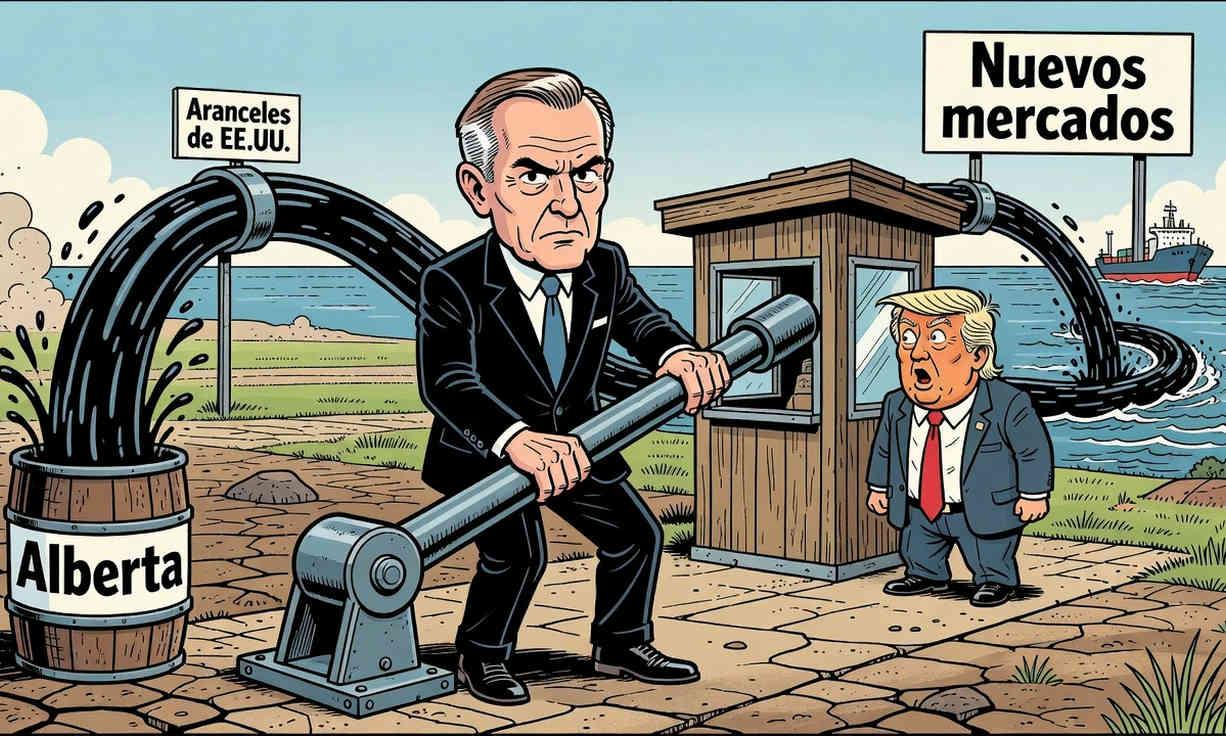
Tariffs, Alberta Politics, and Stakes
Carney framed the pipeline as a response to the effect of US President Donald Trump’s tariffs, and EFE said Washington imposed 50% tariffs on Canadian products worth 27.6 billion Canadian dollars, with Ottawa responding with countermeasures on the same value of imports from the United States. Carney made the announcement alongside Alberta Premier Danielle Smith in Fort McMurray, and Smith called the roughly 22 percent support for separation in a recent poll still too high for her liking. Smith said she would vote to keep Alberta in Canada and called the pipeline an example of how cooperative federalism can work in action, while Carney said it demonstrated that Canada is working and showed what the country could achieve by acting together.
The Business Council of Canada supported the designation, arguing it offers greater certainty to investors, while Avi Lewis, leader of the socialist New Democratic Party (NDP), criticized the use of public funds and warned of the project’s climate and environmental risks. Filling the pipeline would require new tar sands expansions of the type no company has undertaken in more than a decade, and previous pipeline projects faced strong opposition from environmentalists and Indigenous groups, resulting in cancellations, cost overruns, and construction delays.