
Full story
Economic campaign escalates
President Donald Trump has threatened to wage an “economic D-Day” against Iran and to “collapse Iran” by deploying economic warfare on an “unprecedented scale,” with US Treasury Secretary Scott Bessent telling CNBC, “It is going to work in Iran and we are going to collapse this regime.”
“It is going to work in Iran and we are going to collapse this regime”
Bessent said the plan would be the “greatest coordinated economic isolation in the history of the world,” and he told allies, “you are either with us or against us,” as Washington warned that countries that provide “any kind of assistance to Iran” would face consequences.
Iran’s Foreign Minister Abbas Araghchi dismissed the threat as “economic terrorism,” while the Iranian foreign ministry called the sanctions threats “economic terrorism.”
The US and Iran have kept the Strait of Hormuz under strain, with Tehran “partially keeps the key Strait of Hormuz partially shut” and Washington persisting with a “naval counter-blockade of Iran,” as the war that began on February 28 has dragged on for nearly six months.
Bessent said the economic plan meant the United States is less likely to have to return to heavy military operations, adding, “If we are doing the maximum economic pressure, then that means that likely there will not be a large-scale kinetic restart.”
Allies, China, and Russia
Al Jazeera reported that Trump threatened to financially punish any country providing an economic “lifeline” to Iran, while analysts said US leverage over China and Russia is limited and that it would be “very difficult” for Trump to pull off the pressure campaign effectively.
Georgetown University in Qatar associate professor Paul Musgrave told Al Jazeera that Trump is trying to unilaterally assert coordinated sanctions that “traditionally has taken multilateral coordination,” and he said it means getting on board China, Russia, and the P5 of the UN Security Council.
China’s Foreign Ministry spokesman Lin Jian responded that more sanctions would “not help to solve the issue,” and he said, “China calls on relevant parties to take responsible measures and solve the issues through diplomatic and political means.”
Russia, meanwhile, is described by Al Jazeera as already under sweeping US sanctions and operating largely outside the US-led economic framework, while the article also cites a January 2025 20-year partnership treaty between Russia and Iran and a claim that it helped boost trade volume to $4.8bn in the first 11 months of 2025.
Al Jazeera also reported that the United Arab Emirates announced an indefinite trade embargo on Tehran after accusing Iran’s military of launching two ballistic missiles at its territory, as the US threat to disrupt China-Iran trade faces hurdles tied to how China buys Iranian oil and the role of the US financial system.
Tehran’s response and next steps
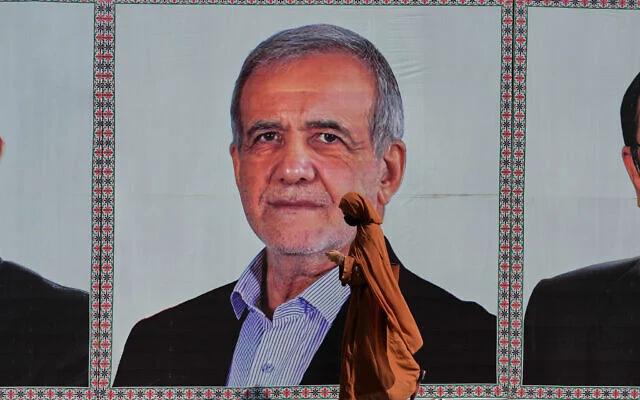
Iranian President Masoud Beshzian called for ending the war with the United States “today,” saying Iran is “in a position of strength,” and he told a meeting with doctors in Tehran, “It is better to end the war today, while we are in a position of strength and dignity.”
“It is better to end the war today, while we are in a position of strength and dignity”
Beshzian defended the June memorandum of understanding with Washington by saying, “there is not a single clause in the joint memorandum of understanding signed with the United States that indicates surrender,” while also insisting, “We will not bow to intimidation under any circumstances… we will stand up to them to the last breath and respond to them decisively.”
Iran’s military leadership echoed the warning, with the Iranian Army Navy commander Brigadier General Shahram Irani saying, “our forces face the enemy with strength and will not allow him to advance; we will continue to defend our security and interests.”
The BBC reported that the two sides had announced two cease-fire agreements in April and June to restore freedom of navigation through the strait, but both agreements collapsed quickly, as Tehran still partially keeps the Hormuz Strait closed and the United States continues to enforce a naval blockade on Iran.
Looking ahead, the BBC said Washington is preparing to impose what it described as the “harshest sanctions in history,” with Mnuchin promising to disclose details at a press conference on Monday, while the US Treasury chief told CNBC that the economic pressure could reduce the likelihood of a broad return to military operations.