Technology and Science · 12 June, 2026 · 3 min read
NOAA Says El Niño Could Intensify to Historic Strength Through November-January
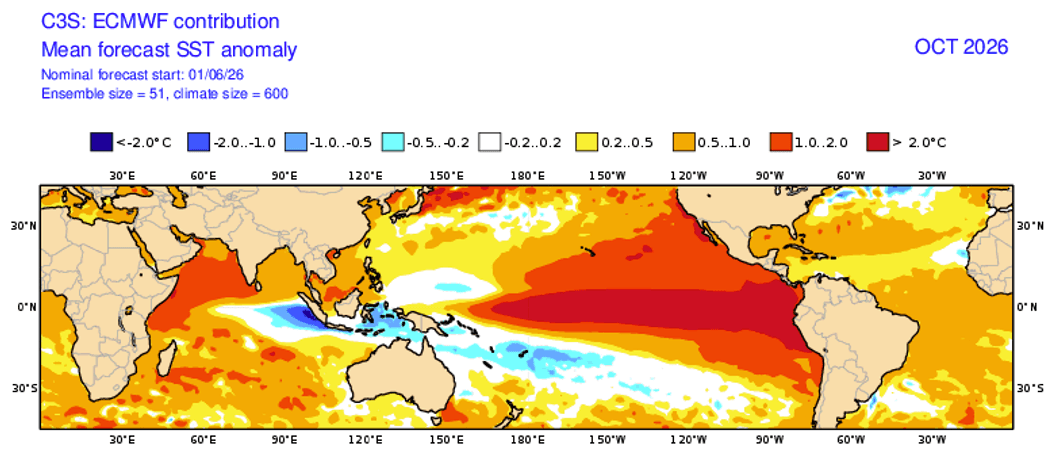
El Niño has arrived and is rapidly strengthening toward a very strong event. Forecasters rate rising odds of Very Strong El Niño by late fall or winter.
Hawaii-specific hurricane implications receive quantitative seasonal focus.
5 of 6 outlets skipped it: central Pacific cyclones: 70% chance of 5–13 storms.
20outlets compared
Same story, two versions
tap a side to read it in full
The Garden Island
“a 70% chance the Central Pacific Basin will see five to 13 tropical cyclones”Read the original ↗
azcentral and The Arizona Republic
“It may bring Arizona a wetter monsoon season if Pacific hurricanes send moisture north.”Read the original ↗
One article quantifies storm counts; the other treats hurricanes as conditional moisture sources.
El Niño Arrives
El Niño has arrived in the central and eastern equatorial Pacific, and the U.S. weather agency says it could intensify through the end of the year, potentially to historic strength.
“There is a 63% chance of a very strong El Niño during November-January”
NOAA’s latest advisory gives a 63% chance of “a very strong El Niño during November-January that would rank among the largest El Niño events in the historical record going back to 1950.”

The forecast is tied to warmer-than-average sea surface temperatures in the central and eastern equatorial Pacific Ocean, with weak tradewinds helping drive changes in global weather patterns.
In Hawaii, the cycle has been linked to more hurricane activity in the Central Pacific Basin in the summer and drought in the winter, which can lead to wildfire threats, according to the National Weather Service warning cited by The Garden Island.T
NOAA’s Climate Prediction Center also says the declaration of El Niño does not mean everything will change immediately, because it is still weak and strengthening through the summer and fall will clarify whether Arizona will see a drier winter like 2015-16 or a wetter one like 2009-10.
What It Could Mean
In Oklahoma, Oklahoma State Climatologist Gary McManus wrote in his blog, the Mesonet Ticker, that “El Niño is not a light switch” that affects Oklahoma weather.
McManus said that “in the winter, however, when the jet stream is stronger, its effects show up more clearly,” while “during the summertime, especially early summer, the effects of El Niño are more subtle and less reliable.”

The Climate Prediction Center said that “Even very strong El Niño events do not lead to the expected impact everywhere,” but that stronger events can “tilt the odds in favor of expected outcomes.”
In Arizona, the azcentral and The Arizona Republic report says El Niño is confirmed now by the National Weather Service's Climate Prediction Center and is on track to be one of the strongest events on record, with the announcement made on June 11.A
That same report says the current Climate Prediction Center forecast shows a 63% chance of reaching the “Very Strong” level by winter, and that “Very Strong” indicates sea surface temperatures are 2 degrees Celsius warmer than average.
Global Stakes and Risks
Beyond the U.S., the AFP report cited by Phys.org says scientists fear El Niño will exacerbate the heat of a planet already warming from burning fossil fuels while amplifying weather extremes.
““the combination of fossil fuel-caused climate change and a potential super El Niño event makes a terrible team””
Marc Alessi of the Union of Concerned Scientists said “the combination of fossil fuel-caused climate change and a potential super El Niño event makes a terrible team,” adding that it could “easily” push global temperatures to record levels.
Mohamed Adow of Power Shift Africa warned that for millions of people it’s “not just another weather forecast” but a “deadly siren to be feared,” because it can mean failed rains, dying crops, rising food prices, and families pushed to the edge.
In the “Dry Corridor” spanning parts of Guatemala, Honduras, El Salvador and Nicaragua, the AFP report says El Niño’s return has triggered fears of drought and stoked concerns of famine, and it notes the Guatemalan government says it has 1.1 million rations ready to distribute in the face of a food security emergency.
UN Secretary-General Antonio Guterres warned in early June that “El Niño conditions will pour oil on the fire of a warming planet,” and he said the impacts will be even stronger and felt even farther afield.