
Technology and Science · updated 1h ago · 2 min read
OpenAI Launches GPT-6 Sol And GPT-6 Luna With Half-Price API Costs
OpenAI released GPT-6 Sol and Luna, expanding the GPT-6 family below GPT-6 Astra. They are priced at about half the API cost of GPT-5.6 promotional pricing.
11 outlets told this the same way.
7 of 8 outlets skipped it: sol is positioned as exactly $2/$10 per 1M tokens and aligned with Sonnet 5 pricing..
11outlets compared
GPT-6 Sol and Luna
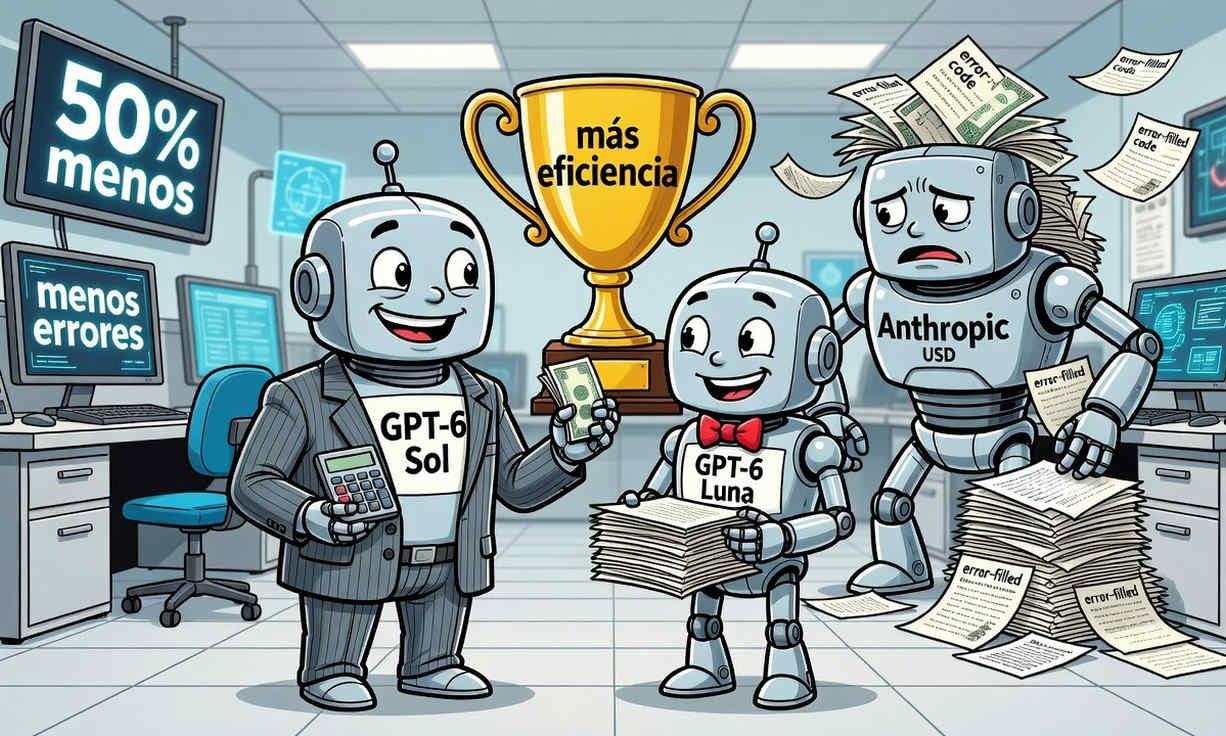
OpenAI expanded its GPT-6 family with GPT-6 Sol and GPT-6 Luna, positioning Sol for complex work like coding and Luna for high-volume office tasks such as summarizing documents, extracting information, and answering quick questions. GPT-6 Sol and GPT-6 Luna would cost half as much as their GPT-5.6 series counterparts, with the change attributed to “improvements in caching and inference” that let the company serve the models at lower cost. GPT-6 Sol makes about half the errors of its predecessor in its internal factuality evaluation, and GPT-6 Luna improves substantially at higher effort levels.
OpenAI’s rollout began arriving in ChatGPT Work, Codex, and the API, while Luna also deployed for Free and Go users. OpenAI’s announcement framed the move as extending the “new generation of intelligence” introduced with GPT-6 Astra into “faster, more affordable models.”
Pricing and rollout
OpenAI set GPT-6 Sol at $2 per million input tokens and $10 per million output tokens, and it set GPT-6 Luna at $0.10 per million input tokens and $0.50 per million output tokens. The models’ caching and inference improvements enabled OpenAI to reduce costs, and OpenAI said it was “passing those savings directly on to users and customers” through the API price cuts. GPT-6 Sol and GPT-6 Luna would be available in ChatGPT Work and Codex for Plus, Pro, Business, Enterprise and Edu users, and Luna would also be available to Free and Go users in the desktop app.
OpenAI said it expected the ChatGPT app and website rollout to be gradual “throughout the day,” and OpenAI said the models were available in the API as gpt-6-sol and gpt-6-luna. OpenAI’s announcement also described how developers could adjust reasoning effort and enable or disable tools without invalidating previously cached context, and OpenAI said it offered “discounts of up to 90% on cached input-token reads.”

Benchmarks and claims
OpenAI tied GPT-6 Sol’s efficiency pitch to results on AutomationBench, where OpenAI said GPT-6 Sol at xhigh effort scored 33.2% and had an estimated cost of $0.27 per task. OpenAI said GPT-6 Sol also scored 56.4% on Agents’ Last Exam at max effort, and that result came at “60% lower cost per task” than Claude Opus 5’s highest score in the evaluation. GPT-6 Sol made about half as many mistakes as GPT-5.6 Sol on its internal factuality evaluation based on de-identified real-world conversations where users flagged mistakes.
GPT-6 Luna at higher effort levels “matches GPT‑5.6 Sol at about a hundredth its cost,” and those evaluations were based on error-inducing conversations where factual errors were flagged. OpenAI’s release framed the overall strategy as cost efficiency across the GPT-6 lineup, while GPT-6 Astra “continues to be our best model across the board” for the most demanding projects.