Full story
Mecca pact signed Friday
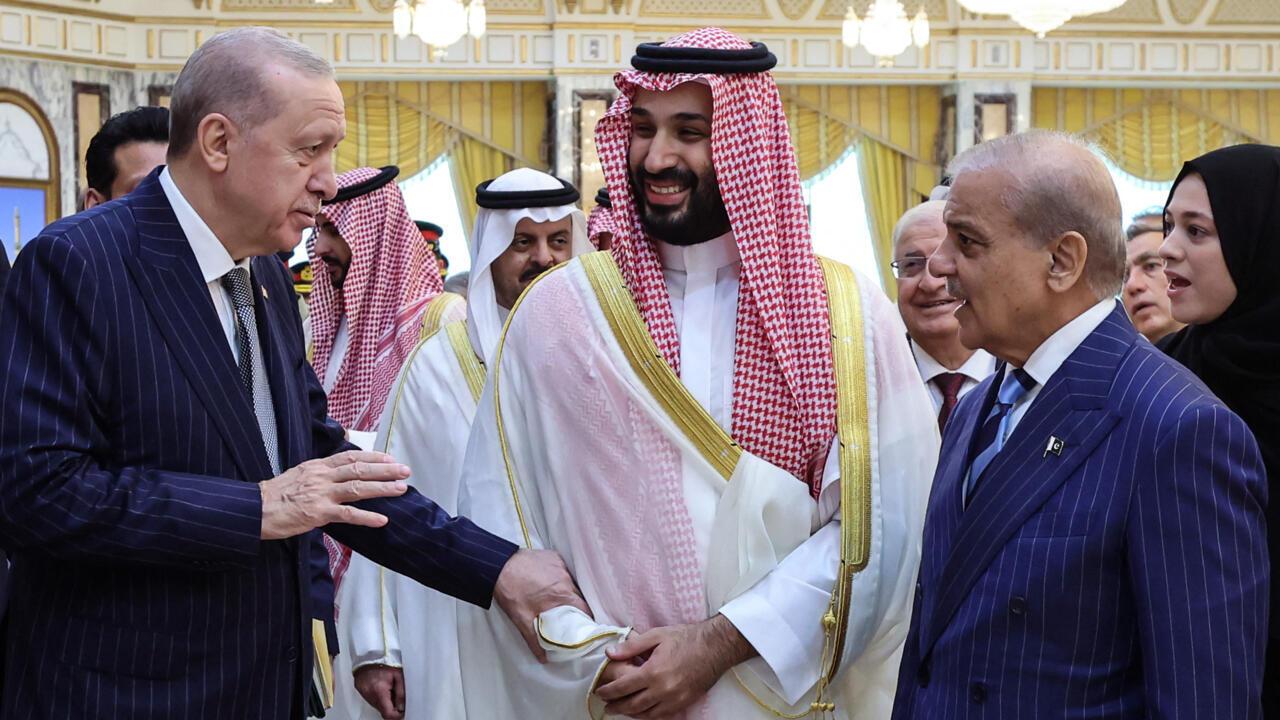
Saudi Arabia, Turkey and Pakistan signed the Mecca Joint Defense Agreement in the Saudi holy city of Mecca on Friday, with the pact stipulating that an armed attack against any one of the three states shall be regarded as an attack against them all.
“The agreement was signed in the Saudi holy city of Mecca by Saudi Crown Prince Mohammed bin Salman”
The agreement was signed by Saudi Crown Prince Mohammed bin Salman, Turkish President Recep Tayyip Erdogan and Pakistan’s Prime Minister Shehbaz Sharif, according to statements from all three countries.

The deal was presented as collective deterrence aimed at strengthening cooperation and deterrence at a time of increased regional uncertainty and threats from the war in Iran.
In Iran, Ebrahim Rezaei, a member of the Iranian Parliament’s National Security and Foreign Policy Commission, criticized the agreement on X, writing, "The Saudis should know that a paper agreement with Turkey and Pakistan will not bring them security".
The Reuters report also said the agreement was intended to strengthen collective deterrence, while noting that the joint statement did not give specifics on commitments and it was not clear how far the agreement would bind each to particular military action.
Defensive framing vs Iranian mockery
Saudi Arabia insisted the agreement does not represent an orientation toward building a military axis or sectarian/religious bloc, and it said it is "not linked to nuclear endeavors or an arms race".
Erdogan said the agreement was based on "collective deterrence" and would deepen cooperation in defense, support joint defense industry projects and bolster efforts to combat terrorism.
Iranian officials and clerics mocked the pact for not naming a threat, and Iran International reported that the agreement "never once named a threat" before Iranian officials and clerics named it for them.
Ebrahim Rezaei’s criticism on X was echoed in Iran International’s account, which quoted him saying, "Correct your policies so you no longer need to go begging for security."
Radio Free Europe/Radio Liberty also quoted Pakistan’s Foreign Ministry describing the pact as strengthening collective deterrence, with the Mecca Joint Defense Agreement stipulating that "any armed attack against any one of the three states shall be regarded as an attack against them all".
What it means for US role
Al Jazeera framed the Mecca Joint Defence Agreement as raising questions about the shifting geopolitical landscape of the Middle East, where fallout from the US-Israel war on Iran prompted some countries to seek new arrangements to safeguard their security.
“Regional states have harbored growing doubts about the reliability of the US security partnership for more than a decade”
Kristian Coates Ulrichsen, a Middle East fellow at Rice University’s Baker Institute for Public Policy, told Al Jazeera over email that "Regional states have harbored growing doubts about the reliability of the US security partnership for more than a decade," and he said the decision to begin military operations against Iran and the conduct of the war intensified those concerns.
Al Jazeera also quoted Sina Toossi, an analyst at the Center for International Policy, saying the pact was "one of the first major geopolitical signs that the regional order is being reshaped by the US-Israeli war on Iran," while Yasmine Farouk of the International Crisis Group said the countries recognize that "there is no framework that can replace the United States."
Reuters reported that Turkish Vice President Cevdet Yilmaz said the agreement was not aimed at any specific country, and it said a Turkish official added it was purely defensive and did not abrogate any existing agreements.
The Times of Israel described the pact as being signed in the shadow of the Iran war, noting that the agreement was intended to strengthen collective deterrence and that a Turkish official said it was defensive in nature, not directed against any specific actor, open to other regional countries, and did not abrogate or replace existing bilateral or multilateral arrangements.