
Technology and Science · 06 August, 2026 · 2 min read
Scientists Capture Sharpest-Ever Sun Surface Images With Daniel K. Inouye Solar Telescope
The telescope captured the sharpest, highest-resolution images of the sun’s surface to date. Images reveal dynamic, wave-like patterns that could improve solar weather forecasts.
Whether KHI wave vortices are observed first time.
3 of 4 outlets skipped it: KHI vortices are about 25 km; granules are 500 to 2000 km.
4outlets compared
Same story, two versions
tap a side to read it in full
New Scientist
“revealed, for the first time, wave-shaped vortices known as Kelvin–Helmholtz instabilities (KHI)”Read the original ↗
Framing shifts from first-time observation to first-time-at-that-resolution wording.
Sharpest Sun Photos
Scientists captured the sharpest images yet of the sun’s surface using the National Science Foundation’s Daniel K. Inouye Solar Telescope, located on the island of Maui in Hawaii.
The team took the images on 14 April 2025 with just a few minutes of their allotted time remaining as clouds fast closing in threatened to force the closure of the observatory’s lens cover.
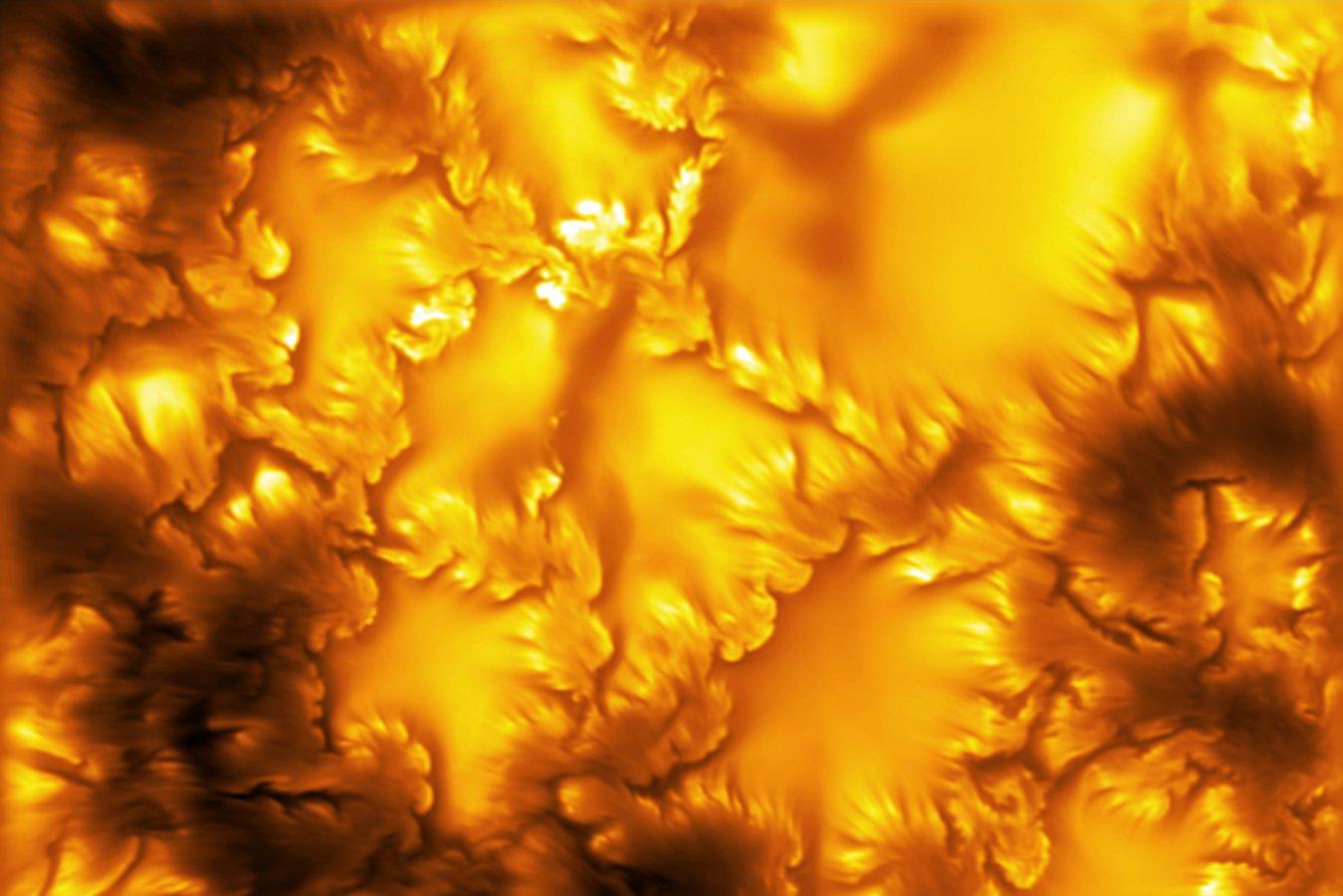
The findings, published Wednesday in the journal Nature, revealed wave-shaped vortices known as Kelvin–Helmholtz instabilities (KHI) that had long been predicted but had never before been observed on the solar photosphere.
Researchers said the telescope is 150 million kilometres from the sun yet could pick out objects just a few tens of kilometres in length on its surface, including “the 25 kilometre-size KHI vortices” they tracked and identified.
Solar physicist Ruizhu Chen of Stanford University said, “That reminds me of famous paintings, like the swirling skies in Van Gogh’s Starry Night,” linking the new wave patterns to familiar vortex-like imagery.
Instabilities and Solar Weather
The researchers described the rippling patterns as surface instabilities caused by bits of magnetized plasma moving past each other at different speeds, similar to waves that stir when a gust of wind blows over water. Scripps News reported that the instability is a well-known phenomenon on Earth and other planets like Jupiter and Saturn, but “it has not been observed ever at that level on the solar surface,” according to study co-author Friedrich Wöger. SNew Scientist said the images showed KHI “everywhere” in the images they processed, and it described how the wave structures form on the boundaries of “granules,” structures between 500 and 2000 km in diameter.N
Wöger said the discovery could help scientists forecast the sun’s most disruptive behaviours, arguing that “we first have to understand the tiny physical processes that drive it,” and he connected KHI to magnetic fields that drive coronal flares and other solar weather. Michael Wheatland at the University of Sydney said the observations captured “something that looks incredible,” and he argued that KHI might contribute to “coronal heating.”

Why It Matters
Scientists said they are curious about the sun’s inner workings to better track massive bursts of energy called coronal mass ejections that can hurl toward Earth. Scripps News reported that when coronal mass ejections hit, they can trigger solar storms, potentially scrambling GPS communications and producing colorful auroras. SNew Scientist added that KHI waves may play a critical role in the dissipation and movement of heat and could influence the magnetic fields that drive coronal flares and other solar weather that can affect life on Earth and disrupt electromagnetic devices.N
The AP-style account in Seattle Post-Intelligencer (AP) also tied the new images to the need to understand enormous energy eruptions called coronal mass ejections, saying they can be launched toward Earth and trigger solar storms with the potential to disrupt GPS communications and produce colorful auroras. Wheatland said, “One of the outstanding problems in solar astrophysics is coronal heating,” and he suggested it’s possible that Kelvin–Helmholtz instability is contributing to that.