Technology and Science · 05 August, 2026 · 3 min read
Daniel K. Inouye Solar Telescope Captures Unprecedented Photosphere Images Showing Swirling Plasma Waves
Highest-resolution images of the Sun's visible surface reveal swirling vortices near a sunspot. Images show plasma waves and fine structures down to about 12–20 km scale.
What the discovery most helps explain.
9 of 11 outlets skipped it: photosphere is photosphere thin layer; granules form via convection.
11outlets compared
Same story, two versions
tap a side to read it in full
BBC
“finding it on the Sun's surface not only explained the dynamics behind space weather”Read the original ↗
New Scientist
“Analysis of the patterns may improve our predictions of solar weather.”Read the original ↗
One stresses space-weather operations; the other stresses forecasting improvements.
Sun’s photosphere, clarified
Scientists using the Daniel K. Inouye Solar Telescope captured the highest-resolution images yet of the Sun’s photosphere, revealing swirling plasma patterns and wave-shaped vortices identified as Kelvin-Helmholtz instabilities.
““We’ve never observed the Sun at that resolution,”Professor Wheatland said.”
The observations were made in Hawaii with the telescope run by the US National Science Foundation, and the imagery spans a section of the Sun about 5,000 by 3,500 kilometres in size.
In those images, the Sun’s surface is roughly 5,500 degrees Celsius while the corona above it can reach 2 million degrees, linking the small-scale plasma process to the outer atmosphere’s extreme heat.
Astrophysicist Michael Wheatland, at the University of Sydney, said the result was “just incredible,” adding “We’ve never observed the Sun at that resolution.”
Hannah Schunker, an astrophysicist at the University of Newcastle, said the Sun is “like an astrophysical laboratory,” because it is only a mere 149 million kilometres away, making detailed study possible.
Kelvin-Helmholtz, and space weather
The new findings were published in Nature and described Kelvin-Helmholtz instability as a physical process where fast-moving plasma slides past slower moving fluid, creating shear that grows into spiralling vortices.
In a magnetically active region near a sunspot, the time-lapse video and imagery showed “whirlpools” of activity that had not been possible to see before, with the Sun’s magnetic field being twisted and moved by hot gas.
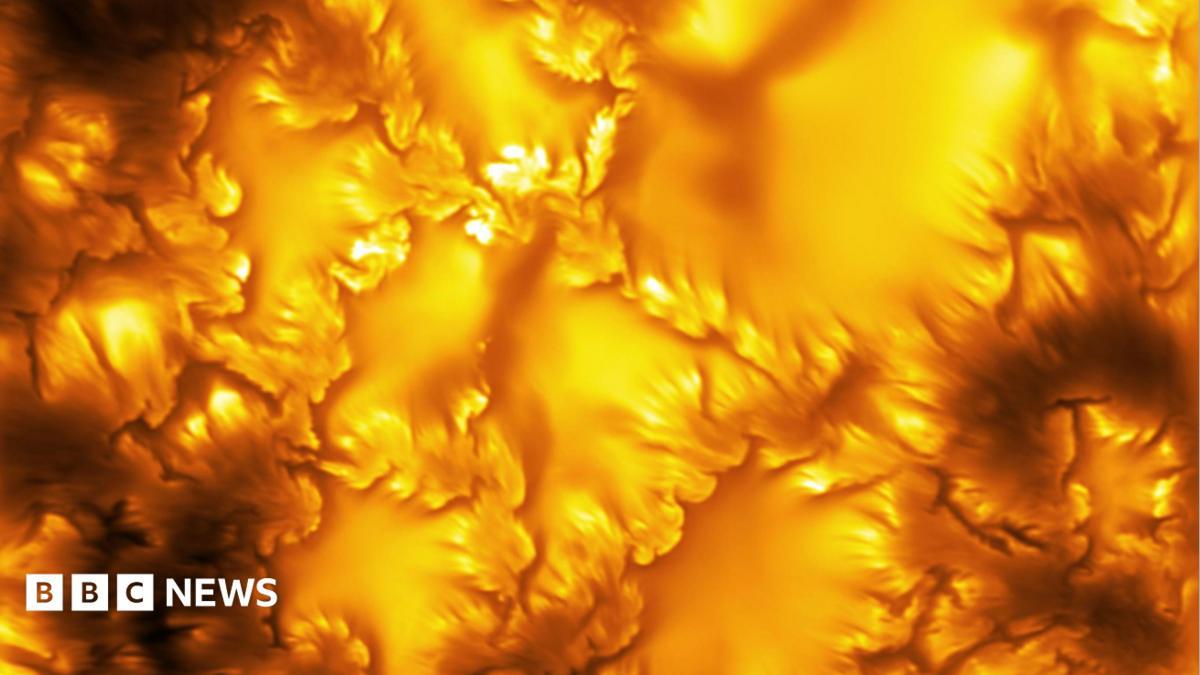
BBC News quoted Dr David Kuridze saying, “These twisting motions are creating magnetic energy, which can build up to produce those large-scale explosions.”B
CNN reported that the swirling patterns could explain enduring solar mysteries, including why the Sun’s corona is much hotter than its surface, and said the findings were made possible by the Daniel K. Inouye Solar Telescope near Haleakalā on Maui.
CNN also quoted Dr Maria Weber, associate professor of physics and planetarium director at Delta State University in Mississippi, describing a “beautiful example of KHIs” at the boundaries of Jupiter’s cloud bands and calling the Great Red Spot “the granddaddy of them all.”
Why it matters next
Researchers said the Kelvin-Helmholtz instabilities help connect small-scale changes on the Sun’s surface to larger-scale heating and eruptions in the atmosphere above, with the goal of improving understanding of coronal heating.
“Future observations of the Sun will eventually help scientists predict space weather like solar flares.”
ABC News & Headlines – Australian Broadcasting Corporation | Other said future observations could help scientists predict space weather like solar flares, and it warned that flares and other solar phenomena can cause bright auroras on Earth and, in serious cases, prompt power outages and damage to satellites and other technology.
The BBC reported that the Sun’s magnetic energy can build up to produce large-scale explosions that create space weather capable of disrupting Earth’s power grids and satellites, and it quoted Dr Friedrich Woeger explaining that finding the instability on the Sun’s surface shows how energy is transported upwards.B
DW said the discovery helps solve the puzzle of how the Sun transports energy to heat its outer atmosphere—the corona—to a million degrees Celsius, and it described vortices as “motors” of magnetic energy crucial for predicting solar storms.
In a statement carried by DW, David Boboltz, deputy director of the NSO, said the discovery “marks a major step forward in our understanding of the dynamics and evolution of solar and stellar plasma, and will serve as a foundation for future discoveries.”