Syria26 September, 20252 min read
Syrian President Ahmed al-Sharaa Addresses UN for First Time in Nearly Six Decades
This article is an automated aggregation of coverage from news outlets. Our editorials offer in-depth analysis curated by the NewsCord team.
Ahmed al-Sharaa addressed the UN General Assembly, first Syrian leader in nearly 60 years. Al-Sharaa condemned Israeli military actions and called for lifting international sanctions on Syria.

27 outlets told this the same way.
Outlets did split on France Suspends Police Stun Grenades at High School Protests After 15-Year-Old Loses Hand →
Syria's UN Reengagement
Syrian President Ahmad al-Sharaa delivered a historic address at the United Nations General Assembly. This marked the first time in nearly 60 years that a Syrian leader has spoken at the assembly. The event signifies Syria's re-entry into the international community following the overthrow of Bashar Assad's regime in December 2024.
“Syrian President Ahmad al-Sharaa, who took power following Bashar Assad’s fall last December, delivered the first Syrian address at the UN General Assembly in nearly 60 years, signaling Syria’s return to the international arena.”
Al-Sharaa, who led the insurgency that ousted Assad, emphasized Syria's desire to restore its international standing and condemned Israeli threats. He also expressed hope for negotiations to revive the 1974 disengagement agreement.
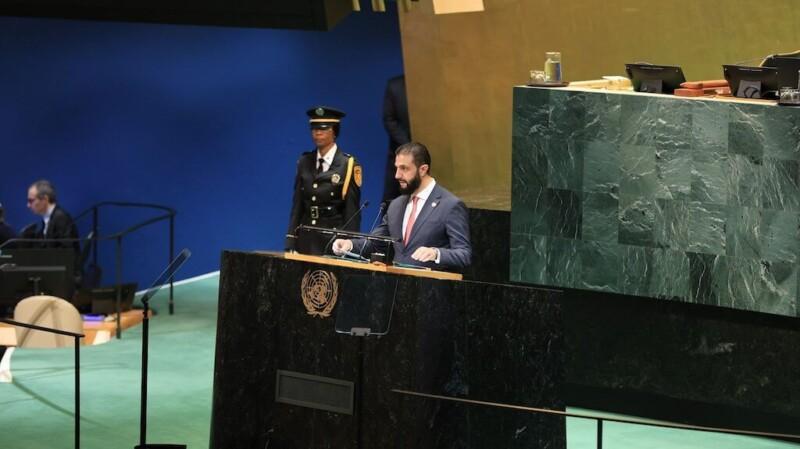
His speech was celebrated in Damascus as a hopeful sign of Syria's new chapter. However, it sparked divisions among the Syrian diaspora in New York.
Al-Sharaa on Syria and Palestine
In his address, al-Sharaa condemned Israeli military actions and expressed strong support for the Palestinian cause. He urged the international community to lift sanctions against Syria. He highlighted efforts to promote coexistence amid sectarian violence and pledged justice for atrocities against minorities.
Al-Sharaa also reported progress in dismantling the Captagon drug trade that funded the Assad regime. His call for lifting Western sanctions was echoed by several sources, noting that some U.S. sanctions have been eased, but key restrictions remain.

Al-Sharaa's Speech and Reactions
Al-Sharaa's speech also addressed internal challenges, acknowledging sectarian violence and human rights abuses. He pledged justice and cooperation with U.N. investigations into these issues. The speech was met with mixed reactions, with celebrations in Damascus and protests from the Syrian diaspora in New York.
“The speech was celebrated in Damascus but received mixed reactions among the Syrian diaspora in New York, with critics accusing al-Sharaa of past ties to al-Qaida-linked insurgents.”
The protesters accused al-Sharaa of past ties to al-Qaida-linked insurgents. Despite these controversies, his leadership is seen by some as a hopeful new era for Syria.
Global Reactions to Syrian Diplomacy
The international response to al-Sharaa's address was varied, with some countries expressing cautious optimism about Syria's reintegration into the global community.
The U.S. has partially lifted sanctions, but key measures like the Caesar Act remain in place.

Al-Sharaa's meetings with global leaders, including U.S. President Donald Trump, were seen as steps toward diplomatic engagement.
However, concerns about his past and Syria's future stability persist.