Gaza Genocide14 January, 20262 min read
Trump Names And Will Chair Gaza 'Peace Board,' Installing Tony Blair, Jared Kushner And Marco Rubio To Oversee Occupied Gaza
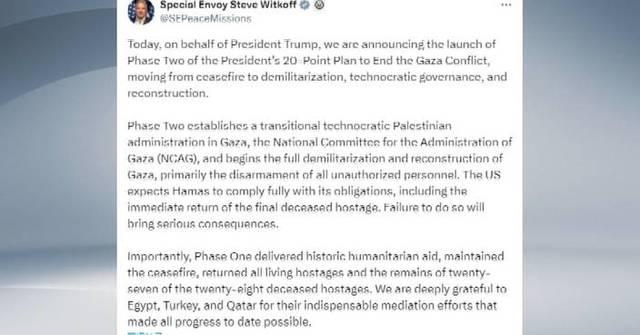
Donald Trump will chair a seven-member oversight board including Tony Blair, Jared Kushner, Marco Rubio Phase Two mandates demilitarization, reconstruction, and a 15‑member technocratic Palestinian administration (NCAG)
58 outlets told this the same way.
Outlets did split on Israel Marks Oct. 7 Anniversary With Strikes on Gaza, Netanyahu Faces Election After Nova Tribute →
ITVX was read line by line by the Watchdog: 7.8. See the score →
Trump-chaired Gaza peace board
The White House announced a new Trump‑chaired “Board of Peace” — variously described as a seven‑member founding executive board or an executive board to oversee Gaza stabilization.
“The White House announced a ‘Board of Peace’ for Gaza as part of President Trump’s 20‑point plan to end the Israel‑Hamas war.”
It named high‑profile figures among its initial members, including former UK prime minister Tony Blair, Jared Kushner and US Secretary of State Marco Rubio.

Reports list other founding names such as developer Steve Witkoff (also styled as special envoy), Apollo CEO Marc Rowan, World Bank president Ajay Banga and US deputy national security adviser Robert Gabriel, with more appointments expected.
The announcement is tied to a U.S. 20‑point plan for Gaza and follows a pause in large‑scale fighting that negotiators call a phase‑one ceasefire agreement.
Phase Two Gaza framework
Phase Two, as announced by U.S. envoys, shifts the U.S. plan from a fragile ceasefire toward demilitarization, technocratic governance, and reconstruction. The framework establishes a 15-member National Committee for the Administration of Gaza (NCAG). Reports describe the NCAG as a temporary technocratic Palestinian administration overseen by a Board of Peace.
Nikolay Mladenov has been named High Representative, and Major General Jasper Jeffers (also reported as Jasper Geffers) will lead an International Stabilisation Force. The Board will assign portfolios for governance capacity-building, regional relations, reconstruction, investment attraction, and capital mobilization.

Demilitarization and stabilization debate
A central and highly contested pillar of Phase Two is full 'demilitarization' — Washington demands disarmament of Hamas and other 'unauthorized' armed groups as a precondition for reconstruction and for international forces to operate. Multiple sources warn this is the most sensitive, unresolved element. Countries are reluctant to join an International Stabilisation Force for fear of being seen as occupiers or of security risks.
“The most sensitive and uncertain part of the plan is disarming Hamas and other unauthorized armed groups.”
Hamas has publicly resisted full disarmament while offering limited compromises. Reports say Israel insists on an expansive definition of disarmament (destroying rockets, tunnels, weapons production and infrastructure), a stance that could let Israel claim noncompliance for years and delay political progress.
Gaza humanitarian toll
The announcement comes amid severe humanitarian tolls and continued Israeli military action in Gaza. Multiple outlets cite Gaza health authorities reporting tens of thousands of Palestinian deaths since October 2023 and hundreds killed since the ceasefire began.
Those outlets explicitly report Israeli strikes and fire killing Palestinians and characterize such incidents as ceasefire violations. Mainstream media note that both sides accuse each other of breaches, while West Asian and alternative outlets foreground civilian casualties and describe ongoing Israeli bombardment and raids that have killed large numbers of Palestinians.

Reactions to Gaza board
International reaction is mixed. Some regional mediators and Palestinian factions have endorsed a technocratic committee and described the move as a path to reconstruction. Critics warn the Board of Peace risks cementing external control over Gaza and enabling continued Israeli dominance.
“Phase two... creates a transitional technocratic body... to be led by Ali Shaath, overseen by a 'Board of Peace' that the report says would be chaired by former US President Donald Trump.”
Prominent criticism focuses on Tony Blair’s inclusion, with The Guardian highlighting controversy over his Iraq record and his past role in the Quartet. Outlets such as The Canary and Mondoweiss label the board a possible 'colonial and corporate takeover' or say it could allow Israel to set de-militarization terms and delay political remedies.
