Gaza Genocide23 September, 20263 min read
Trump’s Board of Peace Unveils $2.45 Billion Gaza Reconstruction Plan at UN General Assembly
This article is an automated aggregation of coverage from news outlets. Our editorials offer in-depth analysis curated by the NewsCord team.
$2.45 billion six-month plan to begin reconstruction and governance in Gaza. 66-project blueprint includes housing, hospitals, economic revival, waste removal, and security arrangements.
www.jpost › tags › gazan-board-of-peace was read line by line by the Watchdog: 5.1. See the score →
$2.45bn plan unveiled
Donald Trump’s Board of Peace unveiled a $2.45bn Gaza recovery plan at a meeting on the sidelines of the UN General Assembly, with the funding spread across 66 programmes over six months and directed at housing, diesel generation and waste removal. Jared Kushner, a Gaza Executive Board member and Trump’s son-in-law, told the meeting of board members and stakeholders, “The goal of today was really just to show you that we're really fully committed to doing it,” and US envoy Steve Witkoff said, “All of the hostages are home.” The board did not set out a date for the start of reconstruction in Gaza, and the plan’s disarmament of Hamas remained a key sticking point.
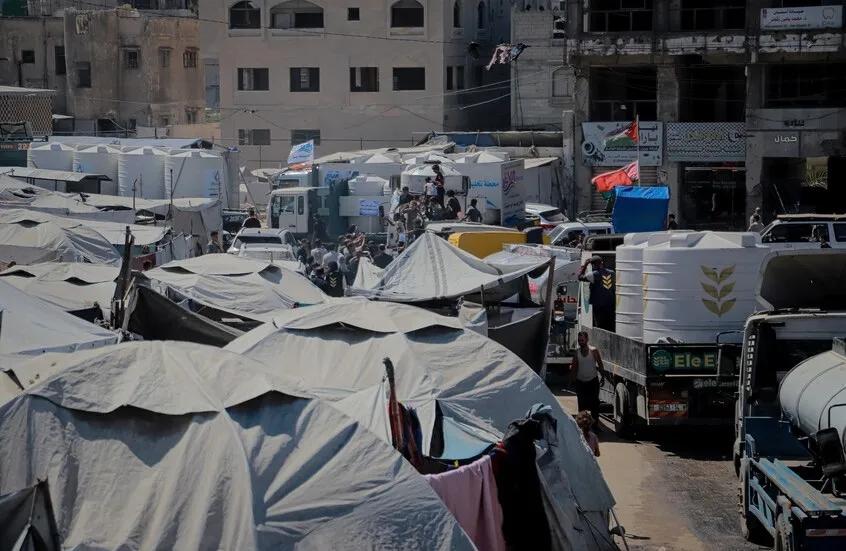
The Palestinian group agreed to give up its weapons in exchange for a phased Israeli troop withdrawal from the 60% of Gaza currently occupied, but Israel insisted it must fully disarm before any pullout. Reconstruction has not begun in Gaza, where an estimated 80% of all structures have been destroyed or damaged during the war and more than 1.9 million people have been displaced.

Governance, security, and delays
Nickolay Mladenov, director-general of the Peace Council, urged countries to support the Gaza Board of Peace’s proposed reconstruction plan and said, “We are not working according to a timetable, first ensuring that every step we take will be good for Israel and the residents of Gaza.” Tony Blair told the meeting that “The residents of Gaza do not need slogans; they need a solution,” and he said beneath Gaza’s cities and villages there are “kilometers of tunnels with weapons depots.” Ali Shaath, the chief commissioner of the National Committee for the Administration of Gaza (NCAG), presented a governance outline based on “one authority, one law and one weapon,” and he said the NCAG’s immediate next step would be a full, independent audit of Gaza’s governance systems, workforce, finances, services, and assets.
Major-General Jasper Jeffers, commander of the International Stabilization Force, presented a security plan in which demilitarization would be carried out gradually, area by area, and after an area is “verifiably demilitarized,” the IDF would begin withdrawing. The board faced challenges including how to ensure security for those operating in Gaza, overhaul internal governance, and find consensus between Israeli and Palestinian officials, while the disarmament of Hamas remained unresolved.

Funding gaps and what’s at risk
The board admitted substantial donations were still needed, with $18bn pledged but only $280m handed over so far, and it estimated full recovery and reconstruction would require about $71bn over the next decade. Violence continued in Gaza amid the deadlock, with near-daily Israeli strikes, and living conditions for the 2.1 million people living there remain dire. Since the ceasefire began, at least 1,408 Palestinians, including more than 300 children, have been killed in Israeli attacks in Gaza according to the Hamas-run health ministry, whose figures are considered reliable by the UN.
The BoP presented five immediate humanitarian actions expected to begin before the NCAG becomes fully operational, including emergency waste management, winter preparedness, emergency rehabilitation of water and sanitation infrastructure, medical evacuations, and responses to shelter and housing needs. The plan’s timeline and implementation remained constrained by the ceasefire’s fragility, with Mladenov warning that a collapse of last October’s ceasefire would be “a point of no return” for the region.