Ukraine War03 May, 20265 min read
Ukrainian Drones Strike Tuapse Oil Terminal, Triggering Fire And Pollution In Russia
This article is an automated aggregation of coverage from news outlets. Our editorials offer in-depth analysis curated by the NewsCord team.
Ukrainian drones struck Tuapse oil terminal, triggering a fire. Oil spilled into the Black Sea from Tuapse after the attack.

Tuapse hits and fires
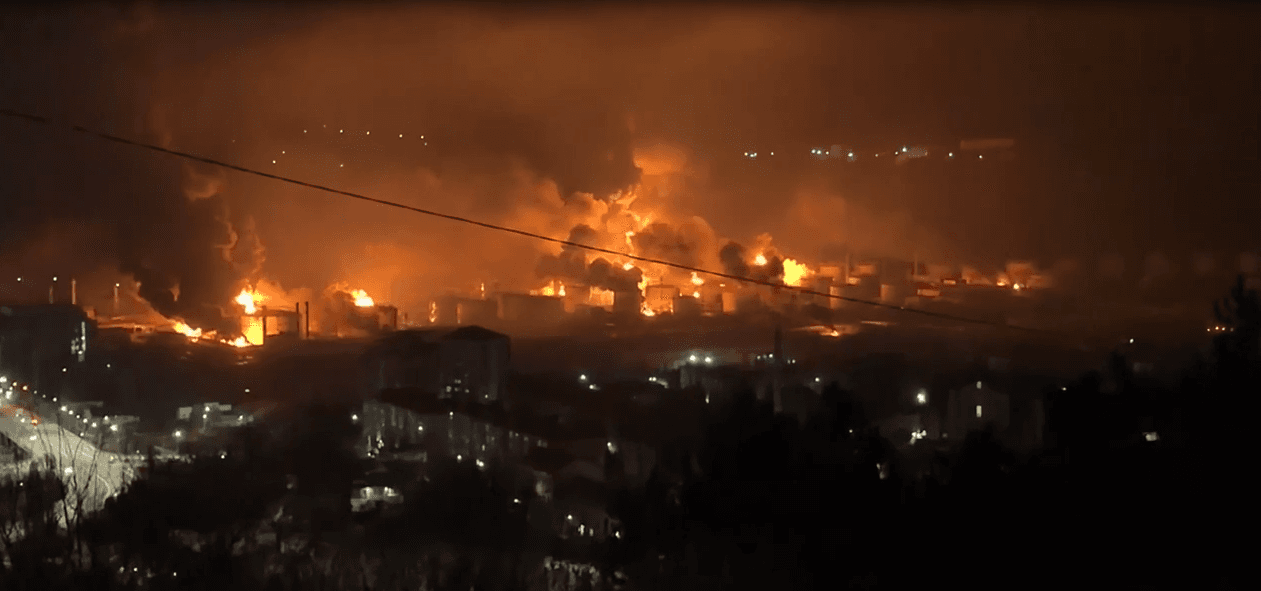
Ukrainian drone strikes have repeatedly targeted Russia’s Black Sea oil infrastructure in Tuapse, triggering fires and pollution concerns that Russian authorities say required large-scale emergency response. The Boston Herald reported that a fire at a marine terminal in Tuapse was extinguished after Friday’s Ukrainian drone strike, citing Krasnodar region emergency authorities on Telegram. It said the hit was the latest in a series of attacks on the port and the nearby Rosneft PJSC refinery since April 16, and that the resultant fires have “typically taken a few days days to extinguish.”
The report added that “Some 130 people and more than 40 pieces of equipment were deployed to contain the latest blaze,” and that Russia declared a regional emergency earlier this week in Tuapse, a city of “over 60,000.” It also described earlier strikes causing an oil-product spill in the Tuapse River and said “more than 459,090 cubic feet of contaminated soil and oil-water mixture have been collected from three cleanup sites.” Local authorities warned residents against using unfiltered water or going outside due to toxic air quality, while the report said air defense units intercepted and destroyed “338 Ukrainian drones” over 17 regions, including Belgorod, Moscow and Krasnodar, according to the Russian defense ministry.

April 28 fire and cleanup
A separate report from L’Indépendant described a new fire at the Tuapse refinery after another Ukrainian drone attack, saying it occurred on Tuesday, April 28, and that “More than 120 rescuers have been mobilized” while residents worried about atmospheric pollution. It quoted Krasnodar region governor Veniamin Kondratiev saying, “A serious incident has occurred again in Tuapse,” and added, “A large fire has broken out at a refinery after a drone attack.” L’Indépendant said the site is owned by Rosneft and has been targeted for “several weeks,” with earlier raids already causing a hydrocarbon leak at sea and atmospheric pollution.
It reported that Kyiv Post suggested the fire was caused by drone debris, and that “No injuries are reported,” while noting that “Four tanks are reportedly burning on top of damage from previous strikes.” The report also tied the incident to earlier attacks on April 16 and 20, saying combustion products mixed with rain coated areas around the oil terminal with a “black deposit.” It further stated that “Last week, atmospheric samples showed benzene, xylene and soot concentrations two to three times higher than permitted thresholds,” and that residents were urged to stay indoors.

Oil spill claims and injuries
Russian officials described the Tuapse attacks in terms of damage to port facilities and an ensuing oil spill, while also reporting injuries. TRT عربي said the Krasnodar region’s Operations Center stated in a press release that “Ukraine launched drone attacks on the port located in the city of Tuapse, causing damage,” and that it “detected an oil spill at sea following the attack, with the affected area totaling 10,000 square meters according to Russian experts.” It said cleanup involved “six ships” and that firefighting continued with “about 250 people participating, two fire engines and more than 70 vehicles,” and it added that “the incident left three people injured.”
The Kyiv Independent, meanwhile, focused on environmental impacts and described “hundreds of tons of oil” leaking from the facility, turning the city and shore into “a contaminated disaster area.” It said that “over the past 10 days, Ukrainian forces carried out a multitude of drone strikes targeting an oil refinery in Russia's port city of Tuapse,” and that “Damage control should have begun immediately after the first attack on April 16,” according to Russian independent environmental experts it quoted. The Kyiv Independent also stated that “A state of regional emergency was only declared on April 28,” and that Rospotrebnadzor “only issued safety recommendations” on April 28, “twelve days after the first strike.”
Other strikes and border activity
Beyond Tuapse, the Boston Herald described continued exchanges of attacks between Russia and Ukraine and reported casualties from a drone strike in Kherson.
It said Russia and Ukraine continued to exchange attacks on Saturday as the conflict “now into its fifth year,” with “no word on a resumption of peace negotiations.”
The report stated that “In Ukraine, two people were killed and seven injured in Kherson after a Russian drone strike on an city minibus,” adding that President Volodymyr Zelenskyy said the injured were civilians on social media.
It also reported that “So far this week Russia has fired about 1,600 drones, nearly 1,100 guided aerial bombs, and three missiles against Ukraine,” with Zelenskyy adding those figures.
The Boston Herald further said Russia attacked critical infrastructure of Ukraine’s Naftogaz Group for a second day, with Chief Executive Officer Sergii Koretskyi saying on Facebook that a gas pipeline in the Zaporizhzhia region was damaged after being struck by an aerial bomb.
It also included Zelenskyy’s post about “unusual activity along sections of the Ukraine-Belarus border” and quoted him saying, “We are closely documenting everything and keeping the situation under control. If necessary, we will react,” while noting that AMK Mapping said two Belarusian military helicopters had been detected by Ukrainian radars within a few miles of the nations’ border.
Baltic spill and sanctions
The Ukraine war’s impact on energy flows and maritime activity also surfaced in a separate report about an oil spill in the Baltic Sea, where Sweden took control of a tanker suspected of being linked to Russia’s “Shadow Fleet.” Anadolu Ajansı said Swedish media reported that authorities took control of an oil tanker suspected of causing a “large oil spill in the Baltic Sea,” and that it was suspected to be affiliated with the Russian “Shadow Fleet” used to circumvent sanctions. It identified the tanker as “Flora 1” and said a coast guard aircraft spotted an oil spill “about 12 kilometers long east of Gotland Island,” citing Sweden’s state television SVT.
Anadolu Ajansı reported that coast guard teams, in cooperation with the police, carried out the operation to seize the tanker on Friday morning, and that authorities opened an official investigation described as an “environmental crime.” It also specified that “at least two thousand liters of oil” had leaked into the sea from the Sierra Leone-registered tanker. In parallel, بوابة الوسط described a Ukrainian drone attack on a pipeline near the Primorsk port on Russia’s Baltic Sea coast, with Russia acknowledging an oil spill while insisting there were no damages.
