USA · updated 1h ago · 3 min read
Experts Warn UN Faces Existential Crisis as Security Council Veto Gridlock Persists in New York
UN faces existential crisis over funding, relevance, and Security Council gridlock. G4 ministers push early UNSC reform; Africa seeks permanent seats and veto power change.
Whether to abolish veto vs add seats.
8 of 9 outlets skipped it: the 1950 UNGA resolution allows debate on vetoed matters.
12outlets compared
Same story, two versions
tap a side to read it in full
TRT World
“At the centre of this roadmap should be the abolition of the veto privilege.”Read the original ↗
Dailynewsegypt
“demanding urgent reform of the UN Security Council to expand African representation.”Read the original ↗
TRT World centres veto abolition, while Reuters-linked Egypt and G4-focused outlets prioritise expanding seats for Africa.
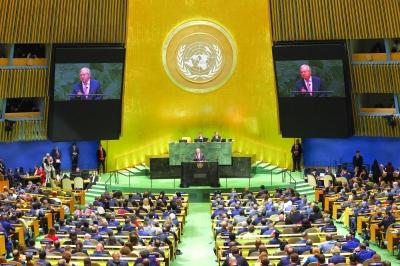
UNGA81 and UN crisis
World leaders gathered in New York for the 81st United Nations General Assembly as experts said the UN was battling an existential crisis of funding, relevance and Security Council gridlock. Daniel Forti, head of UN Affairs at the International Crisis Group, said, “The vast majority of leaders, from small states, from middle powers, and even a few from major powers, recognise the importance of a UN that is a global conversation platform,” while warning that the Security Council veto problem leaves the UN “hamstrung.” Antonio Guterres told Al Jazeera’s James Bays that conflicts were having real humanitarian impacts worldwide, including reduced food access, rising fuel prices, and global inflation.
Alanna O’Malley, professor and chair of Global Governance and Wealth and head of the Department of History at Erasmus University, said, “the veto problem leaves the UN hamstrung,” as she tied the UN’s paralysis to disputes spanning Ukraine, Gaza, and Sudan. The UNGA was still described as the only forum where all 193 member states are equal, even as Forti said major agreements were unlikely.

Reform demands and veto
UN Secretary-General António Guterres told world leaders in New York on September 22, 2026 that “A 21st-century Security Council without permanent African seats is unjust and indefensible,” as he argued Africa still had no permanent representation on the council. UN General Assembly President Khalilur Rahman said, “Africa needs to be at the table, not on the menu,” as he added that Africa “cannot be asked to wait indefinitely” for its place on the council. Mahmoud Ali Youssouf, AU Commission Chairperson, arrived in New York to push for “meaningful African representation” on the Security Council, and he said the AU demanded at least two permanent seats and five non-permanent seats for Africa under the Ezulwini Consensus and Sirte Declaration.
Turkish President Recep Tayyip Erdogan urged the abolition of veto privilege, saying, “At the centre of this roadmap should be the abolition of the veto privilege.” The G4 foreign ministers, including Japan’s Toshimitsu Motegi, called for early Security Council reform and said it was “crucial to implement UNSC reform at the earliest,” in a joint statement released after their New York meeting.
What the US and others do next
The administration of US President Trump pushed through its own Board of Peace, a body that secured Security Council approval and claimed to take on responsibilities previously handled by UN agencies, including distributing aid or managing refugees. Al Jazeera reported that Trump also imposed sanctions on the body’s special rapporteurs, as well as organisations like the International Criminal Court, while experts said major powers could bend the Security Council to their will. Egyptian Prime Minister Mostafa Madbouly, speaking on behalf of President Abdel Fattah al-Sisi, demanded urgent reform of the UN Security Council to expand African representation and warned that the two-state solution faced “unprecedented challenges.”
Madbouly called for the full, simultaneous implementation of US President Donald Trump’s plan and UN Security Council Resolution 2803 to secure a ceasefire, facilitate aid access, and empower a national committee to administer Gaza. In parallel, Russia’s Kremlin said it supported Security Council reform that would increase the number of permanent members but rejected proposals to abolish veto powers, with Kremlin spokesman Dmitry Peskov telling reporters, “this institution of permanent Security Council members, as well as the right of veto, is a very important element of the entire structure of the United Nations.”