Iran · 05 March, 2026 · 7 min read
U.S. And Israel Attacks On Iran Push Oil And Gas Prices Higher, Strait Of Hormuz Disrupted
Oil and gas prices surged after U.S.-Israel attacks on Iran. Iran retaliated, and the conflict continues to escalate in the Middle East.
Specificity of consumer price impacts: national-plus-region detail vs city/state snapshot.
PressTV was read line by line by the Watchdog: 2.5. See the score →
4outlets compared
Same story, two versions
tap a side to read it in full
AP News
““has left ships that carry roughly 20 million barrels of oil a day stranded in the Persian Gulf, unable to safely pass through the Strait of Hormuz””Read the original ↗
The Hill frames a near-total closure (“effectively closed”), while AP emphasizes safety-driven inability to transit (“unable to safely pass”), which implies different levels of controllability and different expectations for how quickly supply might normalize.
Escalation and energy shock
Oil and gas prices surged as the Iran war showed no signs of letting up, with the conflict escalating after “the U.S. and Israel launched major attacks on Iran” and leaving ships unable to safely pass through the Strait of Hormuz.
“roughly 20 million barrels of oil a day”
The AP reported that the disruption stranded ships carrying “roughly 20 million barrels of oil a day” in the Persian Gulf, where the Strait of Hormuz is bordered on its north side by Iran.
AP said the shipping disruption and damage to key Middle East oil and gas facilities “has interrupted supplies from some of the world’s largest oil producers,” while Kuwait said on Saturday it would reduce oil production as a “precautionary” measure due to the war.
AP reported that oil prices surpassed “$90 a barrel Friday,” with American crude settling at “$90.90,” and Brent “land at $92.69.”
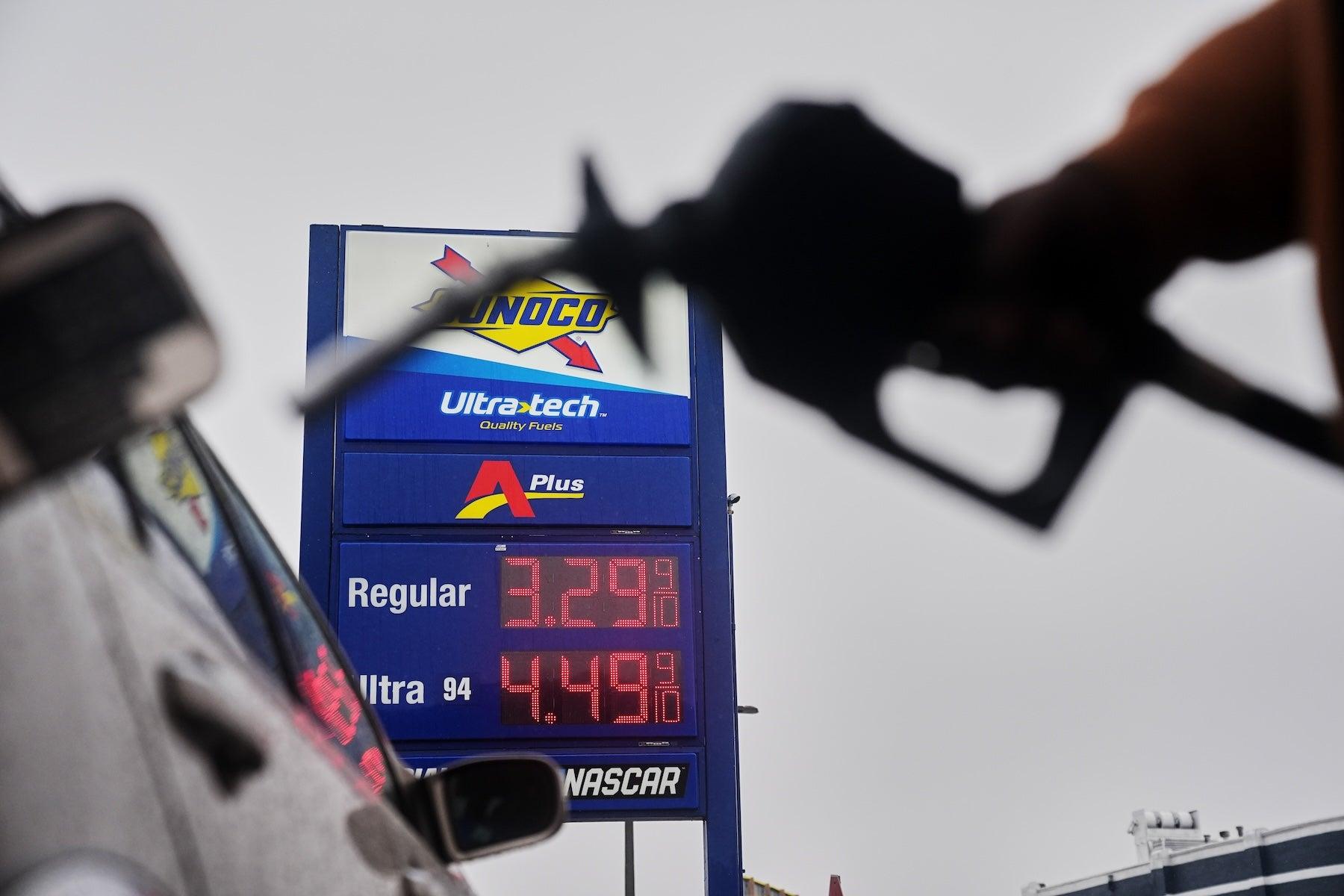
AP also tied the price shock to what consumers and businesses pay for gasoline, diesel and jet fuel, noting that “some drivers already feeling it at the pump.”
In the U.S., AAA data cited by AP showed a gallon of regular gasoline rose to “$3.41 on Saturday,” and diesel was “selling for $4.51 a gallon Saturday.”
The Hill similarly described a domestic price surge, saying the U.S. national average for a gallon of regular gasoline jumped “14 percent since last week to $3.41 as of Saturday,” and that it was the highest national average since “April 2024, when the average peaked at $3.67.”T
Strait of Hormuz and supply disruptions
Multiple reports linked the price spike to disruptions around the Strait of Hormuz and damage to energy infrastructure.
The Hill said “Twenty percent of the world’s crude oil and natural gas mostly passes through the Strait of Hormuz, off Iran’s coast; the conflict has left the waterway effectively closed,Timereported.”T

AP described the Strait of Hormuz as “the narrow mouth of the Gulf that is bordered on its north side by Iran,” and said the disruption left “ships that carry roughly 20 million barrels of oil a day stranded in the Persian Gulf.”
PressTV, in its account, said Iran “has restricted transit through the Strait of Hormuz, a strategic waterway responsible for a fifth of global oil demand, since the early days of the US-Israeli aggression on the country that began on February 28 and halted in a Pakistan-brokered ceasefire on April 8.”
PressTV also asserted that “coordinated passage through the strait is allowed for all ships except for those linked to the US and the Israeli regime and associated entities.”
AP reported that the conflict widened and included attacks that affected facilities, saying Iran launched “a series of retaliatory attacks, including a drone strike on the U.S. Embassy in Saudi Arabia,” and that Iran “hit a major refinery in Saudi Arabia and a liquefied natural gas (LNG) facility in Qatar.”
AP said those actions “halting flows of refined products and taking about 20% of the world’s LNG supply offline,” and it quoted Rystad Energy’s Claudio Galimberti saying, “We keep seeing news of vessels being hit or refineries or pipelines, so the list is very long.”
AP added that “roughly 9 million barrels of oil per day are off the market because of facilities being hit or producers taking precautionary measures,” and described the resulting “extreme deficit.”
What officials and analysts say
U.S. officials and energy analysts described both the expected duration of military operations and the likelihood of continued price pressure.
“four to five weeks”
AP reported that President Donald Trump said Monday that the U.S. expected its military operations against Iran to last “four to five weeks” but also said the U.S. has “the capability to go far longer.”
AP also said that on Friday, Trump appeared to rule out talks with Iran absent its “unconditional surrender.”
The Hill quoted Trump telling Reuters in an interview the day before that he was “not concerned about it,” adding, “They’ll drop very rapidly when this is over, and if they rise, they rise, but this is far more important than having gasoline prices go up a little bit.”T
The Hill also included Energy Secretary Chris Wright’s estimation that gas prices will fall within “weeks, not months,” and quoted him saying, “We got a little bit of an interruption right now to finally put an end to their ability to wreak havoc, to kill Americans and to terrorize their neighbors.”T
AP, however, included a different tone from Al Salazar of Enverus, who said, “The more news we get, the more it seems like this is going to last a really long time.”
AP also quoted Claudio Galimberti of Rystad Energy saying, “Right now, with all of this shut in, we are in a situation of extreme deficit.”
PressTV added a political-economic framing, saying rising U.S. fuel prices and inflation put pressure on President Donald Trump, whose approval rating fell to “34 percent” in a Reuters/Ipsos poll.
The Hill further cited Pacific Research Institute economist Wayne Winegarden telling The New York Times that even a “short-term increase in prices” would “still significantly squeeze people’s budgets, and you significantly impacted the economy.”T
Local pump prices and regional differences
While national figures moved with global oil markets, local reporting showed how the war’s escalation translated into different pump prices across U.S. regions.
WHYY reported that as the U.S.-Israeli war with Iran continued on its “sixth day,” local drivers were feeling the impact at the pump, and it tied that to crude oil price spikes.
WHYY said that in Philadelphia, Thursday’s average for a regular gallon of gas was “up to $3.22,” a “20-cent increase from a week prior,” and that diesel in Philadelphia was “up to $4.43 per gallon,” compared to “$4.18 a week earlier.”
WHYY reported that the current average in Pennsylvania was “$3.36 per gallon,” approximately “10 cents higher than the national average of $3.25,” and it said in New Jersey the current average for regular gas was approximately “$3.14 per gallon,” up from “$2.92” a week earlier.
WHYY also said drivers in Delaware could expect to pay about “$3.15 per gallon of regular gas,” up from “$2.95 the week before.”
AP’s national reporting put the regular gasoline figure at “$3.41 on Saturday,” and it said diesel was “selling for $4.51 a gallon Saturday,” while also describing how the fallout was felt in Europe and Asia.
AP reported that “Diesel prices doubled in Europe, and jet fuel prices rose by close to 200% in Asia,” citing Claudio Galimberti at Rystad Energy.
The Hill added that West Coast states, Hawaii and Nevada were seeing some of the highest prices, with California topping the list at “$5.07,” while Kansas was at the lowest end at “$2.90.”T
In the same Hill report, AAA’s data and the Energy Information Administration were used to describe supply and demand, including gasoline production at an average of “9.3 million per day” and demand falling from “8.73 million barrels per day to 8.29 million.”T
Duration, politics, and outlook
The sources also framed the outlook for prices and the political stakes around how long the conflict would last and how governments respond.
“four to five weeks”
AP said President Donald Trump expected U.S. military operations against Iran to last “four to five weeks” but also said the U.S. has “the capability to go far longer,” and it reported that on Friday Trump appeared to rule out talks with Iran absent its “unconditional surrender.”
AP included a consumer reaction from Mark Doran in Middlebury, Vermont, who said, “It’s crazy. It’s not needed, especially at a time when people are already struggling, but not unexpected from all this turmoil that’s going on,” and added, “I don’t think there’s been an end in sight to any Middle East conflict that’s been started by us.”
AP also reported that “The more news we get, the more it seems like this is going to last a really long time,” quoting Al Salazar of Enverus.
The Hill described Energy Secretary Chris Wright’s view that gas prices would fall within “weeks, not months,” while also quoting Pacific Research Institute economist Wayne Winegarden that even a “short-term increase in prices” would “still significantly squeeze people’s budgets, and you significantly impacted the economy.”T
PressTV argued that the fuel price hike was the sharpest in the G7 and said, “The unprovoked American-Israeli war against Iran has pushed up fuel prices faster in the United States than in any other member state of the Group of Seven (G7).”
PressTV also said that unlike the U.S., “some governments have introduced subsidies or cut taxes to cushion the impact of soaring fuel prices on consumers,” and it quoted Edward Hayden-Briffett saying, “In the US, it’s the consumer bearing the cost, whereas in other countries the state is doing more to absorb the additional cost.”
Finally, AP described how the U.S. could not fully insulate consumers because oil is traded globally and because refineries are designed for different crude types, noting that “most of the oil produced in the U.S. is light, sweet crude” and that refineries on the East and West coasts are “primarily designed to process heavier, sour crude.”