USAupdated 27m ago3 min read
MapU.S. Army Conducts Controlled Detonations of Lead Azide at Iowa Ammunition Plant
12 Western Mainstream3 Other3 Western Alternative4 Other source typesMap: © OpenStreetMap contributors, ODbL · Cropped for layout
This article is an automated aggregation of coverage from news outlets. Our editorials offer in-depth analysis curated by the NewsCord team.
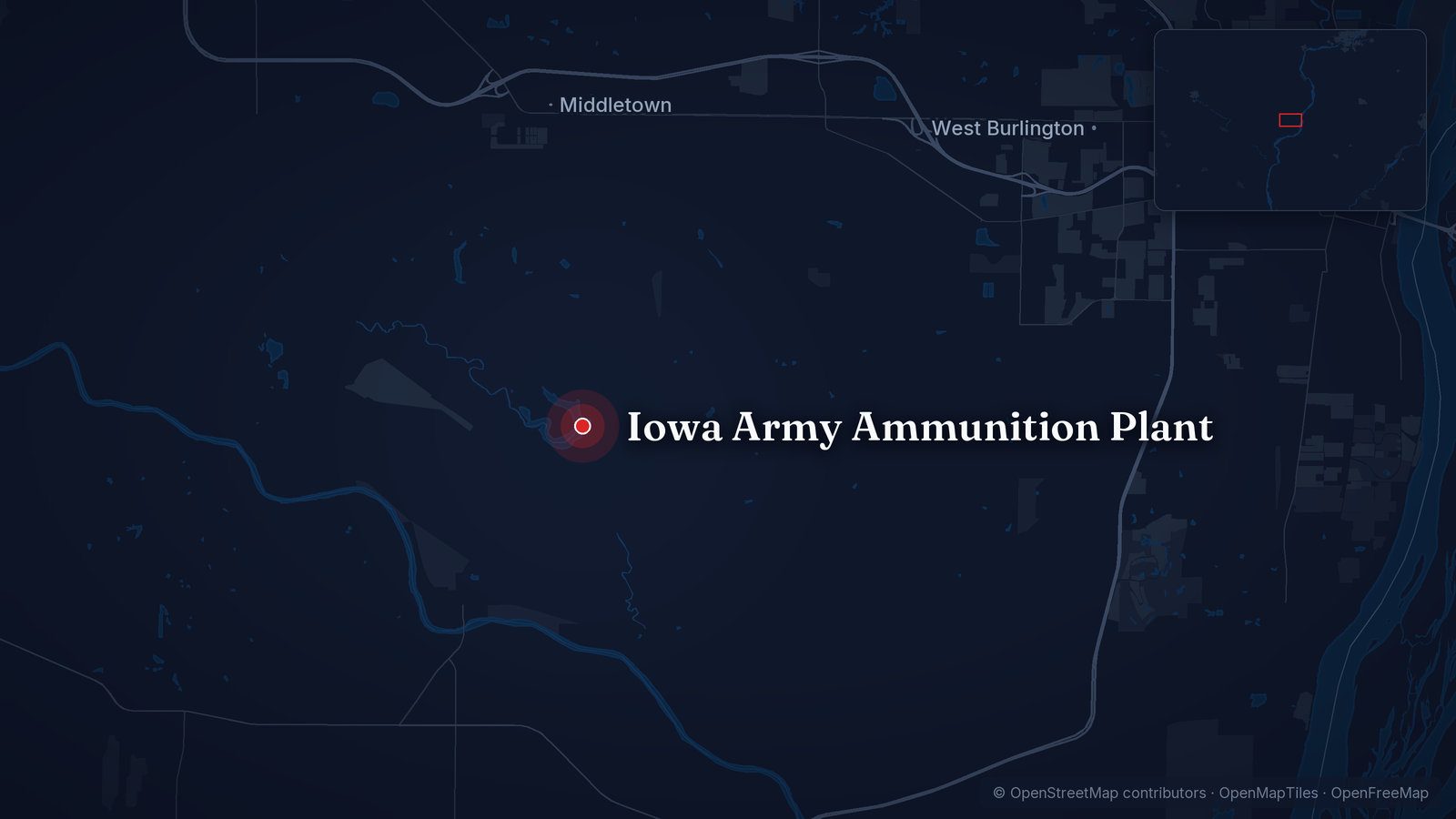
Nearly five tons of lead azide were detonated at Iowa Army Ammunition Plant. Nearby residents were evacuated or sheltered indoors as a precaution against dust.
Save coverage image
Zero lead after detonation
The United States Army carried out two controlled detonations of 68 barrels containing lead azide at the Iowa Army Ammunition Plant in Middletown at approximately 9 a.m. CT/10 a.m. ET on Wednesday, with federal officials saying preliminary reports found "zero" levels of airborne lead in the air.
Maj. Gen. Eric Shirley, the commanding general of the U.S. Army Sustainment Command, said in a video statement later in the day that the blast "exceeded expectations" and that "Every indication is that all of the munitions that were employed absolutely reduced the lead azide threat."
The Environmental Protection Agency said in a statement that "real-time air monitors are reporting ZERO detection of airborne lead" and that it collected 1,591 samples of air, water, soil and dust before the explosion.
The EPA said it has taken more than 1,000 additional samples since Wednesday and that it expects to complete most of its air and water sampling Thursday, including a second round of drinking water tests.
The Army said it had planned the detonation to destroy a degraded stockpile in place after it discovered the explosive bomb-making material had become unstable, and the operation followed a public advisory recommending Middletown residents evacuate "out of an abundance of caution."
Court fight and evacuation
Federal officials said the detonation came after the Army postponed it twice amid public concerns and a legal challenge, and the Iowa Environmental Council and Sierra Club Iowa Chapter filed an emergency motion on Thursday arguing the detonation could spread lead dust across a large area. The Eighth Circuit Court of Appeals granted an administrative stay of the permit while the federal appeals court considered the emergency request to formally halt the detonation, and the Army had earlier recommended evacuation for Middletown residents ahead of the blast. The Army said residents of a small town and other nearby areas should leave "out of an abundance of caution," while acting Secretary of the Army Adam Telle said, "Our goal is to keep as much of it as we can here on our Iowa Army Ammunition plant to prevent it from traveling."
The Army also said it worked with experts to mitigate the effects of detonating nearly 9,700 pounds of the toxic and volatile substance, including using a waterwall, foam barriers and gel blocks to contain the explosion. The operation proceeded after a federal appeals court cleared the plan on Monday after environmental groups sued, and the detonation then occurred at a little after 9 a.m. local time at the Iowa Army Ammunition Plant in Middletown.
Monitoring, politics, and fallout
The EPA said it will be monitoring levels of lead "for as long as it takes that we have the comfort that the levels are back to safe levels," and it added that it expects laboratory results from post-detonation samples as early as Friday.
The Army said its mitigation efforts included barriers around the bunkers holding the material and the use of foam and water to trap particles, while the Army also said its projections showed dust could settle up to 40 miles (64 km) southwest.
Missouri Gov. Mike Kehoe said in an X post after the explosion that "initial analysis shared with us by federal partners and Iowa Homeland Security and Emergency Management indicates that the mitigation measures appear to have been successful and the explosion was well-contained."
Vice President J. D. Vance faced criticism after he attempted to blame former President Barack Obama for the lead contamination concerns, and Vance told reporters, "I think we need to remember that this was a problem that had been deferred."
Environmental organizations and medical groups had raised concerns over the potential impacts of the blast's anticipated lead dust plume, and the Army guidance described a 148 square-mile zone outside of the plant where hazardous dust and materials may cover the area.