Iranupdated 23m ago3 min read
MapUS Fires Precision Munitions, Disables St. Kitts-Flagged Ship Trying To Break Iran Blockade
“A US warplane fired precision munitions at it after American forces had ordered it to ‘abandon targeted spaces.”
“two ‘violating’ oil tankers seeking to transit the strait through an ‘unauthorized’ route caught fire after hitting naval mines.”
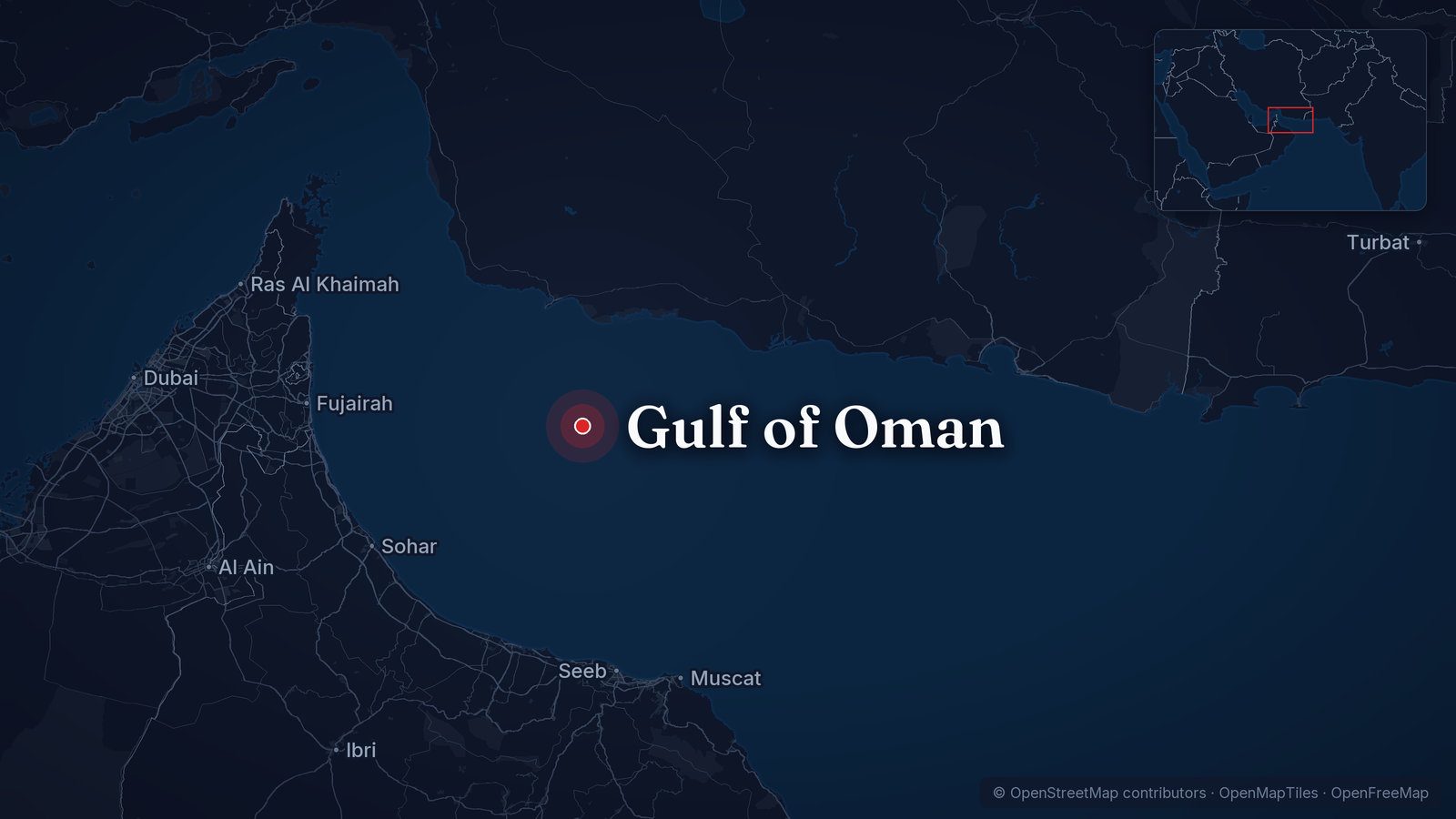
Map: © OpenStreetMap contributors, ODbL · Cropped for layout
This article is an automated aggregation of coverage from news outlets. Our editorials offer in-depth analysis curated by the NewsCord team.
US forces fired on and disabled a ship attempting to breach Iran's blockade. CENTCOM says vessel ignored stop orders and attempted to break the blockade.
Save coverage image
Blockade, drones, and mines
The United States Central Command said it fired on and disabled a commercial ship in the Gulf of Oman after the ship’s crew ignored orders to stop and attempted to break its blockade of Iran, with CENTCOM adding that the ship’s civilian crew ignored repeated warnings and attempted to violate the naval blockade against Iran multiple times.
CENTCOM said a St. Kitts-flagged cargo ship attempted to exit regional waters after stopping at an Iranian port, and a US warplane fired precision munitions at it after American forces had ordered it to "abandon targeted spaces."
Iran’s IRGC warned that two oil tankers in the Strait of Hormuz caught fire after hitting naval mines, after the IRGC said the tankers were seeking to transit the strait through an "unauthorized" route.
The IRGC Navy warned that any vessel that cooperates with the invading and plundering US Army and defies Iranian Strait of Hormuz regulations and enters the unauthorized zone will certainly hit a mine, as the IRGC Navy announced that two offending oil tankers in the eastern area of the Strait of Hormuz and another in the Strait of Hormuz were on fire after colliding with a mine.
Task Force Iron Gate
CENTCOM announced the creation of a new task force to disrupt Iran’s movement of advanced weapons, dual-use technology, and sanctioned material into Iran through land routes and the Caspian Sea, and CENTCOM said Task Force Iron Gate comprises around 20 military and civilian personnel based in Tampa, Florida. CENTCOM Commander Admiral Brad Cooper said the team would also reinforce the US naval blockade of Iran’s ports to "further constrain Iran's ability to finance terrorism, rebuild weapons factories, and replenish their military."
Iran’s Northern Fleet Commander Rear Admiral Mohsen Razzaqi warned US forces in the region against any aggression, saying coordination among Iran’s armed forces is at its highest level and naval units remain prepared to defend Iran’s maritime borders round the clock. Razzaqi said, “The cost of any aggression against Iran must be raised to such an extent that the enemy will no longer dare attack the country again,” and the Times of India said his remarks came amid warnings from Iranian officials and military commanders about preparedness to respond to renewed aggression.
Diplomacy and public warnings
Regional diplomatic efforts intensified as Iran engaged in outreach to secure strategic support and coordinate de-escalation steps, and Secretary of Iran's Supreme National Security Council Mohsen Rezaei met Russian President Vladimir Putin in Moscow on Thursday delivering a message from Iran's Supreme Leader Mojtaba Khamenei. Rezaei said Putin strongly condemned the U.S.-Israeli war against Iran and expressed readiness to provide any assistance necessary to help bring the war to an end, while Iran’s Foreign Minister Seyed Abbas Araghchi held phone calls with counterparts from Oman, Jordan, Qatar, Saudi Arabia, Türkiye, and Kuwait to discuss diplomatic processes.
“The safest place for Iranian civilians during heightened tensions is inside their home.”
A US military official urged Iranian civilians to remain indoors and stay away from Revolutionary Guards positions if military tensions escalate, telling Iran International that the IRGC was placing weapons and command centers in residential areas. The US official said, “The safest place for Iranian civilians during heightened tensions is inside their home,” and the same account said Iranian officials have repeatedly denied using civilians as shields.