Take action
Two complaints to the BBC, in your name
Complain to the BBC about both of its Gosport reports.
What the crowd in Gosport did
On Sunday 4 October the RNLI and a French vessel picked up 149 people from a dinghy in the middle of the Channel. Two RNLI lifeboats brought them into Haslar Marina in Gosport late that evening. A crowd had gathered on Haslar Road from the late afternoon to stop them landing.
The Southampton Daily Echo reported the evening live. At about half past five the crowd blocked a line of ambulances, and the police line advanced to let them through. Just after six a woman on a megaphone told the police to protect their own people and not the people on the boats, whom she called vermin. When the lifeboats came in at about half past ten, protesters on the pier shouted for the people on board to be sent back, along with insults and threats.
Protesters set off flares. Hampshire Police arrested twelve people on suspicion of offences: two of racially aggravated public order offences, six of assaulting police officers or an emergency worker, and one of obstructing the road after ambulances were stopped on Clayhall Road. The force’s Assistant Chief Constable, Simon Dodds, said several incidents that night were not peaceful protest but violent public disorder.
What protesters in Dover did the same night
On the night of 4 October protesters in Dover chanted the n-word. NewsCord has verified the footage.
What was done to a taxi driver
A second video, filmed in Britain, shows people holding a White Lives Matter banner across the windscreen and window of a taxi while its Asian driver sits inside.
The BBC’s Gosport report reduces abuse like this to the legal name of an offence in a list of arrests.
What the BBC wrote
The BBC published its report on 5 October, under the headline “Twelve arrests after protest over migrant boat arrival”. It says the atmosphere at the protest “mostly remained peaceful”.
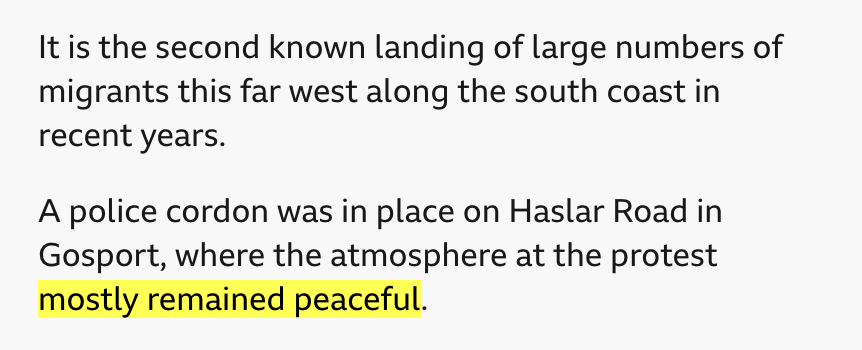
The report quotes two chants, one telling the police to be ashamed and one calling for deportation. It mentions the blocked ambulances only as the reason for one arrest. It does not report the woman who called the people on the boats vermin, or what was shouted at the lifeboats.
The two racially aggravated arrests appear in a list of twelve, one line each. The report never says that anyone was racially abused, who was targeted, or what was said. The words racist and racism do not appear in it.
The 149 people from the dinghy appear as a number taken by coach to a processing centre in Kent. The second half of the report sets out Home Office figures for Channel crossings this year.
The BBC’s earlier report of the same night, by Duncan Kennedy, says there were a few scuffles and that the protest mostly remained peaceful. It reports the Gosport council leader saying protesters left barricades and nails on the roads and started small fires. It reports no arrests.
What the BBC did last time
On 5 September hundreds of masked men blocked the roads into the Port of Dover. The BBC’s report that day named the network an anti-racism group said had organised it, and called Tommy Robinson and Daniel Thomas far-right activists in its own voice. It gave space to an MP who said the men had set out to terrorise the people of east Kent.
On 23 September the BBC described Daniel Thomas as an anti-migrant activist.
The BBC can name the far right in its own voice. It did so on 5 September.
What the BBC’s own code says
Section 3 of the BBC’s Editorial Guidelines covers accuracy. Guideline 3.4.16 says the BBC must not knowingly and materially mislead its audiences. Guideline 3.4.19 says that leaving out significant details can make a report inaccurate, and that audiences should be given the relevant facts, complete information and context to understand what happened.
Two arrests on suspicion of racially aggravated offences are a significant detail. So is a police chief calling the night violent disorder when the BBC calls it mostly peaceful.
September against October
In September the BBC named the network said to be behind the Dover blockade and called two men who praised it far-right activists. In October it reported a night of racially aggravated arrests without using the word racism. Both reports covered protests against people crossing the Channel.
What the BBC should do
- Ask Hampshire Police what the two racially aggravated arrests relate to, and report the answer in plain words.
- Remove the description of the protest as mostly peaceful from the 5 October report, and the description of a few scuffles from the 4 October report.
- Publish a correction note on both reports saying what was changed and why.
Hampshire Police arrested two people that night on suspicion of racially aggravated offences. A reader who relies on the BBC would not know that racism was there at all.
Take action
Two complaints to the BBC, in your name
A complaint about each of the BBC’s two Gosport reports goes to the BBC in your name. Each asks the BBC to say what the racially aggravated arrests relate to, to drop its description of the night as mostly peaceful, and to publish a correction note.
Sources: BBC News, “Twelve arrests after protest over migrant boat arrival”, 5 October 2026, and “Protesters scuffle with police as migrants brought ashore on south coast”, 4 October 2026; Southampton Daily Echo live blog, 4 and 5 October 2026; Hampshire and Isle of Wight Constabulary statement, 5 October 2026; BBC News, “Disruption at Port of Dover due to ‘stop the boats’ protest”, 5 September 2026, and “Migrants taken to Dover after more than 30 hours at sea”, 23 September 2026; BBC Editorial Guidelines, Section 3, guidelines 3.4.16 and 3.4.19; video footage verified by NewsCord.