
What the Telegraph’s headline and opening say
On Sunday 4 October 2026 the Telegraph published this headline:
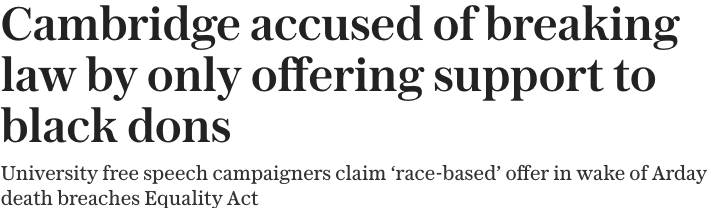
Its first sentence:

The support and advice came from one sentence in an email the University sent to all staff and students on 27 August, on behalf of its Senior Black Leaders Group, five senior Black academics. The Telegraph quotes it:

The email invited Black staff to get in touch. In the Telegraph’s first sentence that invitation becomes “denying” support to everyone else.
The article’s final paragraph quotes the University:

The headline says Cambridge offered support only to black dons. The Telegraph’s own last paragraph says Cambridge sent wellbeing support to everyone.
What the Telegraph left out
The word “abuse” does not appear in the Telegraph’s article. The word “racist” appears once, in an anonymous academic’s complaint that the University might call its critics racist.
On 21 August, six days before the email, the University said:
“We are appalled that many of our Black students and staff, as well as members of our Faculty of Education, continue to receive racist, hateful and abusive messages in online forums and on social media, and condemn all forms of abuse.”
That is the situation in which senior Black academics offered support to Black staff. The Telegraph does not report it.
Jason Arday, Cambridge’s youngest Black professor, resigned on 5 August, writing that he had reached “the limits of what any person should reasonably be expected to endure”. He was found dead on 14 August. Between 24 July and 14 August NewsCord counted 249 articles about him in 15 national outlets. The Telegraph published 43 of them, and put the words “diversity poster boy” in six of its headlines. On 6 August the Daily Mail asked its readers: “POLL OF THE DAY: Has criticism of Professor Jason Arday been ‘racially motivated’, as he claims?” Cambridge’s Chancellor, Chris Smith, said it was possible “to believe in the importance of academic integrity” and “to refuse to join in a racist feeding frenzy over a particular academic”. The Telegraph’s 4 October article mentions none of this.
The Telegraph names all five members of the Senior Black Leaders Group in full. It quotes their email, carries no response from any of them, and does not say any of them was asked for one.
What Black students said
On 24 August the Cambridge Black Alumni and Student Collective said that “Cambridge pays little to no regard to the racially-fuelled difficulties we endure as Black scholars”.
Cambridge Black students and academics signed an open letter about Arday hosted by Good Law Project. Good Law Project holds their names and is not publishing them “because they are fearful of retaliation by the press.”
On 11 September Black students in Cambridge’s Faculty of Education spoke to The Voice under pseudonyms. A fully funded PhD student, Student Y, said:
“I’m now scared to write my thesis, worried about whose scrutiny it would fall under.”
“The press are circling like vultures for students to put one foot wrong so they can ridicule and belittle DEI efforts.”
Student Y said they worried that friends doing strong research would stop writing, “that we will lose the excellent minds of this generation”.
The students asked Cambridge for a Black Academic Protection and Support Taskforce: crisis responses with deadlines, money to protect students’ studies, and a fund for therapeutic care. Black Leaders in Higher Education UK, a group of Black academics and professional staff, called on universities to support and reassure Black students and staff affected by the case.
What the Telegraph did with the evidence

The email said that Black academics “have to achieve far more and clear significantly higher hurdles than their peers”. The Telegraph wrote that the email “claimed” this. It reported, without challenge, the Committee for Academic Freedom’s concern that “contested ideas including racial equity were presented as fact”.
The Higher Education Statistics Agency’s figures for 2024-25: Black staff were 4.21% of UK academics below professor and 1.13% of professors. In 2019 the Equality and Human Rights Commission found that 29% of Black students had been racially harassed since starting their course. The Telegraph printed neither figure.
Who the Telegraph let speak
Every academic the article quotes making the accusation is anonymous. The Telegraph agreed not to name them because one feared that being named could damage their career.
An anonymous academic told the Telegraph that “Senior Cambridge figures have racialised the Arday plagiarism affair throughout”, and that this “suppresses free speech by implying that the institution will call you a racist if you dare to advocate for universal academic standards”. The Telegraph printed both claims without comment. Between 24 July and 2 August the Telegraph had called Arday “Cambridge’s diversity poster boy” in six headlines.
Partway through the news report, the Telegraph placed a link to a comment piece by Zoe Strimpel: “Cambridge is gorging on social justice foolery, and destroying its reputation”.
The Black students who were afraid to put their names to a letter about Arday do not appear in the article.
What the law says
The Equality Act 2010 forbids direct discrimination. Section 13(1): “A person (A) discriminates against another (B) if, because of a protected characteristic, A treats B less favourably than A treats or would treat others.” A member of staff refused help because they are white would have a case to make. The Telegraph reports no such person.
The Act allows targeted support. Section 158 applies where a person “reasonably thinks that... persons who share a protected characteristic have needs that are different from the needs of persons who do not share it”. In that case the Act “does not prohibit P from taking any action which is a proportionate means of achieving the aim of... meeting those needs”.
The Act also puts a duty on universities. Section 149(3) says that having due regard to equality of opportunity involves having due regard to the need to “remove or minimise disadvantages suffered by persons who share a relevant protected characteristic that are connected to that characteristic” and to “take steps to meet the needs of persons who share a relevant protected characteristic that are different from the needs of persons who do not share it”. Schedule 19 lists “The governing body of an institution in England within the higher education sector” among the bodies bound by that duty.
Cambridge had said in writing, six days before the email, that its Black students and staff were being sent racist abuse. That is a disadvantage connected to race, which is what section 149(3)(a) describes. The Telegraph headlined the support as “breaking law” and did not mention section 158.
The law protects the complainants too. The anonymous academics may disagree with the email’s account of race at Cambridge and say so. The Committee for Academic Freedom may write to the Vice-Chancellor. Our complaint is with the Telegraph: with its headline, and with what its article left out.
What the Telegraph should do
- Change the headline so that it reports an offer of support to Black staff, and add a note to the article saying what was changed.
- Add to the article the University’s statement of 21 August on racist abuse of its Black students and staff, and the fact that section 158 of the Equality Act allows support aimed at a group with different needs.
- Publish, with the same prominence as the 4 October article, a response from Black students or staff at Cambridge on why that support was needed.
Black staff at Cambridge were offered someone to talk to, and the Telegraph’s headline should say so.
Sources: The Telegraph, “Cambridge accused of breaking law by only offering support to black dons”, 4 October 2026, and its Jason Arday coverage of 24 July to 2 August 2026; University of Cambridge statement, 21 August 2026, as reported by Varsity; The Voice, 11 September 2026; Good Law Project open letter, August 2026; Inside Higher Ed, 18 August 2026; Daily Mail, 6 August 2026; HESA staff data 2024-25, compiled on the SRHE blog, 27 May 2026; Equality and Human Rights Commission, Tackling racial harassment: universities challenged, 2019; Equality Act 2010, sections 13, 149 and 158 and Schedule 19; NewsCord, the Jason Arday press census.