Data Investigation
Jason Arday told the press he was at the limits of what anyone should endure. It answered with 188 more articles. He is dead at 41.
On 5 August 2026 Jason Arday resigned from Cambridge, writing that he had reached “the limits of what any person should reasonably be expected to endure”. On 14 August he was found dead at his home in Battersea. Nobody knows yet how he died, and this page does not claim to. It counts what he was under: every substantive written article the national press published about him, outlet by outlet and day by day, from the first Telegraph report to the 3:12pm boundary on the day he was found. Later coverage is shown separately.
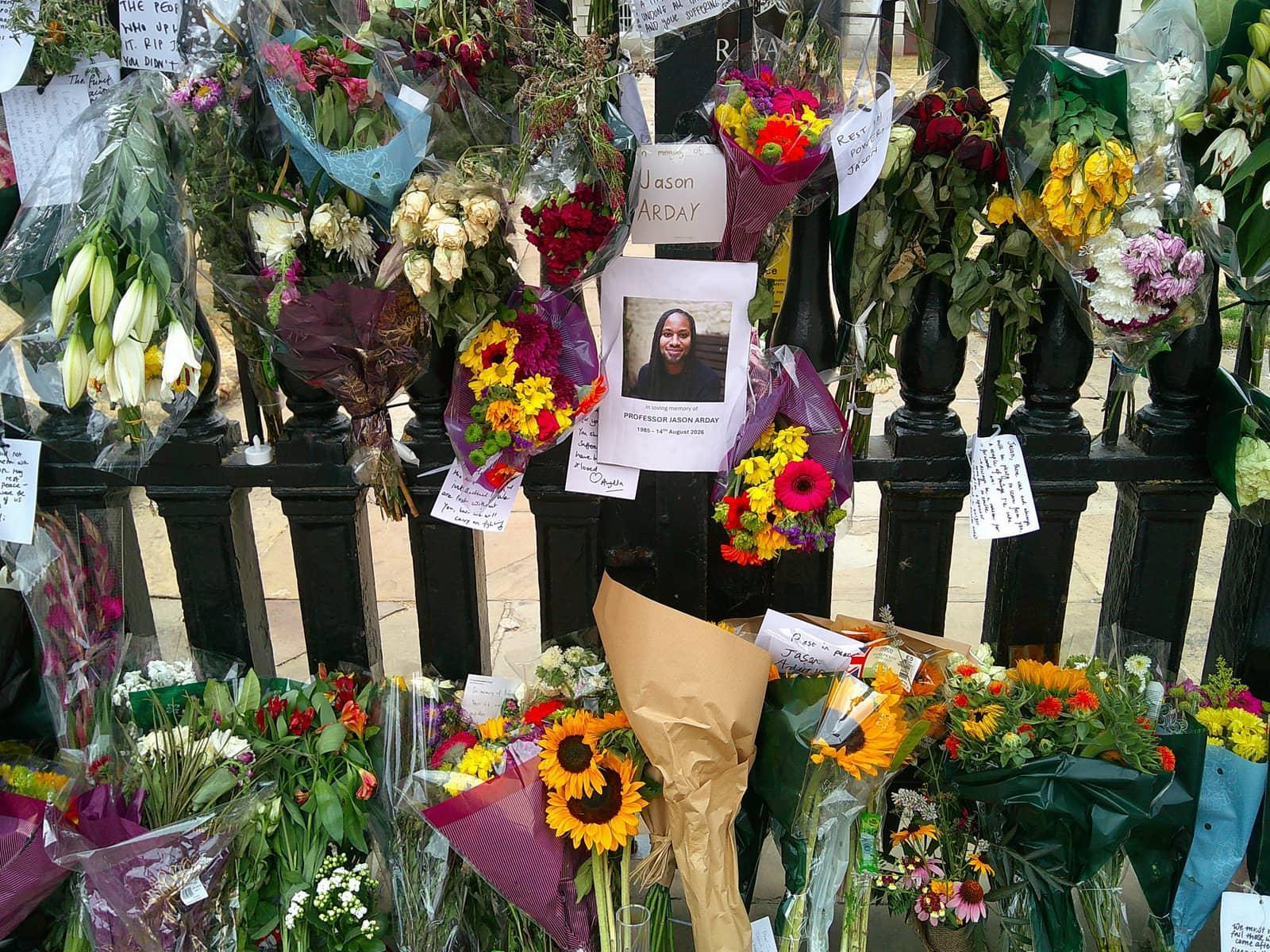
By NewsCord Editorial TeamPublished 14th August 2026, last updated 19th August 2026Photo: Southdevonian, CC0, via Wikimedia Commons
229 articles in 22 days, and 106 more since
We counted every distinct article substantively about Jason Arday published by the national outlets below between 24 July 2026, when the Telegraph brought the allegations mainstream, and 3:12pm on 14 August 2026, the day he was found dead. News, features, columns, leaders and letters pages all count once; a passing mention inside a piece about something else does not count at all. Every article is listed, with its link, in the table at the bottom of this page. Death-day figures are floors: the census was taken hours after his death was announced, while the follow-ups were still landing. The violet band is what those same fifteen outlets published after he was found, 106 articles up to 19 August at 10:33, when the coverage turned on itself. The ambulance was called at 3:12pm on 14 August. The former 249-row figure included one video-only page and 19 written articles published after that boundary. The video is supplementary evidence and those later articles now sit in the violet band, not among the last things printed while he was alive. The chart keeps the original fixed set of fifteen mastheads across every period; fourteen published before he was found, while the Daily Star first appears after the boundary.
One honest finding up front: this was not a red-top phenomenon. The Mirror ran one piece before the boundary; the Daily Star’s one item in the former list arrived after it. The BBC and Sky covered it as news, at news volume. The pile-on was led from the top of the market: The Times, the Telegraph, the Mail, the Spectator and the Express account for 152 of the pre-boundary articles.
The Telegraph
42Broke the story on 24 July under the headline 'Cambridge's diversity poster boy in plagiarism row' and reused 'diversity poster boy' as his name in at least eight further headlines. At 3:11pm on the day he died, one minute before the ambulance service called the police from his home, it published 'Jason Arday says he was an illiterate, mute child. His schoolmates remember it differently.'
Blocks crawlers and archives; 1-3 further comment pieces or letters selections may be missed. Its podcast episode on the case is not counted.
The Times / Sunday Times
41The highest count of any outlet. Ran his only major interview ('I am not a liar'), its own forensic analysis ('impossible data'), a review calling his memoir 'mawkish, self-aggrandising and hard to believe', a piece on whether his resignation letter was AI-written, student testimony ('He was late to class and spouted nonsense'), an interrogation of whether he was really non-verbal as a child, and, on the day he died, an obituary at 8:40pm and a mocking comment piece at 6:12pm that was quietly deleted after his death broke.
Times and Sunday Times counted together. Paywalled; bylines mostly unrecoverable; 0-3 further diary items or letters pages may be missed.
Daily Mail / MailOnline
37Thirty articles in the nine days between resignation and death, more than three a day: a 'Professor Plagiarism' nickname across headlines, a reader poll on whether his racism claim was valid, Boris Johnson naming 'the REAL racists', Jan Moir's Shergar joke, a TikToker's memory of him as a 'chatty patty' at primary school, and, at 1:01am on the day he died, a psychiatrist speculating about 'one condition that could explain everything'. In 2023 the Mail had printed his life story as an uplifting exclusive, unchecked.
Counted from the Mail's own day-by-day sitemaps, so high confidence; at most 1-2 misses where a slug avoids his name.
The Independent
21Twenty-three pieces from resignation day onward, including 'Everyone is laughing at Jason Arday. I think it's a tragicomedy' and a feature calling him 'the seemingly impossible Cambridge professor'. Also carried the one early piece arguing Black academics are held to higher standards.
Three short 'bulletin' digest versions of stories that also ran in full are counted as distinct items; merging them gives 20 post-resignation pieces.
The Spectator
21The national weekly made him its cover story ('The fantastical truth about Jason Arday') with an unsigned leader, 'Cambridge has fallen'. Around the cover: Toby Young's 'Professor Arday is the gift that keeps on giving', which opens by joking he might be a Sacha Baron Cohen character; 'The genius of Jason Arday'; 'Sociology is about much more than fools like Jason Arday'; a former Met officer asking 'Should the police investigate Jason Arday?'; and, released on the morning of his death, a podcast episode titled 'It's a cesspool!'.
Its death-day report appeared on the magazine's own site listing but was not yet indexable when the census closed, so it is uncounted. Five round-up items and passing mentions on its own Arday tag are also excluded; the loosest defensible count is 26.
The Guardian
18Its 1 August investigation into his biography ('Playbooks, plagiarism and a pig's head') moved the story from his thesis to his life. Then seventeen pieces in nine days: news, a leader, letters pages, and an opinion row about what his fall meant, including 'questions raised over Jason Arday's claim he was non-verbal as a child' two days before he died.
Counted via the Guardian's own Content API, so effectively exhaustive; ten passing mentions in briefings and liveblogs were excluded.
Daily Express
11Nothing while it was a thesis story, then ten pieces in his last nine days, almost all comment: 'We should thank Jason Arday, he has humiliated our woke establishment', Carole Malone on 'the diversity cult', and on 13 August, the day before he died, 'Disgraced Jason Arday might finally have one true thing to boast about'.
Three further multi-topic columns with dedicated Arday segments were conservatively excluded from the count.
BBC News
9Straight news at news volume: the resignation, the Met's 'dropped the ball' admission, the university reviews, the death. Its education editor asked 'serious questions for Cambridge'; nothing resembling the nickname-and-mockery register. In 2023 the BBC had run the celebratory appointment profile.
Two daily paper-review round-ups mentioning Arday excluded; plus TV and radio segments (The Media Show led on the case on 12 August) not counted as articles.
Times Higher Education
9Had the story FIRST, in September 2025, as a 63-page dossier, and published nothing: Arday's lawyers Carter-Ruck sent a letter and the story was spiked. Arday reported THE's journalist to the Met for harassment; the force investigated him for four months before conceding the complaint should never have been taken up. THE's first published word on the case was an editor's note on 3 August 2026.
The near-year of silence from September 2025 is the data point; see the killed-story section.
GB News
8Articles plus the TV treatment: a Kelvin MacKenzie column whose search headline read 'If Cambridge professor Jason Arday was white he'd have been sacked months ago', and YouTube segments including 'DEI GONE MAD!' (76,000 views) and a Patrick Christys 'diversity poster boy' segment.
Website articles only; TV segments never uploaded to YouTube cannot be counted, so the true broadcast volume is higher.
The Sun
7Ignored the story entirely for its first twelve days, then arrived on resignation night and gave its space to columnists: Nigel Farage ('it's time we dumped this toxic ideology'), Julia Hartley-Brewer, and Clemmie Moodie calling him 'a thinking man's Lee Andrews'.
Counted from The Sun's own search feed and day sitemaps; Scottish and Irish Sun editions not counted.
Metro
2Straight news only: the resignation, the cancelled book tour, the death. Proof that covering the story without joining the pile-on was always available.
Metro blocks external verification; a minor follow-up could be missed.
Sky News
2Two written pieces in his last nine days, plus video segments including an academic saying on air that a 'Black professor was forced out after a coordinated campaign'. The resignation itself appears to have run through the rolling politics live blog rather than a standalone article.
Material undercount risk: Sky blocks external indexing, so this floor comes from cross-checked search indexes; video pages are not counted as articles.
Daily Mirror
1One column in life ('Everyone should face scrutiny'), one article in death. The Mirror, a red-top, out-restrained every broadsheet in this table.
No standalone resignation story was found in any index; one could exist behind the consent wall.
Daily Star
0Did not judge the story worth a single article until he was dead. The most restrained record in the national press, from the paper the broadsheets call the gutter.
Highest undercount risk of any outlet (weak external indexing).
The pile-on had names. The same ones, again and again.
Every one of the 229 articles now carries its byline. The paywalled outlets stripped theirs, so those were read off the published pieces and filled in by hand. The result is 158 named journalists, and a very small number of them doing most of the work. At the Telegraph, Albert Tait filed 13 pieces and Gordon Rayner 11; with Janet Eastham’s 6, three reporters produced 30 of that paper’s 42.
And 15 of the 229 carry no journalist’s name at all. 5 of those are leaders, and a leader is not one writer’s opinion that an editor allowed through. It is the paper’s official position, signed by nobody because it belongs to everybody there. 5 mastheads ran one about this man while he was alive. Another 6 are letters pages, and the remaining 4 are news nobody signed, among them the Mail’s poll of the day asking readers whether the criticism of him had been racially motivated. A further 7, all of them the Independent’s, carry nothing but a wire credit: volume added to the pile-on by an outlet that did not report it. The chart counts articles credited to an identifiable journalist, with joint bylines credited to each named reporter; the outlet’s own voice is counted as an article but not as a person. Every byline is in the table at the foot of this page.
Articles credited per journalist, the most-credited sixteen, ranked on everything they have filed about him: amber while the pile-on ran, violet since he died. Joint bylines credit each named reporter once. The outlet’s own voice (leaders, editorials, letters pages) and wire credits are counted as articles but not as journalists, so they do not appear here. Bylines the paywalls hid were read off the published articles and filled in by hand, so The Times, The Telegraph and Sky are no longer undercounted across the census. Sky’s pages since his death carry no byline at all, so its violet is thin here while its bar in the chart above is not.
After he resigned, it did not slow down. It sped up.
A resignation usually ends a story. Here it multiplied it. Arday resigned on 5 August with a letter saying he had reached “the limits of what any person should reasonably be expected to endure”. The chart shows what the press did with that information: the heaviest publishing days of the entire affair came after it. In the last fourteen days of his life, the outlets we counted published about him every single day.
Grey: before the resignation. Amber: the nine days between resignation and death. Red: the day he died, all of it (a floor; the census closed at ~10pm that evening). This chart counts by calendar day, so the 14th is whole here, while the outlet chart above splits it at the ambulance call. This chart stops there, unlike the others on this page: it is the shape of the pile-on he lived through. What came after it is counted further down.
The regulator map now has its own page.
This article now stays with the coverage he lived through: the cadence, the headlines, the bylines, the last day and the receipts. The regulator classification has been moved into a separate companion audit, with the four-period split, the written-article table, the video and passing-item exclusions, and the distinction between broadcaster-affiliated web articles and verified Ofcom content.
Read the regulator companionFrom a race-science Substack to a coroner's file in 24 days
The same press printed the myth without checking
At his appointment as Cambridge's youngest Black professor, the life story now being torn apart ran everywhere as an uplifting exclusive: unable to speak until 11, unable to read or write until 18. The Mail's only 2023 Arday article was a glowing lifestyle profile of exactly that story. The Sun and the Telegraph did not cover the appointment at all.
The story existed a year ago, held to a specialist's standard
Times Higher Education reporter Jack Grove compiles a 63-page dossier on the same allegations and puts them to Arday. Arday instructs the libel firm Carter-Ruck; THE spikes the story. Arday reports Grove to the Met for harassment; the Met investigates the journalist for four months before dropping it, and Commissioner Mark Rowley later concedes the complaint should have been screened out.
A race-science blogger lights the fuse
Nathan Cofnas, the self-described 'race realist' whose Cambridge college cut ties with him in 2024 over a blog arguing Black people would 'disappear from almost all high-profile positions' in a meritocracy, publishes 'DEI Fraud and Cover-Up at Cambridge' on Substack, alleging plagiarism in Arday's thesis and papers and disputing his life story.
The Telegraph brings it mainstream
'Cambridge's diversity poster boy in plagiarism row', 1:46pm, Gordon Rayner. The Times follows six hours later, the Mail the same day. A Telegraph-commissioned analysis finds more than 100 passages of his PhD identical or nearly identical to a 2009 Brunel thesis.
The story becomes his life, not his thesis
The Guardian publishes its investigation into his biographical claims. From here the coverage is no longer about duplicated paragraphs in a 2015 PhD; it is about his childhood, his autism account, his charity runs, his memoir, his family.
Cambridge investigates; Arday resigns the same evening
Cambridge announces an investigation 'following new information about Professor Arday's academic qualifications and honorary appointments'. Hours later Arday resigns his professorship and his Jesus College fellowship with immediate effect, calling it 'the decision of someone who has reached the limits of what any person should reasonably be expected to endure'.
Found dead at 41
The London Ambulance Service calls the Metropolitan Police at 3:12pm. Jason Arday is pronounced dead at his home in Battersea. The Met: 'his death is being treated as unexpected, but is not believed to be suspicious. A file will be prepared for the coroner.' Cambridge's Vice-Chancellor says the university is 'desperately saddened'.
The last day, hour by hour
- 1:01amDaily Mail
Publishes a column by psychiatrist Dr Max Pemberton: 'Why would “Professor Plagiarism” make such outlandish claims?... there's one condition that could explain everything.' The column itself concedes 'I've never met Jason Arday, and so have no idea what has been going on in his mind'. The headline offers a diagnosis anyway, on the last morning of his life.
- 3:11pmThe Telegraph
Publishes 'Jason Arday says he was an illiterate, mute child. His schoolmates remember it differently' (page metadata: 14:11 UTC). It is the last article published about him while he was alive.
- 3:12pm
One minute later, the London Ambulance Service calls the Metropolitan Police to an address in Battersea. Jason Arday is pronounced dead at the scene.
- 6:12pmThe Times
Publishes a comment piece mocking him: 'Jason Arday may want to get himself a nice pair of orange trousers.' He has been dead for three hours; the news has not yet broken. After it does, The Times quietly deletes the page. It now returns HTTP 410: gone.
- 8:40pmThe Times
Publishes his obituary.
- 8-10pmFleet Street
The death stories land: the Telegraph at 7:59pm, The Sun at 8:04pm, the Mail at 8:30pm, the Guardian at 8:56pm, The Times at 9:45pm. Many are written by the same desks that spent three weeks on him.
Dead, he draws more copy than he did alive. And the pile-on has changed hands.
The fair question, one day on: did the press slow down once he was dead? It did not. In the 24 hours from the ambulance call (3:12pm 14 August to 3:12pm 15 August (London time)), the same fifteen outlets published 42 articles: more than double the 20.9 a day they averaged across his final nine days alive, and nearly four times the pace of the full 22-day census.
But the bylines moved. The Daily Mail filed thirty pieces in his last nine days, including the psychiatric speculation on his final morning, then published exactly one in the 24 hours after he died. Four days on, that has held. The Mail is running 1.3 pieces a day where it ran 3.3, The Times 2.8 where it ran 3.7, the Telegraph 1.9 where it ran 3.1. The outlets that barely bothered with him while he was alive have taken the story over. The Mirror ran one column in his lifetime and has filed 7 since. Sky News has gone from 0.2 a day to 0.6. The Independent has filed 27, more than any other outlet, and it is the paper carrying what his family say: Within hours of the announcement, his family said in a public statement, as reported that evening, that he had been subjected to a 'campaign of sustained abuse' since taking the Cambridge role.
Amber: each outlet’s daily rate across his final nine days alive. Red: its article count in the 24 hours after his death. The two are the same unit, articles per day. Counted roughly two hours after the window closed, with the same rules as the lead-up census. Sky is a floor (its pages resist indexing), and the one Spectator death item seen on its own site listing never surfaced as a standalone URL, so it remains uncounted.
Every article in the 24 hours after
Nine days before, nine days after
The nine days he was alive to read it, against the nine days since. Same fifteen outlets on both sides. The window closes on 23 August and we will keep counting it.
The rate has fallen since he died, to 20.3 articles a day against 20.9 while he was alive. 4 of the nine days are counted. The 19 August column holds 5 so far and is still filling, so it is a floor and is left out of the rate above.
This is not what accountability journalism sounds like
They renamed him
Once the Mail coined 'Professor Plagiarism' it stopped being a report and became a character. The Telegraph's version was 'diversity poster boy', used in place of his name in headline after headline.
'Professor Plagiarism' falsely claimed to have written book...
Cambridge University boss investigates faculty for appointing 'Professor Plagiarism'...
Cambridge's diversity poster boy in plagiarism row
Cambridge diversity poster boy faces questions over pig's head claims
They put his childhood disability on trial
The claims under investigation began with a thesis. By August, national newspapers were sourcing challenges to a disabled man's account of his own childhood from TikTok and from people who knew him at primary school.
TikToker who says he went to primary school with Jason Arday claims 'plagiarism professor' was NOT mute but a 'chatty patty' in class
Was Jason Arday non-verbal? His old schoolmates disagree
'Always cracking jokes': questions raised over Jason Arday's claim he was non-verbal as a child
Jason Arday says he was an illiterate, mute child. His schoolmates remember it differently
They made him a game
A reader poll on his claim of racism. A former Prime Minister's column. Celebrity columnists competing for the best joke. This is the register of a pile-on, not of accountability journalism.
POLL OF THE DAY: Has criticism of Professor Jason Arday been 'racially motivated', as he claims?
Professor Arday is the gift that keeps on giving (opening line: 'Are congratulations in order for Sacha Baron Cohen?')
BORIS JOHNSON: The Cambridge academics who cynically used and abused Jason Arday for their own selfish ends are the REAL racists here...
His woke admirers wanted to believe Arday so much that if he'd claimed to be Shergar they'd have given him a lump of sugar: JAN MOIR
Plagiarism prof is just a thinking man's Lee Andrews...
The genius of Jason Arday
In Jason Arday's Cambridge, clever people have become stupid
They made him ammunition
For most of the columnists he was not a person but a proof: of DEI, of 'woke capture', of whatever the writer already believed. His name carried other people's arguments for three weeks.
Professor Arday case proves just how much ruling class are in thrall to DEI… it's time we dumped this toxic ideology (Nigel Farage)
We should thank Jason Arday, he has humiliated our woke establishment
The surreal 'plagiarising Professor' scandal exposes in chilling detail just how many of our institutions have now been captured by woke dogma
DEI must die to prevent another Jason Arday scandal
Jason Arday is merely a symptom of the Left's corruption of excellence
Jason Arday is living proof that you reap what you sow
The worst of it, article by article
Seven pieces, chosen from 229, that show what this coverage became. For each one we say plainly whether we judge it worth a formal complaint, and on what basis. Where the Editors’ Code protects a piece as comment, we say that too: part of the story is how much of this the rules of British journalism simply permit.
A practising NHS psychiatrist, in a national newspaper, introducing readers to a psychiatric label (pseudologia fantastica) for a named man in an acute public crisis. The body of the column concedes 'I've never met Jason Arday, and so have no idea what has been going on in his mind' and frames itself as speaking 'generally'; the headline tells readers there is 'one condition that could explain everything'. He was dead within fourteen hours of publication. The piece is still live.
A mockery column published three hours after the ambulance was called, while he lay dead and before the news broke. When the death became public The Times deleted the page without a correction, an explanation or an editor's note. It now returns HTTP 410: gone. The deletion is the paper's own verdict on the piece; the silence about it is a second failure.
The day after he resigned describing 'the limits of what any person should reasonably be expected to endure', the Mail turned his claim of racism into an audience participation game. A man's account of his own treatment, put to a readership vote for engagement.
A national newspaper contesting a disabled man's account of his own childhood on the strength of one TikTok video, under the 'plagiarism professor' nickname. Whatever the truth of the underlying claims, this is medical history litigated through social-media anecdote.
Read the article's own evidence against its headline. Challenging his account: a YouTuber from the year below, not his class, and one anonymous man, also from the year below. Supporting it: two named classmates on the record, and the only adult witness, a classroom helper the deputy head asked to support three-year-old Jason, who read to him on many occasions and says 'Jason never spoke to me'. The article's own count of schoolmate testimony is two against two. The headline leads with the year-below witness's 'always cracking jokes' quote anyway, and the supporting statements are introduced as ones Arday 'organised for the Guardian to be sent', a provenance taint never applied to the challengers, whose provenance is not disclosed at all. He was found dead two days later.
Its page metadata stamps it 14:11 UTC: 3:11pm London time, one minute before the London Ambulance Service called the police from his home. On day 22 of the cycle, the Telegraph was interrogating a disabled man's account of his own childhood. It was the last article published about Jason Arday while he was alive.
Toby Young's column opens by asking whether Arday is a Sacha Baron Cohen satirical creation. It set the register for a 21-piece run in 21 days that made a man's unravelling the magazine's recurring entertainment: a cover feature, an unsigned leader ('Cambridge has fallen'), 'The genius of Jason Arday', 'fools like Jason Arday', a former Met officer asking whether police should investigate him, and, released on the morning he died, a podcast titled 'It's a cesspool!'.
A celebrity columnist reducing a man in crisis to a punchline comparison with a reality-TV villain. The Sun had not judged the story worth a single article while it was about a thesis; it found space once he was down.
The family of the Guardian's own witnesses has come forward. We have put their allegations to the paper.
What the article itself shows
Start with what the Guardian's 12 August article shows on its own face. Its challenging witnesses were a YouTuber from the year below, not Arday's class, and one anonymous man, also from the year below. Its supporting witnesses were two named classmates and the only adult in the piece, a classroom helper the deputy head asked to support three-year-old Jason, who read to him on many occasions and says 'Jason never spoke to me'. The article's own count of schoolmate testimony is two against two. The headline led with the year-below witness's 'always cracking jokes' quote anyway, and the supporting statements were introduced as ones Arday 'organised for the Guardian to be sent', a provenance taint never applied to the challengers, whose provenance the article does not disclose at all. The same article quotes Arday's statement that the 'relentless accusations, speculation and public commentary have taken a profound toll'. He was found dead two days after it was published.
The approach we received
On 15 August, the day after his death, NewsCord was contacted by a person closely connected to the named supporting witnesses. Their account to us: the witnesses were reliable classmates who went on record in good faith and object to being framed as put up to it; the family has severe misgivings about how the paper approached and dealt with them, including over a follow-up article; the safeguarding risk was raised with the Guardian by Arday himself, before publication, and the paper did not act on it; and pressure was applied to the two named witnesses in the course of the paper's enquiries.
The questions now with the Guardian’s readers’ editor
- Mr Arday raised a safeguarding risk with The Guardian himself, before the 12 August article was published. On what date did the paper receive it, who received it, what assessment was made of it, and who took the decision to publish regardless?
- How were the witnesses supporting Mr Arday's account approached and dealt with, and does the paper stand by the characterisation of their statements as ones Mr Arday 'organised'?
- Will The Guardian preserve all correspondence relating to the preparation of the 12 August article, given that Mr Arday's death is before the coroner?
The letter went to the Guardian's readers' editor on 15 August. We will publish the paper's response in full on this page. If the correspondence substantiates the account we have received, we will support the witnesses in bringing complaints in their own names, to the readers' editor and to the Guardian's independent review panel, and this section will be updated with the evidence.
He told everyone, in writing, what this was doing to him
“It is simply the decision of someone who has reached the limits of what any person should reasonably be expected to endure.”
“relentless accusations, speculation and public commentary [that] have taken a profound toll on me and on those I love”
“the cruelty that I've experienced and the positioning of me as this kind of liar and fantasist is totally unacceptable”
Same university. Adjudicated plagiarism. One national article.
In 2018 William O'Reilly, an associate professor of history at Cambridge, published a journal article incorporating large portions of two essays by one of his own undergraduates: Varsity reported that nearly half the article was lifted directly from the student's work. The student complained in 2021. In 2023 a Cambridge tribunal ruled the plagiarism 'not deliberate' but the 'product of negligent acts', and he stayed in post, despite the university's own misconduct policy stating that plagiarism 'normally merits dismissal'. The journal retracted the article; Varsity reported legal threats against its student journalists over the story; PubPeer entries later alleged verbatim overlap in three further articles.
National coverage of that adjudicated plagiarism finding against a Cambridge professor: one Telegraph news story, one Irish Mail on Sunday piece, the student paper Varsity, and a Times Higher Education opinion blog. No nicknames, no reader polls, no columns from former Prime Ministers, no interest in his childhood, no doorstep of his life story.
Arday, whose case was contested and unadjudicated when the press descended, drew a three-figure article count in three weeks. The contrast is drawn on volume and register; no source in hand states O'Reilly's ethnicity, and we do not assert it.
The outlet that had the story held it. The ones that didn't ran wild.
Times Higher Education, the specialist outlet best equipped to weigh the evidence, had the allegations documented in a 63-page dossier in September 2025. One letter from Carter-Ruck and it published nothing for eleven months, while Arday's harassment complaint put its reporter under a four-month Met investigation that the Commissioner later conceded should never have been opened. When the story finally surfaced, it surfaced through a race-science Substack, and the outlets that amplified it were the ones with the least expertise and the fewest scruples about a man's childhood. Legal threats did not stop the story. They selected who would tell it.
The honest version
About his death
No cause of death has been established. The Met is treating it as unexpected but not suspicious, and a file will be prepared for the coroner. Nobody can honestly write the sentence 'the coverage killed him', and this page does not write it. What can be measured is what he was under when he died, and he described it himself nine days earlier: the limits of what any person should reasonably be expected to endure.
About the allegations
The allegations were serious and much of the reporting was substantive. A Telegraph-commissioned analysis found more than 100 passages of his PhD matching an earlier thesis. The Times found data in his work it called 'impossible'. Universities denied positions he claimed; his publisher had quietly watered down his memoir's claims a year earlier. Scrutiny of a celebrated professor's record is journalism, and some of these stories needed writing. This page counts what came with them: the nicknames, the polls, the jokes, the psychiatric speculation, the TikTok-sourced interrogation of a disabled man's childhood, at a rate of twenty articles a day across the press, after he had told everyone in writing that he was at his limit.
Make them answer for it
All five publications are IPSO members. Each gets a formal Editors’ Code Clause 1 complaint anchored to a specific article: the Mail’s death-day psychiatric-speculation column, The Times presenting AI-detector conjecture as a finding, the Telegraph’s ‘Cambridge fantasist’ headline, The Sun’s ‘Plagiarism prof’ label, and the Spectator’s ‘fantastical truth’ cover. Each also gets a direct letter to its editor, so nobody waits for IPSO before answering. Personalised and sent in your name; you preview everything first.
Take action →Every article we counted
335 articles shown: the 229 published before he was found, and 106 the same outlets published after that boundary. Every row is a distinct, verified article; passing mentions are excluded. The download carries the date, outlet, byline, headline, link, article type and window for every row.
How this was counted
The census was taken on the evening of 14 August 2026, article by article: outlets’ own day-by-day sitemaps and search feeds (Mail, Sun), the Guardian’s Content API, and Google News, Bing News and Wayback Machine indices for the paywalled and crawler-blocking titles, with every URL verified for headline, date and substantive content. Counts are lower bounds wherever an outlet blocks indexing, and death-day counts stop at roughly 10pm on 14 August. Passing mentions were logged and excluded.
Each outlet’s regulator was checked against that regulator’s own rulings and membership lists, and Times Higher Education is marked unestablished because we could not confirm it either way in the first census. The expanded regulator audit now has its own companion page, so this article does not mix the coverage count with the membership map. Key documents:
- Retraction Watch: THE killed its Arday story after a Carter-Ruck letter (27 Jul 2026)
- Nathan Cofnas, 'DEI Fraud and Cover-Up at Cambridge' (21 Jul 2026)
- Al Jazeera: Arday quits amid plagiarism allegations (6 Aug 2026)
- THE: Jason Arday resigns after Cambridge opens investigation (5 Aug 2026)
- THE: Met admit they were wrong to warn THE reporter off Arday contact (6 Aug 2026)
- The Independent: Arday's resignation letter in full (6 Aug 2026)
- ITV News: Former Cambridge professor Jason Arday found dead at home (14 Aug 2026)
- LBC: Met statement on the death (14 Aug 2026)
- Varsity: 'Plagiarising professor stays in post and threatens student journalists' (2023)
- Varsity: 'Copycat don caught again' (further O'Reilly allegations)
- The Guardian: 'Playbooks, plagiarism and a pig's head' (1 Aug 2026)
Support
If you are struggling, Samaritans are available free, day and night, on 116 123, or at samaritans.org. Support is also available from Mind on 0300 123 3393.