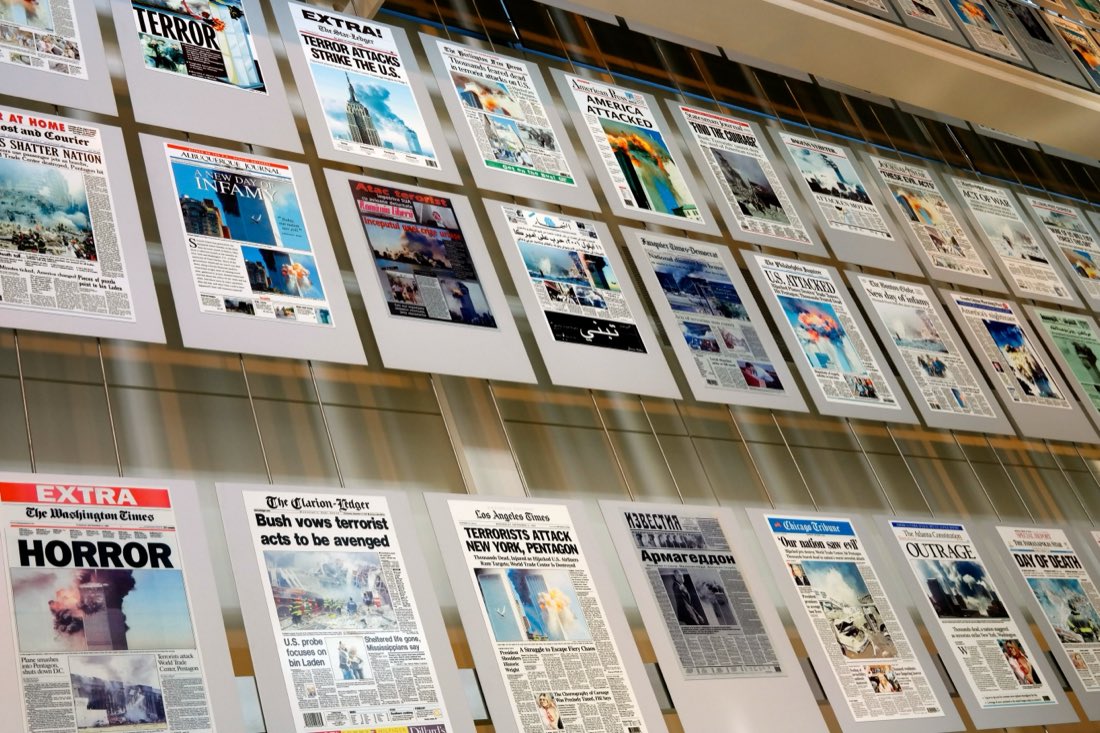
On Friday morning, twenty-five years to the day, Donald Trump stood at the Pentagon and called the war that followed 11 September “a war on sick, horrible terror”. He named Iran by its name, the Islamic Republic. He did not say “Islamic terror”. The Washington Times put the phrase in its headline and its opening sentence anyway. The words were the newspaper’s. This piece is about that habit: who has it, who does not get it applied to them, and what the religion it names actually says.
The words were the paper’s
Tom Howell Jr.’s report ran under the headline “Trump honors 9/11 victims at Pentagon, vows 'victory' over Islamic terror amid Iran war”. Its first sentence:
“President Trump honored the victims and heroes who came "face to face with true evil" during the Sept. 11 terror attacks on a clear blue morning 25 years ago and said the fight against Islamic terror remains vital today.”
The Washington Times, 11 September 2026
Read the quotations in the same report and the phrase is not in any of them. Trump said “we will never, ever forget”, “there can only be victory”, and that “the world’s number one sponsor of terror, the Islamic Republic of Iran, will never ever have a nuclear weapon”. Pete Hegseth said terrorists were being sent “where they belong, to hell”. The reporter supplied “Islamic terror” himself, and it went into the headline. That is one newspaper in one week. Here are four more, from the same month and from a piece the Guardian published on the twentieth anniversary.
| Outlet | Date | Where the phrase sits | Whose words |
|---|---|---|---|
| The Washington Times | 11 September 2026 | “President Trump honored the victims and heroes who came "face to face with true evil" during the Sept. 11 terror attacks on a clear blue morning 25 years ago and said the fight against Islamic terror remains vital today.” | the reporter's own; Trump's quoted words were "a war on sick, horrible terror" and "the Islamic Republic of Iran" |
| Wired | 8 September 2026 | “A new generation of Islamic terror supporters are using AI to spread 'Slop Jihad' to new audiences on TikTok.” | the standfirst, in the magazine's voice; the expert it quotes, Adam Hadley of Tech Against Terrorism, said "violent Islamist extremist material" |
| The Hollywood Reporter | 8 September 2026 | Headline: “German Police Rush to Prevent an Islamic Terror Attack in 'Blindspot Berlin' (Exclusive Trailer)” | the headline, in the magazine's voice, on a drama about the 2016 Breitscheidplatz attack, which Islamic State claimed |
| The Spectator Australia | 15 August 2026 | “It should have been a Royal Commission on Islamic Terror in Australia.” | the columnist's own, about the Bondi Beach Hanukkah shooting of 14 December 2025 |
| The Guardian | 6 September 2021 | “Despite the statistical dominance of far-right and white supremacist killings in the US, America's intelligence agencies have devoted far more resources to the perceived threat from Islamic terror.” | the reporter's own, in a piece whose own headline calls the other side "far-right terror", never "Christian terror" |
Five uses of the phrase, each checked against the article on the date shown. In none of them is a Muslim speaker quoted using it.
Even the expert Wired quoted reached for a word built on the name of the religion, “Islamist”; the magazine’s standfirst dropped the suffix and wrote “Islamic”. Both hand the crime to the faith; one of them does it with a suffix’s worth of deniability. The Guardian piece is the most telling of the five, because it is an argument that America ignored the far right while it hunted Muslims. The far right in that piece is “far-right terror” and “white supremacist extremists”. The other side is “Islamic terror”. Nobody at the Guardian wrote “Christian terror” for the man who murdered nine people at a Charleston church, who is in the article, and nobody should have. The point is that the same restraint was not extended in the other direction, in a piece written to make exactly that complaint.
Terror is a crime in Islam
Start with the text the phrase claims to describe. The Quran forbids the killing of the innocent in plain words, more than once, and it makes the spreading of terror a crime with a fixed punishment. These are the verses, in the Sahih International translation.
| Verse | Text |
|---|---|
| 5:32 | whoever kills a soul unless for a soul or for corruption [done] in the land - it is as if he had slain mankind entirely. And whoever saves one - it is as if he had saved mankind entirely. |
| 17:33 | And do not kill the soul which Allah has forbidden, except by right. |
| 2:190 | Fight in the way of Allah those who fight you but do not transgress. Indeed. Allah does not like transgressors. |
| 60:8 | Allah does not forbid you from those who do not fight you because of religion and do not expel you from your homes - from being righteous toward them and acting justly toward them. |
| 5:33 | Indeed, the penalty for those who wage war against Allah and His Messenger and strive upon earth [to cause] corruption is none but that they be killed or crucified or that their hands and feet be cut off from opposite sides or that they be exiled from the land. |
Verse 5:33 is the crime classical jurists call hirabah, waging war on society by spreading fear. Ibn Abd al-Barr, who died in 1070, defined its perpetrator as anyone who renders the roads unsafe, striving to spread corruption by taking money, killing people or violating what God has made inviolable. It is the closest thing in Islamic law to the modern crime of terrorism, and it carries the law's heaviest sentence.
The first caliph, Abu Bakr, sent his army to Syria with ten rules. The first three were: do not kill women or children or an aged, infirm person; do not cut down fruit-bearing trees; do not destroy an inhabited place. They are recorded in Malik’s Muwatta, one of the earliest surviving books of Islamic law, in the chapter on war. A man who flies an aeroplane into an office building has broken every one of them.
None of this is a modern gloss found after 2001 to make the religion presentable. But the religion’s authorities did answer 2001, within days, and have kept answering since. This is a short selection from a much longer record.
| Who | When | What they said |
|---|---|---|
| Abdulaziz Al ash-Sheikh, Grand Mufti of Saudi Arabia | 15 September 2001 | “hijacking planes, terrorizing innocent people and shedding blood, constitute a form of injustice that cannot be tolerated by Islam, which views them as gross crimes and sinful acts” |
| Muhammad Sayyid Tantawi, Grand Imam of al-Azhar | 14 September 2001 | “Attacking innocent people is not courageous, it is stupid and will be punished on the day of judgement” |
| The Amman Message, 200 scholars from 50 countries | July 2005 | “There is to be no fighting against non-combatants, and no assault upon civilians and their properties” |
| The Fiqh Council of North America, endorsed by more than 130 Muslim organisations | 25 July 2005 | “Targeting civilians' life and property through suicide bombings or any other method of attack is haram, prohibited in Islam” |
| Muhammad Tahir-ul-Qadri, a 600-page fatwa launched in London | 2 March 2010 | “terrorism and suicide bombings are unequivocally un-Islamic, condemned without any ifs and buts; suicide bombers are outside the fold of Islam” |
| 126 scholars, the Open Letter to al-Baghdadi | 19 September 2014 | “It is forbidden in Islam to kill the innocent. It is forbidden in Islam to kill emissaries, ambassadors, and diplomats; hence it is forbidden to kill journalists and aid workers” |
Charles Kurzman at the University of North Carolina keeps a running collection of these statements; it runs to dozens. The 2014 letter to al-Baghdadi is seventeen pages of jurisprudence, signed by 126 scholars including the Grand Mufti of Egypt, and its sixth point is five words long.
So the phrase “Islamic terror” names an act by the law it breaks. It is a contradiction in the way “vegetarian butchery” would be. A man who kills the innocent in the name of Islam is not doing something Islamic; he is doing the thing Islam sentences him to death for.
There is one more fact the phrase hides. The people these men kill are, overwhelmingly, Muslims. The US government’s own count, in the National Counterterrorism Center’s annex to the 2011 Country Reports on Terrorism:
“In cases where the religious affiliation of terrorism casualties could be determined, Muslims suffered between 82 and 97 percent of terrorism-related fatalities over the past five years.”
US National Counterterrorism Center, Country Reports on Terrorism 2011, statistical annex
It has not changed. The Global Terrorism Index for 2025 puts 51 per cent of the world’s terrorism deaths in 2024 in the Sahel, and names Burkina Faso, a Muslim-majority country, as the worst-hit country on earth for the second year running, with 1,532 dead. When a Western newspaper writes “Islamic terror”, it is attaching the religion of the dead to the men who killed them.
The label goes one way
The habit is not an impression. It can be counted, in two corpora that do not depend on each other. The first is Google’s English-language book corpus, which lags the news by a year or two and is the cleaner of the two.
How often English books pair a religion with the word terrorism, 1990 to 2022
Google Books Ngram Viewer, English corpus, pulled 12 September 2026, no smoothing. Each line is the exact two-word phrase. The lines for Christian, Hindu and Buddhist terrorism sit on the floor at this scale; that is the finding, not a rendering problem. Islamist terrorism tracks Islamic terrorism throughout: the suffix changes nothing about which religion is being named.
“Islamic terrorism” was written 18 times per billion words in 2000, 56 in 2002, and peaked at 93 in 2018. “Christian terrorism” in 2018 was 0.9. That is a ratio of about 104 to one. By 2022, the last year in the corpus, it was still 28 to one. “Jewish terrorism” runs at three or four per billion throughout, most of it histories of the 1940s and of Israel’s own settler movement. “Hindu terrorism” and “Buddhist terrorism” barely leave the floor. “Far-right terrorism” only becomes a phrase at all after 2015, and in 2022 it is a quarter of “Islamic terrorism” in a year when, as the next section shows, far-right killers were doing most of the killing in the country that produces most of these books.
The second corpus is the news itself. GDELT monitors online news in real time; we asked it for every English-language article in the last five years containing each two-word phrase.
News articles using each phrase, 14 September 2021 to 12 September 2026
GDELT 2.0 DOC API, English-language sources, exact two-word phrase, out of 357,601,650 articles monitored in the window. "Jewish terror" is mostly Israel's own English-language press writing about settler violence, where the state's security service uses the term; see the text.
8,710 articles carried “Islamic terror”. 31 carried “Christian terror”. That is 281 to one, or 24.4 articles in every million against 0.1. The 984 for “Jewish terror” need an explanation, and it is an instructive one. Israel’s security service, the Shin Bet, uses the term “Jewish terror” for settler violence in the West Bank, and Israel’s English-language press follows it: the Times of Israel headlined Amiram Ben-Uliel’s sentence “Jewish terrorist gets 3 life terms”. The British and American press, reporting the same sentence, wrote “Jewish settler”. The phrase exists where the state that polices the crime chose to name it, and stops at the water’s edge.
The pattern is easiest to see in the cases where a killer named his own religion and the press declined to. Six men, six attacks, 143 dead.
| Who, where, when | Killed | What he said or did | What he was called |
|---|---|---|---|
| Anders Breivik, Oslo and Utøya, Norway, 22 July 2011 | 77 | a supporter of a monocultural Christian Europe, in his 1,500-page manifesto; he called himself a cultural Christian | far-right extremist, mass killer. The Christian Science Monitor asked "Was Breivik a Christian terrorist?" as a question |
| Robert Dear, Planned Parenthood clinic, Colorado Springs, 27 November 2015 | 3 | "I'm a warrior for the babies", shouted in court; the indictment says he meant to wage war on the clinic because it offered abortions | gunman, shooting suspect |
| Amiram Ben-Uliel, Duma, occupied West Bank, 31 July 2015 | 3 | sprayed "Revenge" and "Long live King Messiah" on the wall before firebombing the Dawabsheh home; Ali, 18 months, and his parents Saad and Riham burnt to death, and Ahmed, four, survived | Jewish settler, extremist. Israel's own Shin Bet called the conviction a milestone against "Jewish terror"; the British and American press did not borrow the phrase |
| Darren Osborne, Finsbury Park, London, 19 June 2017 | 1 | drove a van into worshippers leaving Ramadan prayers; Makram Ali, 51, died. A jury convicted him of terrorism-related murder | van attack, Finsbury Park attacker |
| Brenton Tarrant, Al Noor Mosque and Linwood Islamic Centre, Christchurch, 15 March 2019 | 51 | shot 51 Muslims at Friday prayer and livestreamed it; the first person charged under New Zealand's Terrorism Suppression Act | white supremacist, gunman |
| Robert Aaron Long, Three spas, Atlanta, 16 March 2021 | 8 | a member of Crabapple First Baptist Church who told police he wanted to remove the "temptation" of a sex addiction that conflicted with his faith | spa shootings; a sheriff's captain said he had "a really bad day" |
The descriptions in the last column are the ones that led the British and American coverage of each case; the linked report for each row carries the facts in the third.
Every one of those descriptions is defensible. Breivik’s Christianity was cultural and his motive was hatred of Muslims and multiculturalism; Long’s pastor did not tell him to kill anyone; Dear was mentally ill. The press looked at the man, looked at the faith he claimed, and refused to hand the crime to the faith. That is the right instinct. It is applied to every religion but one.
It is applied so unevenly that it fires when there is no Muslim in the story at all. On 29 July 2024 Axel Rudakubana, born in Cardiff to Rwandan Christian parents, killed Bebe King, 6, Elsie Dot Stancombe, 7, and Alice da Silva Aguiar, 9, at a dance class in Southport. Within hours a false name, “Ali Al-Shakati”, was circulating with the claim that he was a Muslim asylum seeker who had arrived by boat. The mosque in Southport was attacked the next night, and a mosque in Sunderland three days later. Tell MAMA, which records anti-Muslim incidents, logged 6,313 cases in 2024, the most in its history and 43 per cent up on the year before, and says more than half of its online cases that year came after Southport. The Home Office counted 7,164 religious hate crimes in England and Wales in the year to 31 March 2025, a record, 4,478 of them against Muslims, up 19 per cent, with the spike after Southport, and that count excludes London. The label had done its work before anybody knew the man’s name.
It works after the real attacks too. In the week after the Manchester Arena bombing of 22 May 2017, Tell MAMA recorded 72 anti-Muslim incidents against 9 the week before, a rise of 700 per cent. Salman Abedi killed twenty-two people. Muslims in Manchester who had never heard of him paid for it in the street.
Who is actually doing the killing
The honest version of this argument has to sit next to the security figures, so here they are, including the ones that cut against it.
United States. The Government Accountability Office counted every deadly extremist attack from 12 September 2001 to 31 December 2016: 85 incidents, 62 by the far right and 23 by what it filed as radical Islamists. The far right killed 106; the second group killed 119, most of them at Orlando and San Bernardino. The ADL’s count for 2015 to 2024: 429 extremist-related killings, 328 of them by right-wing extremists (76 per cent) and 79 by those it files as Islamist extremists (18 per cent). In 2024 every one of the 13 was by the far right, for the third year in a row.
United Kingdom. Prevent referrals in the year to 31 March 2025: 8,778, of which 21 per cent (1,798) were for extreme right-wing radicalisation and 10 per cent (870) for what the Home Office files as Islamist extremism; 34 per cent had no ideology anyone could name. But referrals are not attacks. The government’s CONTEST strategy of 2023 says what it files as Islamist terrorism accounts for 67 per cent of attacks in the UK since 2018 and about three quarters of MI5’s caseload, with the extreme right at 22 per cent and a quarter. That is the counterweight, and it is real.
European Union. Europol counted 58 attacks in 2024, completed, failed and foiled. 24 were jihadist, and those were the most lethal: 5 people killed. 21 were left-wing and anarchist, almost all in Italy. 4 were separatist. 1 was right-wing. 289 of 449 terrorism arrests were for jihadism.
So no, the argument is not that Muslims commit no attacks, or few. In Britain and in Europe men claiming Islam have committed more of them than any other group in recent years, and Europol says they kill more when they do. The argument is about the word. Nobody at Europol or in the press writes “atheist terror” for the Italian anarchists who firebomb power lines, and nobody wrote “Christian terror” for the thirteen Americans murdered by the far right in 2024. The religion of one set of killers is treated as the cause of the crime. The religion of every other set is treated as a private matter, which it is. And the category names in those reports, Islamist, jihadist, are part of the same habit: the state files the crime under the religion’s name and the press copies the file.
What the label does to the coverage
The best study of the effect is American. Erin Kearns, Allison Betus and Anthony Lemieux took every terrorist attack in the United States from 2006 to 2015, 136 of them, and counted the news coverage each received.
“In this dataset, Muslims perpetrated 12.5% of the attacks yet received 50.4% of the news coverage.”
Erin M. Kearns, Allison E. Betus and Anthony F. Lemieux, Why Do Some Terrorist Attacks Receive More Media Attention Than Others?, Justice Quarterly 36(6), 2019
Holding the death toll, the target and whether anyone was arrested constant, an attack by a Muslim received 357 per cent more coverage than the same attack by anyone else. The under-reported end of their table reads like a list of the men above: Wade Michael Page, who killed 6 at a Sikh temple in Oak Creek, Wisconsin, got 1.9 per cent of all the coverage in the decade; Frazier Glenn Miller, who killed 3 at a Jewish community centre and a Jewish retirement home in Kansas, got 2 per cent of all the coverage in the decade; Dylann Roof, who killed 9 at a Black church in Charleston, got 4.5 per cent of all the coverage in the decade.
The British numbers point the same way. Cardiff University’s study of the national press from 2000 to 2008 found that 36 per cent of all stories about British Muslims were about terrorism. Lancaster University’s corpus of 143 million words of British newspaper text from 1998 to 2009 found “conflict” the richest category of words sitting next to “Muslim”. The Centre for Media Monitoring read 48,000 online articles and 5,500 broadcast clips from 2018 to 2020 and found almost 60 per cent of the articles associated Muslims or Islam with something negative, and more than one in five was primarily about terrorism or extremism. A reader who met Muslims only in the newspaper would meet them mostly at the scene of a crime.
It was a choice, and it was made on purpose
The pairing was not inevitable. Six days after the attacks, George W. Bush went to the Islamic Center of Washington and said: “The face of terror is not the true faith of Islam. That’s not what Islam is all about. Islam is peace.” He had every reason to say the opposite and did not.
Barack Obama refused the phrase for eight years and, asked by a Gold Star mother at a CNN town hall in September 2016 why he would not say it, explained: “When you start calling these organizations Islamic terrorists, the way it’s heard, the way it’s received by our friends and allies around the world is that somehow Islam is terroristic. And that then makes them feel as if they’re under attack.” He called the demand that he say it “manufactured”.
Four months later Donald Trump made the phrase the promise of his inaugural address: “unite the civilized world against radical Islamic terrorism, which we will eradicate completely from the face of the Earth”. The word had been chosen, argued over and chosen again. On the twenty-fifth anniversary the Washington Times chose it for him.
The trade’s own rules already point away from it. The BBC’s editorial guidelines say the word terrorist “can be a barrier rather than an aid to understanding” and tell reporters to say what happened and who did it: bomber, gunman, attacker. IPSO published guidance on reporting Muslims and Islam in November 2020. The AP Stylebook was revised in April 2013 to stop “Islamist” being used “as a synonym for Islamic fighters, militants, extremists or radicals”, and the British government’s counter-terrorism strategy writes “Islamist terrorism” rather than “Islamic terrorism”. That is a half-step, and it should be said plainly that it is not the answer either. “Islamist” is still the name of the religion with a suffix on it, a reader hears the same thing, and the chart above shows the word rising and falling in lockstep with its parent. The ideology a murderer claims is not the story. He does not represent Islam in any form, however loudly he says he does, and a word that keeps the religion in the sentence keeps the association he wanted.
What to write instead
Describe the act and name the man. Anis Amri drove a lorry into the Breitscheidplatz Christmas market and killed twelve people that night and a thirteenth who died of his injuries in 2021; Islamic State claimed it. Every word of that is true, specific and checkable, and none of it accuses a religion. If a group claimed it, name the group: ISIS, al-Qaeda. Then stop. The man is a murderer; that is his category. A murderer’s theology is no more the cause of his crime than Robert Dear’s was, and the press did not need Dear’s to report Colorado Springs.
Then apply one test. If you would not have written “Christian terror” above the Oslo bomb, the Colorado Springs clinic or the van at Finsbury Park, do not write “Islamic terror” above the Christmas market. The press already knows how to do this. It has done it for every religion but one, for twenty-five years.
The photograph at the top of this page is a wall of front pages from 12 September 2001. They say TERROR, HORROR, ACT OF WAR, DAY OF DEATH. Not one of them says Islamic. That word was added later, by choice, and it can be taken away the same way.
How we counted
The Google Books series come from the Ngram Viewer’s English corpus, pulled as JSON on 12 September 2026 with smoothing off, for each two-word phrase exactly as written, 1990 to 2022, in occurrences per billion words. The news counts come from the GDELT 2.0 DOC API in timelinevolraw mode for the five years to 12 September 2026, restricted to English-language sources; a count is the number of monitored articles containing the exact phrase, and GDELT matches whole words, so “Islamic terror” does not match “Islamic terrorism”. GDELT monitored 357,601,650 English-language articles in the window. The five uses in the first table were each read on the date given. Security and hate-crime figures are quoted from the reports linked below, on the reports’ own definitions; where two bodies count differently, as the Home Office and the Metropolitan Police do, the text says which one is quoted.
Sources
- The Washington Times, Trump honors 9/11 victims at Pentagon, vows 'victory' over Islamic terror amid Iran war, 11 September 2026
- Stars and Stripes, At Pentagon 9/11 commemoration, Trump, Hegseth say war on terror continues, 11 September 2026 (Trump's quoted words)
- Wired, Gen AI Tools Are Now Being Used to Push 'Slop Jihad', 8 September 2026
- The Hollywood Reporter, German Police Rush to Prevent an Islamic Terror Attack in 'Blindspot Berlin', 8 September 2026
- The Spectator Australia, It's a mad, mad, mad, mad world, 15 August 2026
- The Guardian, Close to home: how US far-right terror flourished in post-9/11 focus on Islam, 6 September 2021
- Google Books Ngram Viewer, English corpus, JSON export, 12 September 2026
- GDELT 2.0 DOC API, timelinevolraw, English-language sources, five years to 12 September 2026
- Kearns, Betus and Lemieux, Why Do Some Terrorist Attacks Receive More Media Attention Than Others?, Justice Quarterly, 2019
- US State Department and National Counterterrorism Center, Country Reports on Terrorism 2011, statistical annex
- Institute for Economics and Peace, Global Terrorism Index 2025
- US Government Accountability Office, Countering Violent Extremism, GAO-17-300, April 2017
- ADL Center on Extremism, Murder and Extremism in the United States in 2024
- Home Office, Individuals referred to and supported through the Prevent Programme, year to March 2025 (written statement HCWS1045)
- HM Government, CONTEST: the United Kingdom's Strategy for Countering Terrorism 2023
- Europol, European Union Terrorism Situation and Trend Report 2025
- Open Letter to Dr Ibrahim Awwad al-Badri, alias Abu Bakr al-Baghdadi, 19 September 2014, 126 signatories
- The Amman Message, three points, July 2005
- Charles Kurzman, Islamic Statements Against Terrorism (a collection, University of North Carolina)
- Minhaj-ul-Quran, launch of the Fatwa on Terrorism and Suicide Bombings, London, 2 March 2010
- Malik's Muwatta, Book 21 (Jihad), hadith 10: Abu Bakr's instructions to his army
- The Quran, Sahih International translation (5:32, 17:33, 2:190, 60:8, 5:33)
- George W. Bush, remarks at the Islamic Center of Washington, 17 September 2001
- CNN, President Barack Obama: Why I won't say 'Islamic terrorism', 28 September 2016
- Donald Trump, inaugural address, 20 January 2017
- AP Stylebook revision of 'Islamist', 5 April 2013 (Slate)
- IPSO, guidance on researching and reporting stories involving Muslims and Islam, 9 November 2020
- Moore, Mason and Lewis, Images of Islam in the UK: the representation of British Muslims in the national print news media 2000 to 2008, Cardiff University
- Baker, Gabrielatos and McEnery, Sketching Muslims: a corpus-driven analysis of representations around the word 'Muslim' in the British press 1998 to 2009, Applied Linguistics 34(3), 2013
- Centre for Media Monitoring, British Media's Coverage of Muslims and Islam (2018 to 2020)
- Tell MAMA, anti-Muslim incidents after the Manchester Arena attack, 2017 annual report
- Tell MAMA, almost 5,000 anti-Muslim cases a year on from 7 October, and the 2024 record
- Home Office, Hate crime, England and Wales, year ending March 2025
- Hyphen, Police were told not to reveal Axel Rudakubana's religion, 25 February 2025
- The Christian Science Monitor, Norway attacks: was Breivik a Christian terrorist?, 1 August 2011
- NPR, Planned Parenthood shooter: 'I'm a warrior for the babies', 9 December 2015
- Al Jazeera, Jewish settler convicted in arson attack that killed Palestinians, 18 May 2020
- The Times of Israel, Jewish terrorist gets 3 life terms for killing Palestinian family in 2015 arson
- Al Jazeera, Darren Osborne found guilty of Finsbury Park attack, 1 February 2018
- Al Jazeera, Christchurch mosques attacker Tarrant charged with terrorism, 21 May 2019
- NBC News, Motive still disputed, some point to shooting suspect's religion, shame, 18 March 2021
- BBC Editorial Guidelines, section 11: War, Terror and Emergencies
- Sherman Jackson on hirabah, in Juan Cole, Top ten ways Islamic law forbids terrorism, 2015