South Americaupdated 52m ago3 min read
Map6.7 Earthquake Shakes Peru’s Andes, Lima Residents Rush Into Streets
11 Western Mainstream4 Other3 Asian3 Latin AmericanMap: © OpenStreetMap contributors, ODbL · Cropped for layout
This article is an automated aggregation of coverage from news outlets. Our editorials offer in-depth analysis curated by the NewsCord team.
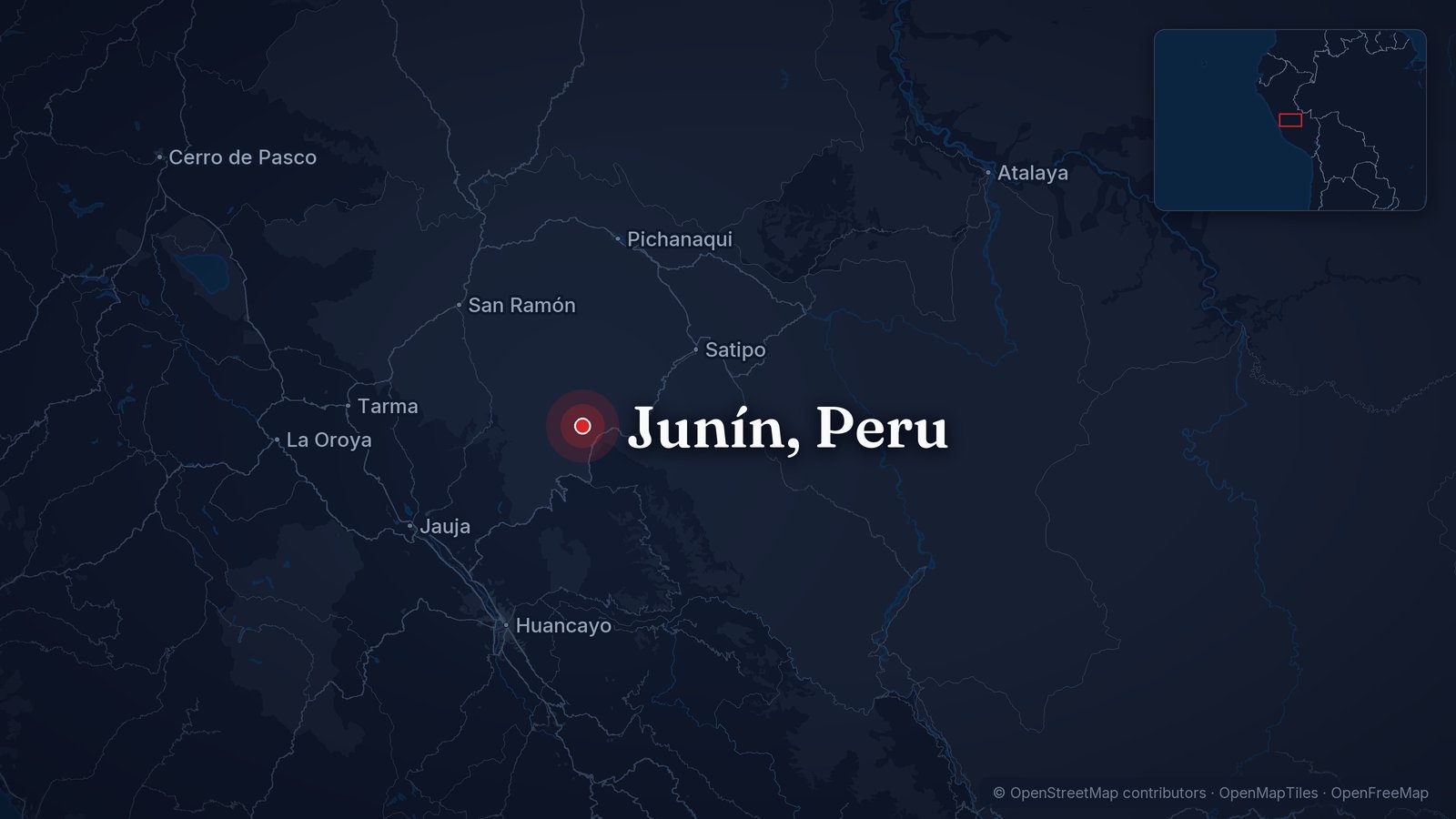
Magnitude 6.7 earthquake struck central Peru, epicenter near Junín in the Andes. Felt in Lima, with no immediate reports of damage or casualties.
Save coverage image
21 outlets in this story. Read their headlines below.
Quake hits central Peru
A magnitude 6.7 earthquake shook Peru’s Andes on Friday at 7:09 p.m. local time, according to the U.S. Geological Survey, with its epicenter in the Andes 34 kilometers (21 miles) north of Junín and at a depth of 108 kilometers (67 miles).
Peru’s Geophysical Institute said no damages or casualties had been reported, and the mayor of Carhuamayo, Abdel Vega, told local television that there were no reports of victims or material damages.
Residents in Lima rushed into the streets after feeling the tremor, and the U.S. Geological Survey said the quake struck at 7:09 p.m. local time.
The earthquake’s depth and epicenter details varied across accounts, with Telemundo citing the Peruvian Geophysical Institute for a depth of 80 miles and an epicenter about 18 miles northwest of Junín, while Le Figaro cited the Peruvian Geophysical Institute for a depth of 129 kilometers and an epicenter 30 kilometers northwest of Junín.
Clarín also reported that the temblor occurred at 19:09 local time with an epicenter 30 kilometers northwest of the town of Junín and at a depth of 127 kilometers, and it said initial assessments did not report major damages beyond minor building damage, brief power outages, and road closures due to falling rocks.
Evacuations and local reports
The National Emergency Operations Center reported that the quake was felt with moderate to strong intensity and said, "monitoring continues in vulnerable areas," while residents evacuated offices and buildings in Lima’s Miraflores tourist district. IGP President Hernando Tavera told AFP, "The ground shaking was intense," and he also reported landslides and falling rocks in places. Luis Vásquez, director of the National Civil Defense Institute, told RPP radio that there were no major damages to report but that landslides had been reported on certain stretches of road.
Europa Press said the National Emergency Operations Center coordinated with competent authorities and that first-response units and local authorities continued monitoring vulnerable zones without reporting damages to date. DIE WELT reported that hundreds of people had to leave offices and buildings and that the Emergency Measures Center said, "Monitoring in the hazard zones will continue," as the quake was felt in Lima, Huánuco, and Callao.
Tsunami ruled out
The Hydrography and Navigation Directorate (DHN) of the Navy ruled out on its social networks that the earthquake could generate a tsunami along Peru’s coast, and Europa Press said the Navy had ruled out a tsunami along Peru’s coast. The US Tsunami Warning System also said there was no tsunami threat following the earthquake, while Europa Press said the National Civil Defense Institute advised citizens to remain calm and follow authorities’ recommendations. Europa Press reported that the seismic movement was perceived as strong in several districts of the provinces of Huancayo, Jauja, Satipo and Tarma, and it said the quake was moderate in various jurisdictions of Lima.
NBC News said residents evacuated their homes in Lima and that television footage showed lawmakers leaving Congress, and it quoted Vicente Quispe, a local council member in Junin province, saying, "So far, no damage has been reported." AP News noted that the earthquake was felt in the Peruvian capital, prompting residents to rush into the streets, and it placed the event within Peru’s Pacific Ring of Fire setting where most of the world’s earthquakes occur.