Entertainment27 August, 20263 min read
Archaeologists Unearth 11,000-Year-Old Human Riding Leopard Statue At Karahan Tepe, Turkey
This article is an automated aggregation of coverage from news outlets. Our editorials offer in-depth analysis curated by the NewsCord team.
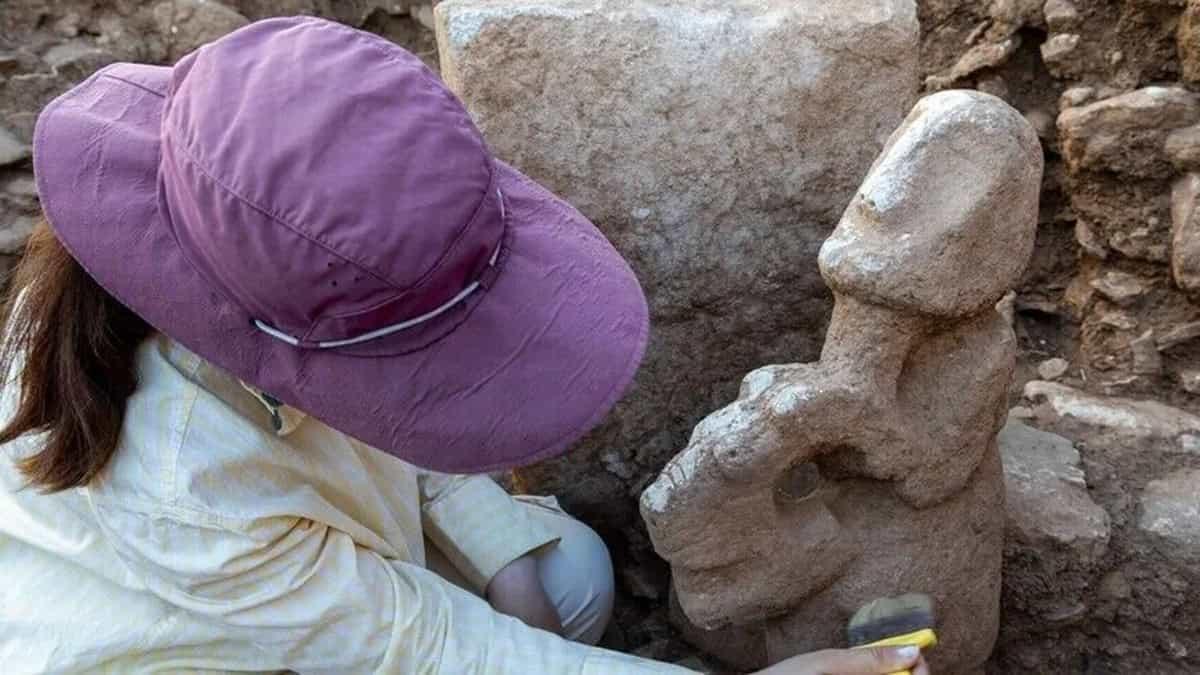
An 11,000-year-old limestone statue shows a man riding a leopard at Karahan Tepe, Turkey. The sculpture stands about 70 centimeters tall and was unearthed during 2026 excavations.
5 outlets told this the same way.
Outlets did split on RJ Mitte Dies At 34 In Brownsville, Texas, Representatives Say Suicide →
Leopard Rider Unearthed
Archaeologists have unearthed an approximately 11,000-year-old statue at Karahan Tepe in southeastern Turkey, where a human figure is seated on the back of a leopard. Turkey’s Minister of Culture and Tourism Mehmet Nuri Ersoy announced in an X post that a “composite statue featuring a style unlike any previously encountered” was discovered during the 2026 excavations under the ongoing Heritage for the Future project. The Art Newspaper reports the statue is 70-centimetre-tall and was found on a bench extending along the wall of a three-metre structure with a floor covered in flat stones.
The Times of India adds that the sculpture was found in situ on a stone bench inside a circular structure measuring about 3 metres across, with a floor paved with flat stones. The discovery is being treated as a reversal of earlier human-leopard imagery at Karahan Tepe, where previous sculptures showed the animals positioned on people’s backs rather than beneath them.

Scholars Weigh Meaning
Elizabeth Carter, a professor emerita of Near Eastern archaeology at UCLA, told The Art Newspaper that “To my knowledge, the human figure mounted on an animal is unique.” Carter also said that while animal sculptures have been identified before on benches within buildings at Göbeklitepe, “I don’t know of a human astride an animal.” Ergun Lafli, a professor of archaeology at Dokuz Eylul University in Izmir, told TAN that more research on dating is “crucial,” because “calibrated and uncalibrated dating attempts are not entirely presented in scholarly publications yet and not sufficiently discussed.”
Lafli said the statue is “a second composite statue depicting a combination of abstracted iconography of a human and a leopard” and that the first one was found on the site in 2021. The Art Newspaper reports that Lafli described the new find as “one of the very earliest evidences of religion and cult in the entire ancient Near East,” stretching from Spain in the west to Afghanistan in the east.

Context and Next Steps
The Art Newspaper says the statue was discovered during the 2026 excavations conducted under the ongoing Heritage for the Future project, and it frames the find as opening “the door to new questions about the earliest periods of human history.” In a separate account, All That's Interesting says Karahan Tepe is one of the oldest-known human settlements in the world and that excavations of the particular area where this statue was found began in 2019. All That's Interesting reports that Karahan Tepe was discovered in 1997 and that it was established circa 9750 B.C.E. in what’s now the province of Şanlıurfa.
The Art Newspaper notes that Lafli said the statue was carved in local limestone native to Şanlıurfa and that it was excavated right in the middle of an area which seems to be a votive deposit for offerings. While the exact provenance and purpose of the sculpture remain to be revealed after further analysis, the Times of India says archaeologists continue to describe the sculpture primarily in terms of what can actually be observed rather than assigning it a definitive religious meaning.