Gaza Genocide15 September, 20263 min read
Lebanese Parliament Debates PM Nawaf Salam Government Amid Israeli Attacks in South Lebanon
This article is an automated aggregation of coverage from news outlets. Our editorials offer in-depth analysis curated by the NewsCord team.
Parliament debates Salam government's general policy as Israeli attacks hit southern Lebanon. Speaker Nabih Berri says session evaluates performance, not a confidence vote.

Parliament tests Salam
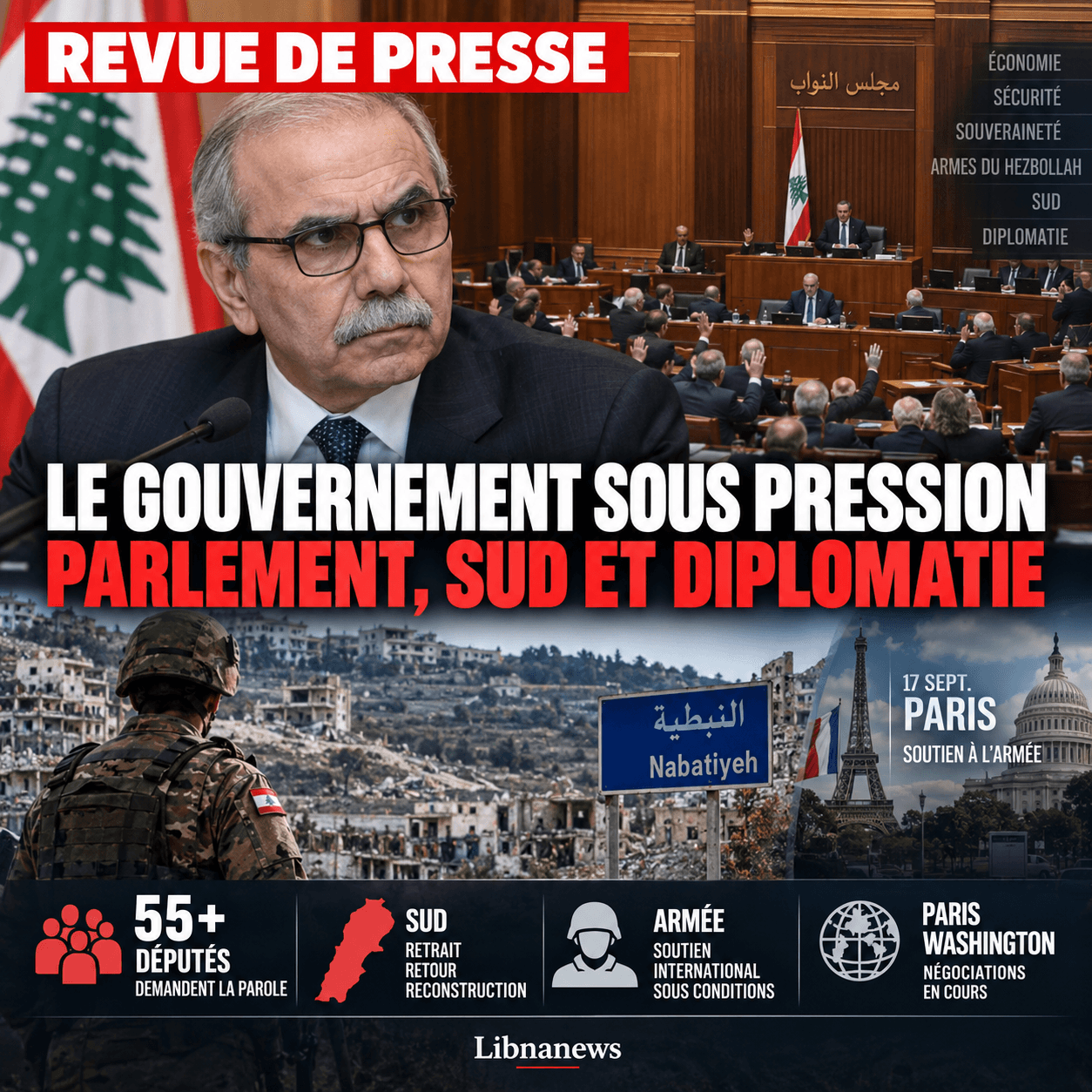
Lebanese Parliament convened Tuesday to debate the government’s general policy amid Israeli attacks on the country’s south, with Parliament Speaker Nabih Berri saying the session was held to debate government performance and not to question the cabinet or hold a vote of confidence. Prime Minister Nawaf Salam opened the debate by emphasizing that war and peace decisions must be taken solely by the Lebanese state, asserting that the country will not serve as a "bargaining chip" in foreign negotiations. Salam said Lebanon was thrust into a war "we did not choose, nor were we consulted on entering," and he warned that the destruction far exceeds the state’s current resources, making Arab and international backing indispensable for recovery.
“Parliament Speaker Nabih Berri said the session was held to debate the government performance and not to question the cabinet or hold a vote of confidence.”
He argued that "Sustainable reconstruction requires funding, funding requires trust, and trust cannot exist without a capable state, which naturally demands reform," and he said negotiations with Israel are far from simple, adding that their success can only be judged by their final outcomes. In the same parliamentary setting, Hezbollah MP Ali Ammar vowed that Hezbollah will not disarm "as long as a single inch of Lebanese land remains occupied," tying the position directly to the status of occupied land.
Competing demands on weapons
Free Patriotic Movement leader and MP Gebran Bassil harshly criticized Salam’s cabinet, dubbing it a government of "axes and submission," and he said the government opened the door to discord, failed to establish a state monopoly on weapons, and lacks a plan for reform. Bassil said, "We support negotiations with Israel to stop the war, as Hezbollah's weapons can no longer protect Lebanon," while also asserting, "We fully support a complete state monopoly on arms, but disarmament cannot be implemented by relying on foreign backing — we call for a course correction." Hezbollah MP Ali Ammar also said he wished Salam had not adopted a policy of "turning a blind eye" to the history of Israeli aggression against Lebanon.
The Lebanese Forces official website described the parliamentary debate as a "dangerous tug-of-war" in which the "Hizbullah" bloc and some who ally with it sought to transform debates into harsh campaigns against the government leading to an accountability session that could end with a vote of no confidence. It further framed the session as one where a majority of parliamentary questions would focus on the shortfall or delay in implementing the weapons monopoly decision, turning the debate into a broad trial of "Hizbullah" and its weapon and its direct ties to Iran.
Gaza-linked pressure and next steps
While the parliamentary debate centered on Lebanon’s south and Israeli attacks, Al-Manar TV Lebanon reported the "Second day of Lebanese Parliament’s general policy debate over PM Salam government underway" on Wednesday, 16/09/2026.
The Lebanese Forces official website tied the session’s stakes to international and diplomatic preparations, noting that internal files would move to the forefront of the Lebanese political scene today and tomorrow with the government’s debate session in Parliament.
It also described preparations for Paris meetings next Thursday, saying a Lebanese official source clarified the Paris preparatory meeting is part of the 'Obstacle Path' launched by King Abdullah of Jordan in 2015 and held periodically or annually to discuss geo-strategic files related to the region.
The same source said the meeting would be held at the U.S. State Department in Washington in the next couple of days between the Lebanese and Israeli ambassadors in the United States, and it added that preparations for the preparatory meeting of the conference to support the army in Paris next Thursday were underway.
In its framing of the political environment around the war, the Lebanese Forces website said the session began with a provocative speech on the anniversary of Imam Musa al-Sadr’s disappearance and moved through threats of street protests, with a single objective of weakening the government and reasserting control of state levers.