Asia15 March, 20263 min read
Bus Carrying Indian Pilgrims Plunges Off Mountain Road in Nepal, Killing Seven
This article is an automated aggregation of coverage from news outlets. Our editorials offer in-depth analysis curated by the NewsCord team.
Seven Indian pilgrims died when their bus plunged off a mountain road in Nepal. Seven others were injured in the crash.

Fatal Bus Crash
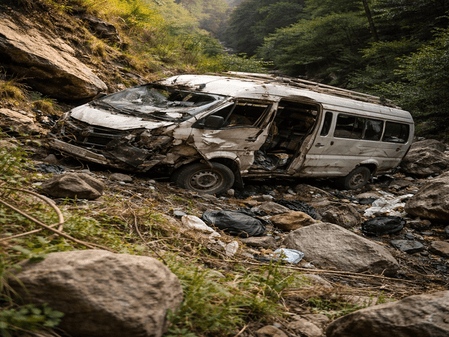
A passenger bus carrying Indian pilgrims plunged off a mountain road in central Nepal, resulting in seven deaths and multiple injuries during the early morning hours of Saturday night. The accident occurred on a treacherous downhill route near Shahid Lakhan village, approximately 120 kilometers west of Kathmandu, as the pilgrims were returning from visiting the revered Manakamana Temple, a popular Hindu pilgrimage site where devotees believe a goddess grants wishes.
“A passenger bus carrying Indian pilgrims slipped off a mountain road and rolled down its slopes in central Nepal, killing seven people and leaving nine more injured, police said Sunday.”
All seven fatalities were Indian pilgrims, while seven other Indian pilgrims plus the Nepali bus driver and his assistant sustained injuries requiring hospitalization. The vehicle reportedly slipped off a curve and rolled down the mountainside about 150-200 meters before coming to rest in a ravine, according to official reports from police and local authorities who rescued the injured.

Accident Causes
Local authorities have identified several potential contributing factors to the deadly accident, including the steep mountainous terrain, rainy weather conditions, and possible brake failure on the downhill route. The vehicle involved was described as an electric micro-bus carrying more than a dozen passengers when it lost control on the hazardous road stretch.
According to Deputy Superintendent of Police Raj Kumar Shrestha from the Gorkha District Police Office, the vehicle plummeted roughly 150 to 200 meters from the roadway before coming to rest in a ravine. Seven of the injured pilgrims were transported to Chitwan Medical College in Bharatpur, with one reported to be in critical condition while others remain stable, though officials have not yet definitively determined the final destination of the pilgrimage group.
Pattern of Accidents
This latest tragedy follows a disturbing pattern of fatal bus accidents involving Indian pilgrims in the same region, with a similar incident occurring just months earlier in August 2024 when a bus crash in the nearby Anbukhaireni area claimed the lives of 27 Indian pilgrims. The Kantar area of Sahid Lakhan Rural Municipality where the most recent accident occurred has become a known high-risk zone for transportation accidents, particularly along the mountainous routes connecting major pilgrimage sites.
“The tragedy follows a similar incident in August 2024, when a bus crash in the nearby Anbukhaireni area claimed the lives of 27 Indian pilgrims.”
Chief District Officer Tulasi Bahadur Shrestha noted that while the electric micro-bus was traveling toward the Anbukhaireni area of Tanahun district, the final destination of the pilgrimage group remained uncertain at the time of reporting. This highlights the challenges in managing transportation safety for religious tourism in Nepal's difficult terrain, where pilgrimage routes often traverse hazardous mountain passes.
National Crisis
Nepal is experiencing a persistent and alarming increase in road traffic accidents and fatalities, with official data showing a dramatic rise over the past decade. According to traffic police statistics, the country recorded approximately 5,000 road accidents annually a decade ago, but this figure has escalated significantly to 28,692 accidents in the 2024-25 fiscal year, resulting in 2,549 deaths. This represents a more than five-fold increase in accidents and a substantial rise in fatalities over the decade.
The World Bank has highlighted the mounting crisis, noting that the economic cost of road injuries in Nepal has tripled since 2007 and now accounts for approximately 1.5% of the nation's gross national product. The bank's research further indicates that road crashes have a disproportionate impact on vulnerable populations, with more than 70% of all road fatality victims being pedestrians, cyclists, and motorcyclists who are often from economically disadvantaged backgrounds.

Systemic Challenges
The recurring accidents on Nepal's mountainous roads, particularly those serving pilgrimage routes, reflect broader systemic challenges in transportation safety and infrastructure management. Despite the economic burden and human cost, the country continues to struggle with inadequate road safety measures, poor maintenance of mountainous routes, and insufficient enforcement of traffic regulations. The pattern of fatal accidents involving pilgrim buses suggests that religious tourism, while economically significant, poses particular safety challenges when combined with Nepal's difficult terrain and weather conditions.
“The World Bank further noted that 70% of those killed are 'vulnerable road users,' including pedestrians and motorcyclists.”
Local authorities and international organizations like the World Bank have identified the need for comprehensive road safety interventions, including improved road engineering, better vehicle maintenance standards, enhanced driver training, and stricter enforcement of safety regulations. These measures are needed to address the escalating crisis that is affecting both the economy and the most vulnerable segments of the population.