Full story
Tankers hit after missile exchange
The United States struck three Iranian oil tankers on Sept. 5 after Iran fired on U.S. Navy ships, with CENTCOM saying the U.S. attacks followed an unsuccessful Iranian ballistic missile attack on a U.S. aircraft carrier and a guided-missile destroyer.
“The U.S. military struck three Iranian oil tankers on Sept. 5”
Air & Space Forces Magazine reported that a mix of Air Force and Navy aircraft carried out the attacks, and it named M/T Downy, hit near Kharg Island, and M/T Stark 1, struck near Jask, as two of the tankers that were “permanently disabled.”

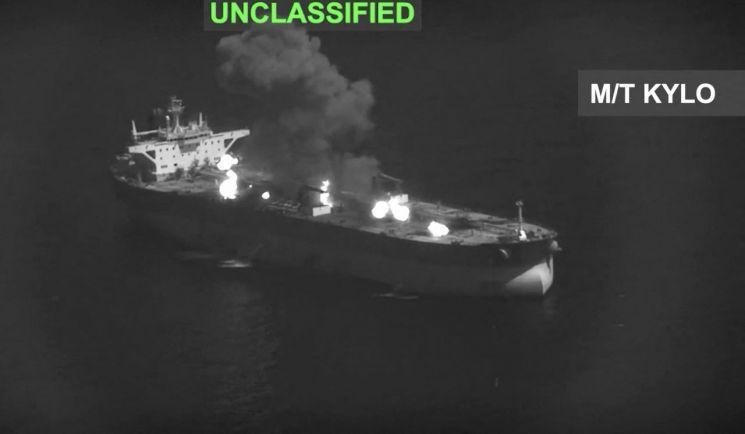
CENTCOM said the third tanker, M/T Kylo, was hit in the Gulf of Oman, was “completely destroyed,” and later sank, while the Iranian crew was warned to abandon ship before the strike.
BBC said the U.S. and Iran exchanged retaliatory attacks on vessels on Saturday, with CENTCOM announcing it had “permanently disabled” a tanker near Hormuz Island and another near the Strait of Hormuz and “completely destroyed” a third in the Gulf of Oman.
BBC also reported that Defense Secretary Pete Hegseth had written on social media, “It’s very simple: if Iran fires at US ships, we will destroy (and sink) their tankers.”
Competing claims and threats
Adm. Brad Cooper, the CENTCOM commander, framed the U.S. response as a message to the IRGC, saying, “Let the message to the IRGC be clear,” and warning that if Iran “shoot[s] at our ships, we will impose an even higher economic cost—take out three of yours.”
BBC reported that Iranian state media confirmed the attacks and said Tehran launched actions against three US-linked vessels in response, as well as against three oil tankers navigating via an “unauthorized” route through the Strait of Hormuz.

In Al Jazeera’s account of the same broader confrontation, the IRGC said it would follow suit and targeted “three oil tankers traveling through an unauthorized route in the Strait of Hormuz, as well as three vessels affiliated with the United States in other areas.”
DW reported that the IRGC claimed it launched “several ballistic missiles” at a US aircraft carrier and Navy destroyer that “harassed Iranian vessels and participated in a naval blockade,” while also saying the statement did not mention when the missiles were fired.
DW added that the U.S. account said the aircraft carrier and a destroyer evaded “multiple unprovoked Iranian attacks” while patrolling, and that no US personnel were hurt.
Strait stakes and next moves
The attacks sharpened the fight over the Strait of Hormuz, which BBC described as having remained “virtually closed since the war began in February,” and as a “major leverage and pressure point for Iran.”
“has remained virtually closed since the war began in February”
BBC said Hormuz Island hosts Iran’s main oil export terminal and that “About 90% of the country’s crude passes through this island,” reached via pipelines from the mainland.
CENTCOM’s account, as relayed by Air & Space Forces Magazine, tied the U.S. strikes to a deterrence strategy, saying the oil tankers were part of a “multi-billion-dollar clandestine network that funds the IRGC and its allied groups in the region.”
BBC reported that the 60-day ceasefire between the United States and Iran “formally expired last month,” with “no signs of a new diplomatic agreement forthcoming,” and it said Trump reiterated that the U.S. would implement tougher economic measures against Iran.
In the same escalation narrative, Air & Space Forces Magazine said the U.S. is seeking to use economic sanctions and a blockade to pressure Iran to give up its attempt to control international shipping through the Strait of Hormuz and to agree to limits on its nuclear program.