Crypto27 April, 20265 min read
K Bank Partners With Ripple To Pilot On-Chain Cross-Border Remittances With UAE And Thailand
This article is an automated aggregation of coverage from news outlets. Our editorials offer in-depth analysis curated by the NewsCord team.
K Bank and Ripple sign strategic partnership to pilot on-chain cross-border remittances. Multi-phase proof-of-concept tests blockchain-based cross-border remittances rather than full launch.
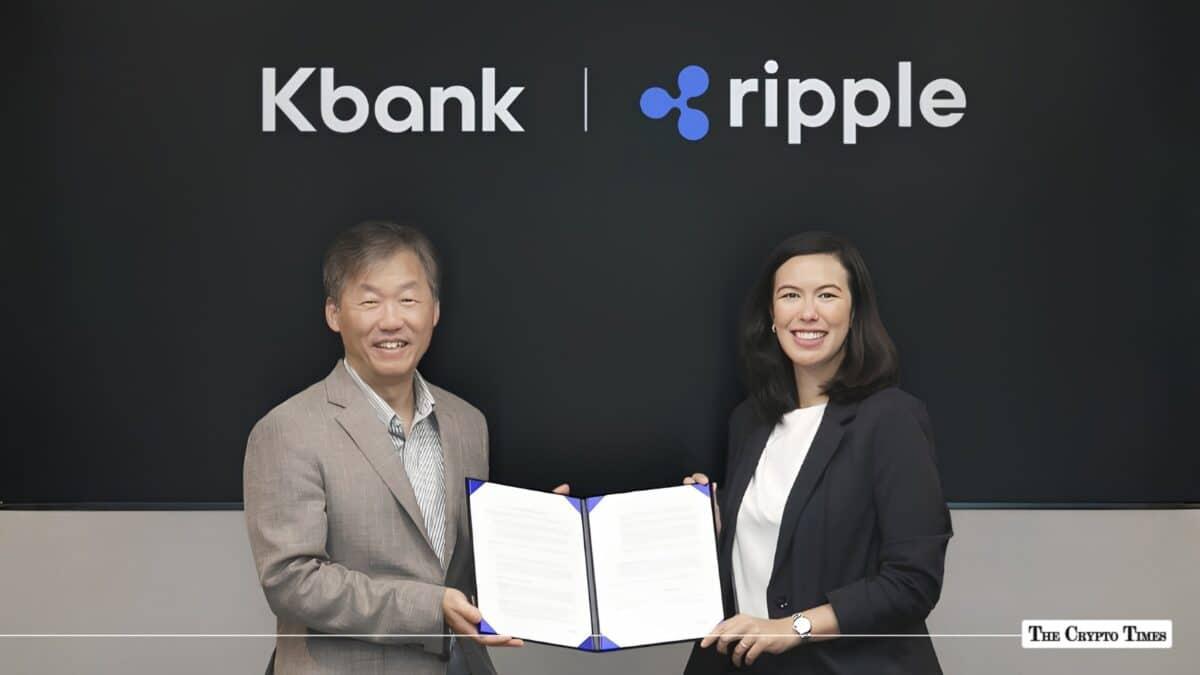
K Bank and Ripple Trial
South Korea’s internet-only lender K Bank has signed a strategic partnership with Ripple to test blockchain-based overseas remittances, with the agreement framed as a multi-phase proof-of-concept rather than a full commercial rollout. Multiple reports tie the signing to K Bank’s headquarters in Seoul, where K Bank CEO Choi Woo-hyung and Ripple Asia-Pacific managing director Fiona Murray signed the deal. Seoul Economic Daily says the partnership was announced on the 27th, with Choi signing a strategic partnership with Fiona Murray at K Bank’s headquarters in Jung-gu, Seoul.
Cointelegraph describes the partnership as using Ripple’s global network and blockchain infrastructure to test whether overseas remittances can be made “faster, cheaper and more transparent,” while also noting that the companies are already conducting phased technical verification. Coinpaper similarly says K Bank and Ripple are working on a proof of concept linked to overseas transfers and that the latest phase will test on-chain transactions with partners in the United Arab Emirates and Thailand. The trial’s scope is described as practical payment use rather than a full commercial launch, with Coinpaper stating, “The work centers on practical payment use rather than a full commercial rollout.”

How the Multi-Phase Test Works
Across the reports, the K Bank–Ripple project is described as moving from an app-based remittance structure toward deeper system integration and on-chain transfers. Cointelegraph says the first phase reportedly tested a separate app-based remittance structure, while the second phase digitally links customer accounts and internal systems to test remittance stability. Coinpaper adds that K Bank’s first phase tested transfers through a separate application, and that the second phase assesses transaction stability through a virtual link between customer accounts and K Bank’s internal systems.
Seoul Economic Daily describes the ongoing second-phase verification as testing remittance stability by virtually linking customer accounts and internal systems, and it specifies that the second-phase verification examines ways to transfer funds directly through a blockchain network to major countries such as the United Arab Emirates (UAE) and Thailand. Coinpaper states that the second phase will test on-chain transactions with partners in the UAE and Thailand and that K Bank is using Ripple’s SaaS-based digital wallet, Palisade, in the second phase. Crypto.news and MoneyCheck both describe the second phase as moving into a virtual environment where on-chain transfers are assessed for stability across corridors including the UAE and Thailand, with MoneyCheck also stating that the current phase connects systems more closely and uses Ripple tools for evaluation.
Stablecoin and Wallet Infrastructure
Several reports place stablecoins and wallet infrastructure at the center of the trial’s design, while still describing the work as controlled testing. Cointelegraph says the tie-up comes as South Korean financial companies test blockchain-based cross-border payment infrastructure while the country’s stablecoin and digital asset rules remain under discussion. MoneyCheck says the project focuses on stablecoin-based transactions and digital wallet use, and it describes the proof-of-concept as being carried out in stages, with earlier tests using an internal wallet system atKbank.
Coinpaper says K Bank is already conducting a proof of concept with Ripple for overseas remittances, and it describes the second phase as assessing transaction stability through a virtual link between customer accounts and K Bank’s internal systems. The Crypto Times report adds that K Bank is evaluating Ripple’s Palisade platform, described as a software-as-a-service wallet solution, and it says local reports indicate K Bank also plans to use stablecoins in the background for some remittance flows.
In that same account, the Crypto Times says customers would still see and send local currencies in the app, but stablecoins and on-chain transfers would move value between countries during the settlement step. The Seoul Economic Daily account ties the wallet choice to compliance and deployment speed, saying a key feature of the trial is the use of Ripple’s digital asset wallet “Palisade” instead of an in-house developed wallet and that Ripple’s wallet already has a security framework and regulatory compliance capabilities at the level of financial institutions.
Regulatory Backdrop and Timing
The K Bank–Ripple remittance trial is repeatedly linked to South Korea’s evolving regulatory environment for stablecoins and digital assets, with multiple reports pointing to draft legislation and ongoing rule discussions. Cointelegraph says South Korea is weighing how to regulate stablecoins under broader digital asset legislation and that on April 8, South Korea's ruling Democratic Party prepared a draft bill that would classify stablecoins as foreign exchange payment instruments. It further says the draft would require tokenized real-world assets to be backed by assets held in trust, and it cites an integrated draft of the proposed Digital Asset Basic Act as previously reported by the Seoul Economic Daily.
Cointelegraph also says stablecoins used in cross-border transactions would be treated as a “means of payment” under the country's Foreign Exchange Transactions Act. The same report frames the policy backdrop as a reason tie-ups are accelerating before rules are final, stating, “The policy backdrop may explain why stablecoin and blockchain-payment tie-ups are accelerating before the rules are final.” Coinpaper similarly places the partnership against South Korea’s upcoming Digital Asset Basic Act and describes it as a defensive shift by South Korean banks ahead of the act.

Executives, Partners, and Next Steps
The reports also include direct executive statements and describe how the partnership fits into Ripple’s broader push in blockchain payments and stablecoin infrastructure. Coinpaper quotes K Bank CEO Choi Woo-hyung saying, “This partnership will help strengthen K Bank's competitiveness in blockchain-based overseas remittance technology.” It also quotes Ripple Asia-Pacific Managing Director Fiona Murray welcoming the partnership, saying Ripple is pleased to work with a bank that has helped set the standard for digital banking in Korea and continues to drive innovation.
“This partnership will help strengthen K Bank's competitiveness in blockchain-based overseas remittance technology.”
Coinpaper says Ripple operates Ripple Payments, a global financial network used by more than 100 financial companies worldwide, and it says Ripple was founded in 2012. MoneyCheck says Ripple operates a global payment network used by over 100 financial institutions and that it introduced its stablecoin RLUSD in 2024, while also stating Ripple is seeking a US trust bank charter approval with the approval process still underway. Looking forward, Coinpaper says the work remains at the proof-of-concept stage and that the second phase moves testing closer to account-linked systems and partner-based international transfers, while Seoul Economic Daily quotes Choi saying, “This partnership will serve as an opportunity to strengthen K bank's competitiveness in blockchain-based cross-border remittance technology.”