Gaza Genocide23 July, 20263 min read
Kozo Okamoto, Japanese Red Army Militant, Dies In Beirut After 1972 Lod Airport Attack
This article is an automated aggregation of coverage from news outlets. Our editorials offer in-depth analysis curated by the NewsCord team.
Lod Airport massacre killed 24–26 people according to multiple outlets. Died in Beirut at age 78; death announced by the PFLP.
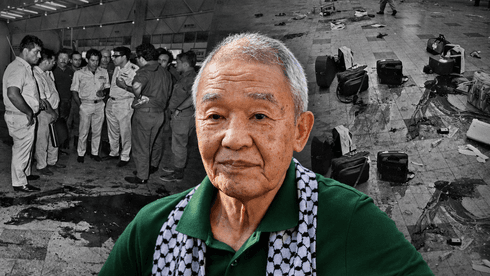
Okamoto’s death in Beirut
Kozo Okamoto, a Japanese Red Army member linked to the May 30, 1972 Lod Airport attack, died Thursday in Beirut at the age of 78, the Popular Front for the Liberation of Palestine said. PanOrient News said Okamoto participated in the 1972 Lod Airport attack in Israel and lived in Beirut’s southern suburb from 2000 until his death, after being freed in 1985 as part of the “Galilee Operation” or “Jibril Deal” prisoner swap.
The Times of Israel said the PFLP mourned “militant comrade Kozo Okamoto… who passed away today” in Beirut’s southern suburbs and lauded his “unwavering support for the Palestinian cause.” Multiple accounts tied the 1972 attack to the PFLP, with PanOrient News describing it as an operation in which the attack claimed the lives of 26 people and wounded 71 more, while Le Figaro said it left 26 dead in Israel and identified 17 Americans, eight Israelis, and one Canadian among those killed.

Victims recall the attack
In Israel, Prof. Abraham Katzir said he felt “a sense of relief that he is no longer in this world, but I do not feel revenge,” after the death of Kozo Okamoto, whom he described as a participant in the 1972 massacre at Lod Airport, now Ben Gurion Airport.
Katzir’s father, Prof. Aharon Katzir, was among the 24 people murdered in the attack, and Katzir recalled that on the day of the massacre he and his mother were behind a glass window when “The window shattered. I was a major in the army at the time, and it took me a second to understand that someone was shooting at me.”

Ynetnews also quoted survivor Eti Ringel, who said she was “covered in blood, and the entire floor was covered in blood,” and described remembering the fear of explosions, noise, fragments, smoke, and blood.
The Times of Israel framed Okamoto’s death as the end of a figure tied to a PFLP-planned attack, saying the group is classified as a terror group by Israel, the US, the European Union and Japan.
What the death changes
PanOrient News said Okamoto was regarded by Palestinians and many Arabs as a “hero,” while the Japanese government considers him a “terrorist,” and it described Japan’s repeated requests for extradition after his 1997 arrest and 2000 political asylum. Le Figaro reported that the Lod attack was planned by the PFLP, founded by Georges Habache, and it said the pro-Palestinian MEP from LFI, Rima Hassan, is to be tried in October for praising terrorism following a post on her X account in late March that mentioned Kozo Okamoto.
Al-Jazeera Net said Hamas also mourned the Japanese fighter, praising his path and affirming that he will remain a symbol of freedom and a beacon of resistance. Across the accounts, Okamoto’s death was presented as closing a long arc that included his capture and sentencing to life imprisonment, his release in 1985, and later imprisonment in Lebanon in 1997 before political asylum in 2000, with PanOrient News adding that the Popular Front reaffirmed its commitment to the “approach of internationalist struggle.”